



Optimizing Part & Tool Probing for High-Mix, Low-Volume Production
In today’s industry it’s all about quick setup and changeover between parts...especially in an environment where you run a high-mix of low volumes. In this article I want to discuss how part and tool probing can offer a real advantage for the shops that find themselves in this type of environment.
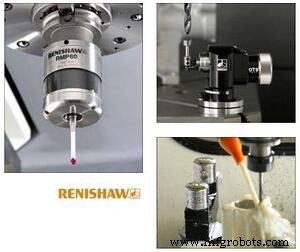
Although tool touch-off and setup isn’t really considered a huge time killer, it can become quite time consuming if you are setting up a job with a larger number of features...therefore a larger than usual number of tools. However, the addition of a tool touch or laser probe can help streamline this process tremendously. It can even help speed up the setup of jobs with fewer tools as well.
When setting up tools using a tool touch or laser probe, the operator can simply load the tool into the spindle, determine a reference gage length with a tape measure or pocket scale, and tell the control to probe the current tool. Depending on the cycles designated by the operator, the machine will automatically position the tool and probe it for length, diameter, corner radius, or all of the above. The operator also has the option to probe the tool with the spindle running...which can be much more accurate than a manual process, because any runout in the tool will be accounted for.
Part setup, on the other hand, can be very time consuming and tedious, and can become a tremendous time killer...adding a great deal of time to even the simplest of jobs. The addition of a spindle mounted part probe can eliminate much of the extra time necessary to indicate or edge-find a part...and will prove to be much more accurate as well.
Probing part features, such as: hole or rectangular pocket, cylindrical or rectangular boss, plane intersection, slot or web, or a single edge - where the control will probe numerous points on each of these features, and average the center or intersecting corner of each - can take a part setup from thirty minutes, and produce results in as little as 2 minutes.
Also, an added bonus to incorporating a touch probe into your shop, is the ability to inspect parts on the machine...a "poor man's" CMM if you will. The results of these measurements can be stored in a file on the machine, that can be downloaded and printed. Although using the macine in this way would be tying up the spindle during the inspection process, it might be worth it depending on the need for such documentation.

CNC Machine
- Helix Angles in Cutting Tools: Benefits & Drawbacks Explained
- Mastering Surface Mapping: Probing Techniques for High-Speed Machining
- The CNC Machine Tool Production Journey – From Fabrication to Installation (Part 2)
- CNC Machine Tools: Evolution & Impact on Modern Manufacturing – Part 1
- CNC Probing Systems: Accurate Component Measurement, Key Functions, Benefits & Industrial Applications
- Low Volume Injection Molding: Key Limitations and Practical Solutions
- Optimizing Low-Volume Injection Molding: Best Practices for Precision and Efficiency
- Sinumerik 808D CNC Lathe: Step‑by‑Step Tool Offset Setup – Video Tutorial Part 7
- Master Tool Setup on Sinumerik 808D CNC Lathe – Video Tutorial (Part 5)
- Understanding Wear Offset Value: Definition and Practical Use in CNC Machining