



CNC Machining vs. 3D Printing: A Clear Guide to Fabrication Choices
While both are computerized fabrication processes, CNC machining and 3D printing differ significantly in terms of processes, materials, production capabilities, and final product outcome. Though the two processes may occasionally produce similar results in specific applications, they achieve those results quite differently.
CNC machining is a subtractive manufacturing method that uses pre-programmed cutting tools to shape parts and components from a piece of stock material. Conversely, 3D printing uses additive measures to create pre-programmed shapes from melted plastic, resin, and metal. Both methods are automated and highly dependent on computer software, but they are fundamentally different processes.
Additive Manufacturing vs. Subtractive Machining
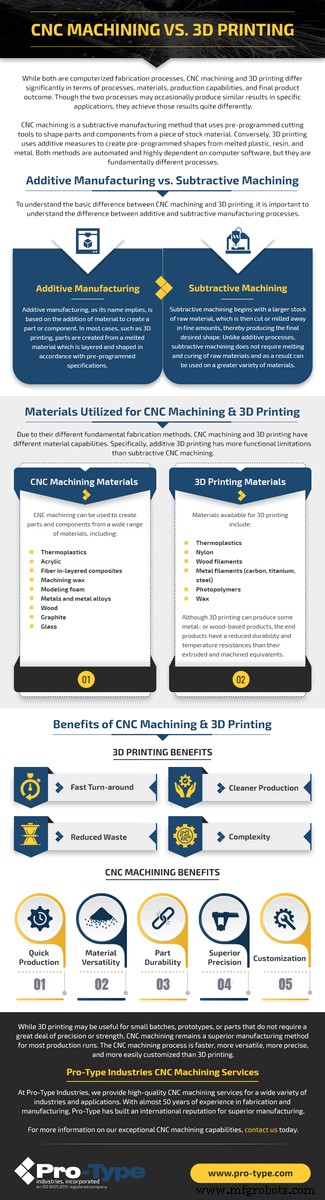
To understand the basic difference between CNC machining and 3D printing, it is important to understand the difference between additive and subtractive manufacturing processes.
- Additive manufacturing, as its name implies, is based on the addition of material to create a part or component. In most cases, such as 3D printing, parts are created from a melted material which is layered and shaped in accordance with pre-programmed specifications.
- Subtractive machining begins with a larger stock of raw material, which is then cut or milled away in fine amounts, thereby producing the final desired shape. Unlike additive processes, subtractive machining does not require melting and curing of raw materials and as a result can be used on a greater variety of materials.
Materials Utilized for CNC Machining & 3D Printing
Due to their different fundamental fabrication methods, CNC machining and 3D printing have different material capabilities. Specifically, additive 3D printing has more functional limitations than subtractive CNC machining.
CNC Machining Materials
CNC machining can be used to create parts and components from a wide range of materials, including:
- Thermoplastics
- Acrylic
- Fiber in-layered composites
- Machining wax
- Modeling foam
- Metals and metal alloys
- Wood
- Graphite
- Glass
3D Printing Materials
3D printing is much more limited in its range since the material must be able to melt into a liquid state in order to be printed to the required specifications. The vast majority of 3D printing uses plastic resins, though the latest developments in the technology have expanded material options for certain printer types.
Materials available for 3D printing include:
- Thermoplastics
- Nylon
- Wood filaments
- Metal filaments (carbon, titanium, steel)
- Photopolymers
- Wax
Although 3D printing can produce some metal- or wood-based products, the end products have a reduced durability and temperature resistances than their extruded and machined equivalents.
Benefits of CNC Machining & 3D Printing
CNC machining and 3D printing are very different processes and each method offers its own particular benefits, depending on the application.
3D Printing Benefits
- Fast turn-around.3D printed parts have very little set up and custom programming to operate and as such a small batch of parts can ship within 2-3 business days.
- Cleaner production.3D printing is an overall cleaner process than CNC machining.
- Reduced waste.Since it is an additive process, 3D printing produces notably less energy and material waste. Most of which comes from supportive materials used in the printing process.
- 3D printing can create extremely complex parts. Since complicated geometries are built in rather than cut out no tooling needs to reach internal features expanding the potential complexity of printed parts.
CNC Machining Benefits
- Quick production.CNC machining is a much faster production process than 3D printing, especially for higher-volume production.
- Material versatility. CNC machining can be used to fabricate parts from a much wider range of materials.
- Part durability.Material versatility means that CNC machining can produce parts from much stronger and more durable materials.
- Superior precision. CNC machining offers exceptional precision and accuracy when compared with 3D printing.
- CNC machining is easily customized for special parts and components.
While 3D printing may be useful for small batches, prototypes, or parts that do not require a great deal of precision or strength, CNC machining remains a superior manufacturing method for most production runs. The CNC machining process is faster, more versatile, more precise, and more easily customized than 3D printing.
Pro-Type Industries CNC Machining Services
At Pro-Type Industries, we provide high-quality CNC machining services for a wide variety of industries and applications. With almost 50 years of experience in fabrication and manufacturing, Pro-Type has built an international reputation for superior manufacturing. For more information on our exceptional CNC machining capabilities, contact us today.
CNC Machine
- Choosing Between 3D Printing and CNC Machining for Plastic Parts
- Mastering 5‑Axis CNC Machining: Precision, Speed, and Industry Benefits
- CNC Machining vs. 3D Printing: Which Technology Delivers Superior Value for Your Projects?
- Comparing 3D Printing and CNC Machining: Which Is Best for Your Projects
- Precision Acrylic CNC Machining: Accurate, Safe, and Efficient
- CNC Machining vs. 3D Printing: Which Technology Delivers Superior Performance?
- Precision CNC Machining for Polymers: Advanced Techniques & Tips
- Precision CNC Machining vs. 3D Printing: Choosing the Best Fabrication Method for Your Project
- CNC Machining vs. 3D Printing: Understanding the Key Differences
- CNC Machining vs. 3D Printing: Choosing the Right Production Method