



Robotic Positioners: Key to Precision and Efficiency in Welding
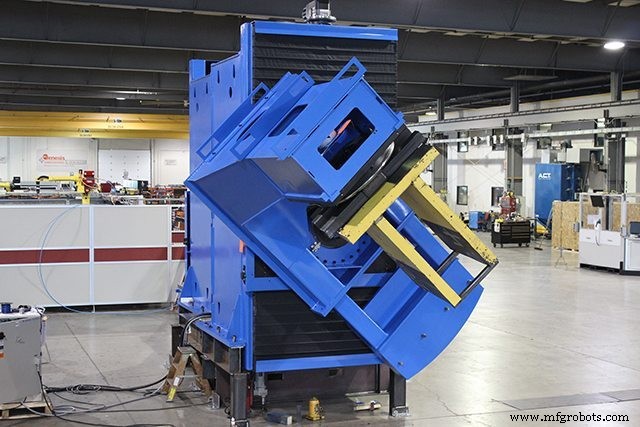
Robotic positioners are a fundamental component of robotic automation, particularly in robotic welding applications of large and/or high-volume parts. The positioner plays an important role in accuracy, repeatability and overall production quality. It is an essential consideration in any robotic welding system.
But what exactly does a robotic positioner do in welding applications? How does it facilitate productivity and promote automation of complex welding tasks?
What are Robotic Positioners?
Robotic positioners come in many different forms, but their primary duty is the same. Positioners hold a part in a predictable and repeatable position for a welding robot. Often, positioners have two or more axes to rotate and reposition a part so the welding robot can reach the entire piece.
Robotic positioners can be made for single station or multi-station designs, and can handle small parts in high volume or large parts at low volume. In some instances, positioners can be made to hold, position and reposition parts as much as 70,000 lbs. or more.
How Do Robotic Positioners Facilitate Productivity?
Robotic positioners can rotate a part when a joint cannot be reached in the correct welding position. For example, when welding large parts in position, a robot cannot perform overhead welding as weld spatter gets lodged in the tip which can lead to system errors. A positioner can rotate the part so the robot can access tricky weld locations without performing overhead welding, reducing the likelihood of system failure.
Further, a robotic positioner is highly repeatable, which enables more consistently accurate welding. With manual loading/unloading and positioning of a part, there are variations in part orientation which affect weld accuracy. A positioner is far more accurate, helping to improve overall weld and part quality.
Less downtime, higher accuracy and improved quality all contribute to a positioner’s ability to drive productivity in welding applications.
Robotic positioners are foundational part of most robotic welding systems. They facilitate higher productivity and help automate tasks that would be impossible without rotational capabilities.
Genesis Systems Group is a recognized leader in robotic integration with a core competency in robotic welding. Browse a selection of robotic welding positioners here.
Industrial robot
- Optimizing Robotic Welding Workflow for Peak Production Efficiency
- Robotic Laser Seam Stepper Welding: Boosting Efficiency, Safety, and ROI
- Accelerate MilSpec Production: How Robotic Welding Cuts Cycle Times
- Robotic vs. Manual Welding: Benefits, Drawbacks, and When to Choose Each
- Explore the Four Key Welding Processes & Their Real-World Applications
- Choosing the Right Robotic Positioner: A Comprehensive Guide
- Robotic Spindling: Precision, Consistency, and Safety in Automated Material Removal
- Advanced Robotic Arc Welding Machines for High‑Precision, High‑Volume Production
- Choosing the Right Robotic Welding System for Your Business
- Robotic Pipe Welding: Precision, Efficiency, and Safety