



Robotic vs Conventional Palletizing: Choosing the Right Solution
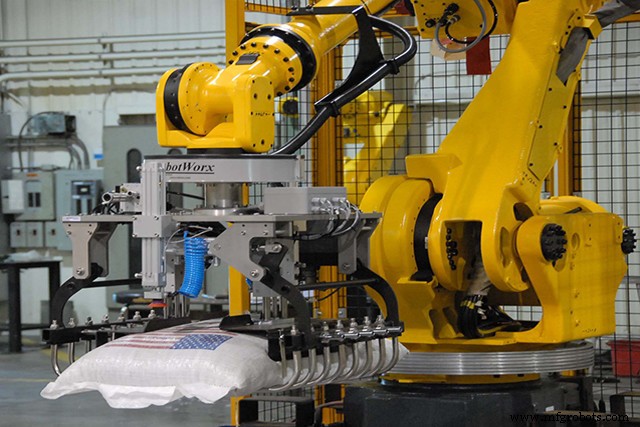
Palletizing equipment comes in many shapes and sizes. While there are many different palletizing equipment layouts, manufacturers really have to evaluate their processes to see if robotic palletizing will be more beneficial for your facility than manual palletizing.
Some important things to consider are:
- The size, weight and shape of your products
- The construction and stability of your products
- The secondary packaging involved
- Any pattern-forming capabilities available during production
Conventional palletizers can create a pattern when loading, but robots can make user-friendly loads. Robot palletizers can also handle difficult loads and high speeds of production.
Robot palletizers are great solutions for applications where the product demands precision. Bags and pails are perfect examples of this. The need to precisely place items like pails on pallets is necessary, for example, because pails need to be placed on top of each other in a very specific way, “nesting” on the lid of the pail below it.
Robot palletizers also have the ability to work in confined spaces or environments full of dust and other particles, which make them great for bag palletizing applications.
While robot palletizers can move up to 70 cases per minute, conventional palletizers can work at very high speeds, processing 200 cases per minute.
Since conventional palletizers never have to pick up a product, as opposed to just moving a product, they can handle several different types of products with little to no problem. Palletizing robots can also handle this type of versatility and flexibility if they have their end-of-arm-tooling switched to fit the product.
Conventional palletizing is best for high-speed applications that have reduced product packaging and complex pattern forming. Robotic palletizing is best when palletizing on a lower-speed, multi-line system, especially when handling bags, pails and other specific types of materials.
Manpower is also a factor when deciding between conventional and robotic palletizing. These machines are very different in their operation and maintenance needs. Manufacturers need to consider whether their staff would be able to learn the more complex robotic applications over the conventional applications.
RobotWorx, a certified integrator of Motoman, KUKA, ABB, Universal Robots, and Fanuc robots, can work with customers who choose robotic palletizing for their facilities. All robotic systems comes with the RobotWorx Value Package.
Industrial robot
- Robotic Palletizers Explained: Boosting Efficiency and Control
- RoboDK Launches User‑Friendly Palletizing Plugin for All Robot Brands
- Key Specs for Choosing the Right Industrial Robot
- Manufacturing Challenges and Robotics: A Lean Solution
- Robotic Palletizing: A Modern Ergonomic Solution for Workforce Efficiency
- Advanced Palletizing Robot Software: Intelligent Control for Efficient Automation
- Efficient Palletizing with Advanced Robot Software Solutions
- Key Facts About Industrial Robots: From Unimate to Modern Applications
- Motoman Robotics: Advanced Industrial Automation Solutions
- Boost Palletizing Efficiency with the Fanuc R-2000iA/125L Robot