



Eliminate Welding Spatter with Push Connectors for Cleaner, More Reliable Workpieces
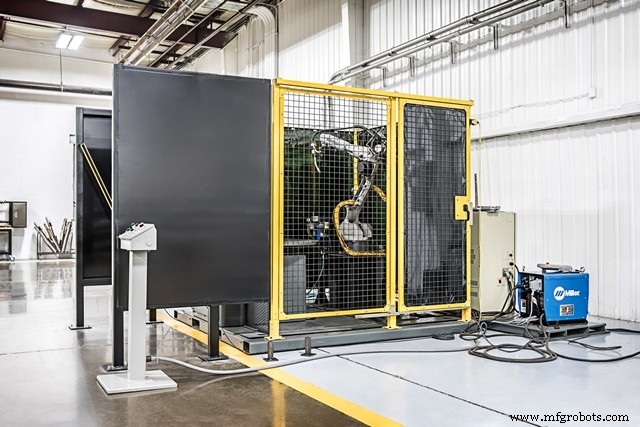
Weld spatter, the small particles of non-metallic material expelled during the fusion of metals during welding, is a big problem for welding applications. Robotic push connectors can help cut down on the occurrence of spatter.
Spatter is a problem because it can cause discontinuity to the weld, either by interfering with the serviceability of the work piece, or by causing issues with another application for the piece, like coating or painting.
By using push connectors on the air and water tubing for robotic welding equipment, manufacturers can help prevent spatter build-up in the lines. These robotic push connectors, along with the hoses they connect, can handle temperatures as low as -40 degrees or as high as 140 degrees.
A push connector and flexible tubing are also spark resistant, something that is a requirement of pneumatic control systems on welding robots. Since robotic connectors are made of materials like nickel-plated brass, they are resistant to shock, corrosion and sparks.
Push connectors also significantly reduce assembly time for hoses and cables. All the connectors come pre-assembled and provide tubing with a leak-free connection. This allows the robotic welders to get up and running quicker, meaning less downtime for production lines.
Basically, while robot push connectors are just a small element in the robotic welding system, they are an integral part of the safety system, keeping the tubes from sparking and preventing spatter build-up.
RobotWorx helps all their customers customize the right safety and dress packages for their robots and robotic systems, right down to the push connectors and tubing.
Industrial robot
- Optimizing Robotic Welding Workflow for Peak Production Efficiency
- Through-Arm Robotic Welding Guns: Key Benefits Over Conventional Designs
- Revolutionizing Aerospace Manufacturing: 5 Key Robotic Innovations
- How Robotics Revolutionizes Inspection: A Manufacturer's Practical Guide
- Robotic Machining: Unlocking Flexibility, Efficiency, and Cost Savings
- Robotic Welding: From Primitive Tools to Cutting-Edge Automation
- Robotic Palletizing: A Modern Ergonomic Solution for Workforce Efficiency
- How Interconnected Robotic Systems Drive Reliable Performance
- Robotics Transforming Injection Molding: Enhanced Precision & Productivity
- How to Select the Ideal Robot Design for Your Application