



Robotic Automation for Magnesium Welding: Precision and Efficiency
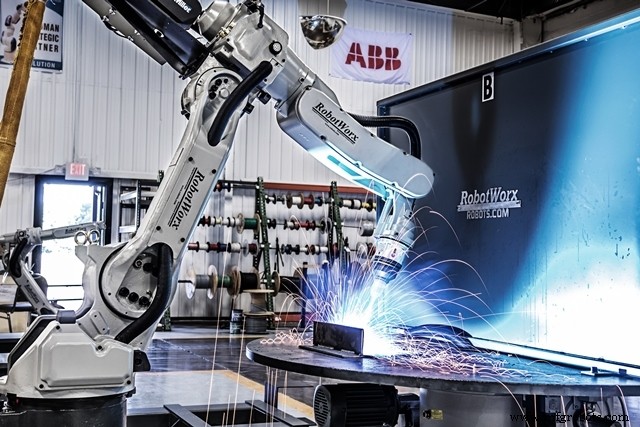
Welding magnesium is performed for primary manufacturing or repair.
Properties
Magnesium alloys with a density of about 1.74 g per cubic centimeter (0.063 lb. per cu in.), when in cast form alloyed with Aluminum, Manganese, Rare Earths, Thorium, Zinc or Zirconium, display high strength to weight ratio making them materials of choice whenever weight reduction is important or when it is imperative to reduce inertial forces (for rapidly moving machine parts). Magnesium is roughly 20% the weight of steel and 67% the weight of aluminum. Magnesium castings exhibit remarkable damping capacity.
- Pure Magnesium melts at 650 degrees Celsius (1202 degrees Fahrenheit).
- Contraction from liquid to solid is 3.9 to 4.2% and from liquid at melting temperature to a solid at room temperature is 9.7%.
- Magnesium is used as an alloying element in the production of certain aluminum alloys.
- In cast iron foundries producing nodular cast iron, magnesium is used to make the graphite particles nodular. It is also used for cathodic protection of other metals from corrosion.
Safety
Safety precautions must be understood and followed. Magnesium oxidizes easily. If ignited when it is in the form of machined turnings or powders, it burns intensely. Machining must be performed under controlled conditions, with extinguishing agents on hand.
Specifications
- Casting alloys are covered by Specifications ASTM B80, B94 and B199.
- Wrought alloys by ASTM B90, B107 and B217.
- Filler metals for Welding magnesium alloys are specified in
- AWS A5.19 Specification for Magnesium Alloy Welding Electrodes and Rods
- ASTM B 448 Specification for Magnesium-Alloy Welding Rods and Bare Electrodes
- SAE AMS 4397 Magnesium Wire, Welding.
Characteristics
Welding magnesium alloys require lower amounts of heat to melt than other materials. However, they are susceptible to distortion, due to the high thermal conductivity and coefficient of thermal expansion. Adequate precautions must be taken.
Alloying Elements
Because magnesium is too mechanically weak to be used as is, it must be alloyed with other elements which confer improved properties. The Mg-Al-Zn group of alloys, contains Aluminum, Manganese and Zinc, which are the most common alloying elements for room temperature applications. Alloying elements Thorium, Cerium and Zirconium (without Aluminum) are used for elevated temperature, forming the Mg-Zn-Zr group.
An increase in alloy content depresses the melting point, enlarges melting range and increases weld cracking tendency. High alloy content needs less heat for melting and limits grain growth, showing higher welding magnesium efficiency.
- Aluminum is the most effective ingredient in providing improved results. In percentages of 2 to 10%, with minor additions of zinc and manganese, it increases strength and hardness, at the expense of less ductility. Magnesium alloys containing more than 1.5% Al are susceptible to stress corrosion and must be stress relieved after welding.
- Zinc combined with aluminum helps to overcome harmful corrosive effects of iron and nickel impurities that may be present in magnesium alloys. The higher the Zn content (over 1%) the higher the hot shortness, causing weld cracking.
- Manganese improves yield strength (slightly) and salt-water resistance of magnesium alloys. Higher melting point requires higher heat input to melt. Grain growth adjacent to the weld reduces strength.
- Thorium or Cerium can be added to improve strength at temperatures from 260 to 370 degrees Celsius (500 to 700 degrees Fahrenheit). Zirconium in small amounts is a grain refiner that improves weldability.
- Beryllium is sometimes added to reduce the tendency of magnesium to burn while melting. No adverse effect on welding has been observed. It may be beneficial, in a brazing alloy, in reducing the danger of ignition during brazing in furnace.
- Calcium is added in small amounts to reduce oxidation, but it can increase the risk of weld cracking.
Processes
Welding magnesium is generally performed with arc processes using direct current with reverse polarity (electrode positive). Wrought alloys are usually more weldable than certain cast alloys.
Metal Transfer Modes for Gas Metal Arc Welding magnesium (GMAW) or Metal Inert Gas (MIG)
- Short circuit mode - filler touches the work many times per second and extinguishes the arc, the metal is supplied as a sequence of drops.
- Pulsed arc mode - a power supply provides a modulated current. The arc is uninterrupted and the metal is transferred intermediately.
- Spray transfer mode - metal is transferred with a spray of droplets.
- The most used shielding gas is generally argon while mixtures with helium are acceptable.
Gas Tungsten Arc for Welding magnesium (GTAW) also known as Tungsten Inert Gas (TIG)
- Alternating current machines or direct current reverse polarity (electrode positive) power supplies, with high frequency current superimposed are used.
- For thin sheets both are suitable, for heavier sheets alternating current is preferred as it provides deeper penetration.
- Direct current straight polarity (electrode negative) is not preferred because it lacks the cathodic cleaning action.
Electron Beam welding magnesium has been used for repairing expensive casting on alloys containing less than 1% Zinc. The relative weldability of the different magnesium alloys is similar to that displayed for the more common arc processes.
The conditions have to be strictly monitored because of the danger of developing voids and porosity due to the low boiling point of Magnesium and the still lower one of Zinc. A slightly defocused beam may help to obtain sound welds.
Laser Beam is a preferred method for welding magnesium because of its low heat input, elevated speed and limited deformation. However this method has a tendency of developing porosity.
Resistance welding magnesium for either spots or seams is performed on wrought alloys like sheets and extrusions, essentially with equipment and conditions similar to those used for aluminum.
Repairing Castings: One of the most common Welding magnesium applications is repairing castings either as cast or after service. Preparation is important and should exclude contamination from extraneous materials. Generous bevels should be prepared to allow for full penetration.
Preheating: The need for preheating when welding magnesium is dictated by the degree of joint restraint and by metal thickness: for thick walls and a short welding bead, it may not be required. Preheating should be performed in a furnace with a protective atmosphere for reducing oxidation. One of the recommended procedures to minimize weld cracking is to weld from the center towards the sides (one half after the other). Thermal shocks should be avoided.
Industrial robot
- Unlocking Welding Automation: Boost Quality, Reduce Costs, and Accelerate Production
- Precision Aluminum Welding with Fanuc Robots for Automotive Excellence
- Dual-Arm Fanuc Robots: Boosting Arc Welding Efficiency
- Enhancing Productivity: Automated Machinery & Robotics Solutions
- Enhance Spot Welding Quality and Speed with Robot Automation
- Transform Spot Welding: Fanuc Robots Deliver Speed & Precision
- Advanced Nickel Welding Automation with Robotics
- Optimizing Copper Welding with Industrial Robots for Superior Performance
- Automated Aluminum Welding: Precision, Efficiency, and Quality
- Top Benefits of Industrial Automation with Robotics