



AWS vs Azure: Comprehensive Services Overview & Comparison
What Is Cloud Computing?
Cloud computing enables organizations to upload, store, access, and manage data, applications, and infrastructure over the internet, eliminating the need for on‑premise hardware. With just an internet connection and proper permissions, users can securely retrieve resources from anywhere in the world. By adopting a pay‑as‑you‑go model, businesses reduce capital expenditure, lower maintenance costs, and scale services precisely to their needs.
Today’s market hosts dozens of cloud providers, but Amazon Web Services (AWS) and Microsoft Azure dominate the industry, together commanding over 90% of the public‑cloud market.
AWS and Azure: Services Overview and Comparison
This article provides a concise introduction to AWS and Azure, highlights the environments they deliver, and showcases their flagship services. We’ll start with AWS, the market leader that has maintained roughly double Azure’s share.
What Is AWS?
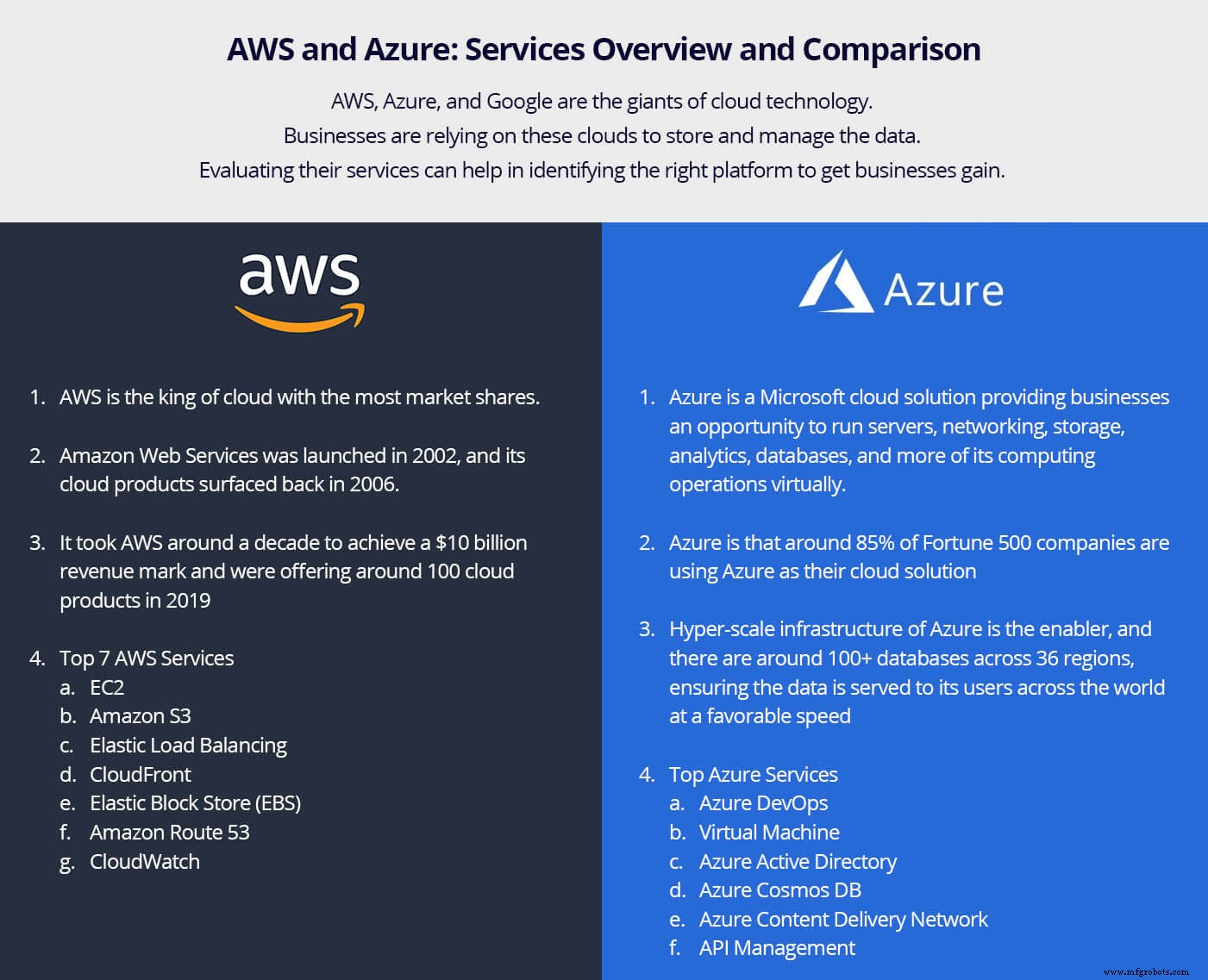
Amazon Web Services, launched in 2002 and publicly available in 2006, offers a unified platform that blends Infrastructure as a Service (IaaS), Platform as a Service (PaaS), and Software as a Service (SaaS). By 2019, AWS had introduced over 100 cloud services and generated more than $10 billion in revenue—a testament to its widespread adoption.
Overview of AWS Cloud
AWS’s breadth of services empowers startups and enterprises alike to build secure, scalable, and cost‑effective digital infrastructures without upfront hardware investment. The platform covers computing, networking, storage, migration, database management, analytics, messaging, and more, allowing users to scale up or down as demand shifts.
Top 7 AWS Services
Below are seven of AWS’s most frequently used services and how they solve common business challenges:
1. Amazon EC2
EC2 provides virtual servers—called instances—that launch in minutes. AWS offers several instance families:
- Compute‑Optimized: Ideal for high‑throughput workloads using industry‑leading processors.
- Memory‑Optimized: Designed for applications requiring large amounts of RAM.
- Storage‑Optimized: Offers fast SSD access for I/O‑intensive tasks.
2. Amazon S3
S3 stores objects in buckets and supports four storage tiers:
- Standard: Frequently accessed data with high durability.
- Infrequent Access: Cost‑effective for data accessed less often.
- Glacier: Long‑term archival with retrieval times ranging from minutes to hours.
- Reduced Redundancy: Economical storage for non‑critical, reproducible data.
3. Elastic Load Balancing (ELB)
ELB distributes incoming traffic across multiple EC2 instances to maintain performance and availability:
- Classic Load Balancer: Provides basic fault tolerance for legacy applications.
- Application Load Balancer: Routes traffic based on content and microservices architecture.
4. Amazon CloudFront
CloudFront is a global CDN that delivers content from edge locations nearest to users, reducing latency and enhancing the end‑user experience.
5. Amazon EBS
Elastic Block Store supplies low‑latency, persistent block‑level storage for EC2, with options for SSD and encryption via AWS Key Management Service.
6. Amazon Route 53
Route 53 is a scalable DNS service that routes end‑users to the most efficient endpoint, ensuring high availability and performance.
7. Amazon CloudWatch
CloudWatch aggregates logs and metrics across AWS resources, enabling proactive monitoring and automated alerts.
These core services form the foundation of most AWS‑based architectures. Next, we’ll examine Microsoft Azure and its standout offerings.
What Is Microsoft Azure?
Microsoft Azure, announced in 2008 and publicly released in 2010, provides a wide range of virtualized resources—compute, networking, storage, analytics, and databases—on a subscription basis. Azure’s hybrid‑cloud capabilities and deep integration with Microsoft software make it a compelling choice for organizations invested in the Windows ecosystem.
Azure’s growth is accelerating: Microsoft reports nearly 1,000 new customers each day, and 85% of Fortune 500 companies run workloads on Azure.
Overview of Microsoft Azure
Azure delivers enterprise‑grade reliability through features such as:
- Disaster Recovery: Multiple data centers, Azure Site Recovery, and traffic routing via Azure Traffic Manager provide continuous availability.
- Elasticity: Auto‑scaling adjusts capacity to match demand—ideal for seasonal spikes or fluctuating workloads.
- Developer Tools: Integrated IDEs, CI/CD pipelines, and pre‑built templates accelerate innovation without new hardware.
- Cost Efficiency: Pay‑as‑you‑go billing per second and no upfront hardware costs reduce waste.
Top Azure Services
Azure’s rapidly expanding service catalog includes:
1. Azure DevOps
Azure DevOps unifies planning, code management, CI/CD, and monitoring, enabling teams to ship features faster.
2. Virtual Machines
Azure VMs support Windows and Linux, with options for compute‑optimized, burstable, general‑purpose, and memory‑optimized workloads.
3. Azure Active Directory
Azure AD provides identity and access management, single‑sign‑on, and multi‑factor authentication across the cloud and on‑premise environments.
4. Azure Cosmos DB
Cosmos DB is a globally distributed, multi‑model database offering 99.999% availability and single‑digit millisecond latency across 36+ regions.
5. Azure Content Delivery Network
Azure CDN ensures fast, secure content delivery worldwide, handling traffic surges and delivering deep analytics for consumer insights.
6. Azure API Management
Azure API Management simplifies API creation, security, monitoring, and versioning, enabling developers to expose services reliably.
With a clear understanding of AWS and Azure’s capabilities, you can choose the platform that best aligns with your business strategy. To build or enhance cloud expertise, consider training from Cloud Institute, which offers AWS and Azure courses and certification preparation.
Cloud Computing
- Microsoft Azure Cloud: Features, Pricing, and Future Impact
- Mastering AWS Cloud: Your Complete Guide to the Leading Cloud Platform
- AWS, Azure, and Google Cloud: 2024 Cloud Competition Analysis
- From AWS to Google Cloud: A Practical Guide for Cloud Professionals
- COVID‑19 and the Cloud: How Major Providers Empowered Businesses During the Pandemic
- Azure Cloud 2020: Updates, Service Landscape & Capacity Scaling
- Top 5 Microsoft Azure Certifications & Courses in India – Elevate Your Cloud Career
- Top 5 AWS Certifications & Courses in India for Cloud Careers
- AWS Certified Developer Associate (CT002AC): Exam Cost, Prerequisites, and QuickStart Training Overview
- Azure vs AWS: Which Cloud Platform Wins for IoT?