



IoT Predictive Analytics Transforms Russian Power Generation – Saving Lives and Enhancing Reliability
In Western Europe, power‑supply security often focuses on regulatory compliance and fines. In Russia and Kazakhstan, the top priority is protecting lives by preventing unexpected shutdowns during the brutal winter months.
When a massive explosion at a Russian hydro‑electric plant a few years ago caused a widespread outage, the tragedy underscored the real‑world stakes of power‑generation reliability.
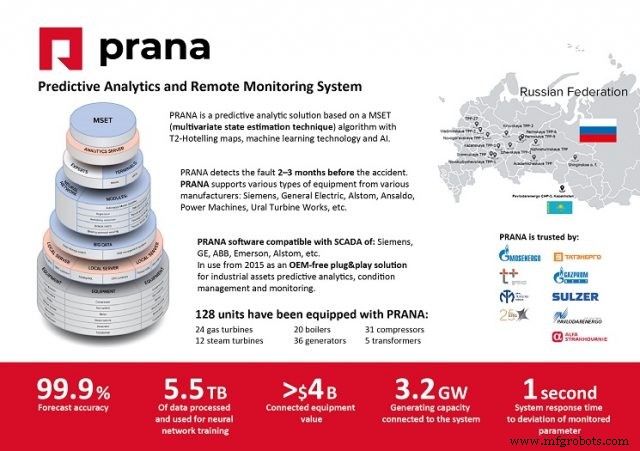
Since 2015, ROTEC JSC has been digitalising the Russian power sector. Its flagship PRANA system is now installed on 22 combined‑cycle and combustion‑turbine units that total more than 3.2 GW across Russia and Kazakhstan. The connected equipment is valued at over $4 billion.
PRANA can detect faults two to three months before a failure would occur. Installation and commissioning of the predictive analytics and remote‑monitoring platform take only one month, regardless of equipment make. The system works with equipment from multiple OEMs, including ABB, Alstom, Ansaldo, GE, Power Machines, Siemens and Ural Turbine Works, and is independent of any single manufacturer.
"We began research into remote monitoring of power‑generation assets in 2011, but monitoring alone is not enough – preventing unexpected shutdowns is essential," says ROTEC’s Alexander Levin. "In Russia, such outages can trigger heavy fines and, more critically, endanger lives during extreme cold.
ROTEC currently monitors 22 plants in Russia and one in Kazakhstan, and it has expanded into the oil and gas sector. Using acoustic‑emission technology, the company now monitors large pipelines, storage tanks and other upstream assets.
Maxim Lipatov, technical director of the PRANA project, explains that for each piece of equipment a bespoke mathematical model is built. Live data—temperatures, oil and fuel pressures, and other key parameters—stream 24/7 from Russian plants. When a deviation is detected, experts can advise the precise corrective action.
Lipatov showed a tablet displaying live data feeds from power‑generation clients. One screen highlighted the ten most critical system discrepancies. "We can identify potential defects or degradations early, allowing engineers to plan maintenance and save significant costs," he says. "Owners can monitor status continuously; all parameters are logged, and the system shows how operators respond to alarms, ensuring transparency across enterprises. We have over 300 unique models for turbines, compressors and boilers."
Levin adds, "Our independence from OEMs makes us more objective. PRANA unites equipment from diverse manufacturers into a single, standardized data platform, and we continually refine our models using neural networks and AI."
Proactive Alarm System
Unlike traditional SCADA alerts that may arrive too late, PRANA’s preventive alarms activate well before a fault escalates. By consolidating data into one database, the system creates a comprehensive archive that enhances predictive accuracy.
ROTEC is now negotiating to supply PRANA to nuclear and hydro‑electric generators—industries known for their stringent testing protocols. Meanwhile, partners in Kazakhstan appear more receptive to digitalisation than those in Russia.
In Siberia’s remote oil and gas sector, where gas turbines and booster compressors can be a helicopter ride from the nearest city, PRANA’s ability to preempt failures during the inaccessible 6‑7 month summer period is invaluable. The company oversees equipment worth $4 billion, making its preventative capabilities essential for regional reliability.
Despite occasional resistance from plant operators—who once felt their authority diminished by transparent monitoring—ROTEC’s system has proven to enhance operational control rather than undermine it.
Long‑Term Service Contracts
Sulzer, a key partner since 2016, boasts a portfolio of long‑term service agreements. Dmitriy Maslov, Sulzer Turbo Services Rus, LLC’s sales & marketing director, stresses the importance of efficiency, planning and transparency. "With PRANA, we know the condition of each machine and can predict maintenance needs, reducing unexpected outages," he says. "For the Siemens V94.2 gas turbine, we cut outage time by up to 20% by pre‑preparing required parts. When a part was needed, we had it on site within two weeks, saving the customer significant downtime—‘it’s like magic,’ they remarked."

Maxim Lipatov notes that units once experienced 20–30 unscheduled shutdowns per year. Now, with PRANA, scheduled shutdowns are capped at a maximum of 10 per unit, dramatically improving reliability.
Internet of Things Technology
- Startups Pioneer Battery‑Free IoT with Energy Harvesting
- AIoT: Harnessing the Synergy of Artificial Intelligence and the Internet of Things
- Six Real-World Case Studies: How Predictive Analytics Boosts Power Plant Performance
- Building a Global IoT Network: Leveraging Sigfox and LPWA for Interoperability
- Why Longevity Matters in Industrial IoT: Securing Factory Operations for Decades
- Leading Cloud‑Based IoT Analytics Platforms for 2026
- Industrial IoT: Merging Legacy Systems with Smart Sensors
- Revolutionizing Wearables: The Emerging Power Suit for Health Monitoring & Energy Generation
- Unlocking Real-Time Value: Why Your Business Must Embrace IoT
- Heavy Equipment: More Than a Tool—Why It’s a Valuable Asset