



Why Ultra‑Precise Wi‑Fi Positioning is Essential for Industrial Contact Tracing

Vikram Pavate, CEO of Locix Inc.
As businesses prepare to reopen after the COVID‑19 pandemic, implementing robust “Test and Trace” systems in industrial and commercial environments has become a priority. While testing protocols are expanding, current contact‑tracing methods remain largely manual, slow, and prone to errors.
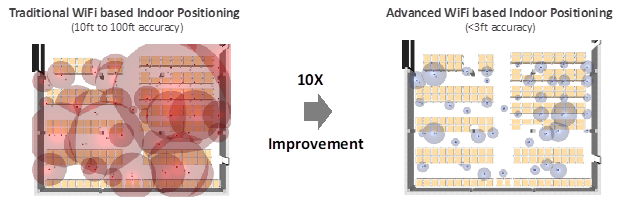
Global initiatives—including the Apple and Google Bluetooth‑based solution—capture temporary identifiers between smartphones to infer potential exposure when a positive case is reported. This approach respects user privacy but suffers from limited indoor accuracy. Bluetooth relies on RSSI or AOA metrics, which, in complex indoor settings such as warehouses, factories, and hospitals, typically deliver only ten to one hundred‑foot precision. That level of inaccuracy can generate false positives, leading to unnecessary alarm and operational disruption.
Accurate indoor positioning is also critical for surface‑based transmission risk assessment. By pinpointing the exact locations where infected individuals have touched objects or surfaces, health teams can target cleaning and disinfection efforts more effectively.
Figure 1. Comparison of Wi‑Fi‑based indoor position accuracy in a commercial distribution centre. Leveraging advances in Wi‑Fi technology and analytics, sub‑three‑foot (≈ 1 m) accuracy is achievable.
Wi‑Fi–based contact tracing offers several advantages over Bluetooth:
- Sub‑three‑foot accuracy in challenging indoor environments thanks to improved signal processing and advanced analytics.
- Compatibility with existing Wi‑Fi infrastructure, eliminating the need for additional hardware.
- Real‑time tracking of workers and assets at sub‑meter resolution, enabling dynamic exposure heatmaps.
- Secure, opt‑in participation managed by corporate IT, ensuring privacy and compliance.
Figure 2. Representative Wi‑Fi‑based worker contact tracing and exposure heatmap in a commercial distribution centre. Each circle marks a spot where two workers passed within 6 ft.
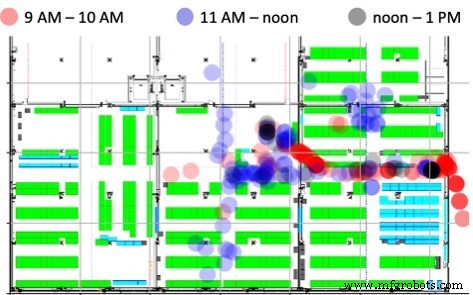
Real‑time and historical contact data can be integrated with public health databases for deeper analytics. Because most commercial facilities already host Wi‑Fi networks, workers’ smart devices or dedicated Wi‑Fi trackers can be employed, allowing a scalable, privacy‑respecting approach to contact tracing.
In short, Wi‑Fi‑enabled contact tracing holds the promise of efficient, accurate, and scalable monitoring in indoor commercial and industrial spaces. Successful deployment will require collaboration among industry stakeholders, health authorities, and technology providers as we work together to reopen safely.
Author: Vikram Pavate, CEO of Locix Inc.
Internet of Things Technology
- Why Automation Is Essential for Scaling 3D Printing Service Bureaus
- Wi‑Fi Indoor Positioning Systems: Benefits, Challenges, and Alternatives
- How Indoor Positioning Systems (IPS) Work: A Practical Guide
- Container Tracking Systems: A Complete Guide to ROI, Technology, and Implementation
- Remote Commissioning: Unlocking Efficiency and Flexibility in Industrial Operations
- Unlocking Predictive Maintenance: The Future of Manufacturing Reliability
- When to Replace a Dock Leveler: Key Signs & Reasons
- Unlocking Industry 4.0: Why Your Workforce Is the Key to Success
- How 5G‑Enabled IIoT Drives Rapid Industry 4.0 Adoption
- SCADA Systems & Industry 4.0: Revolutionizing Remote Process Control