



Why Upgrading PLC/SCADA to Industry 4.0 Matters: Key Benefits & Risks
The need to update an existing PLC/SCADA system is rising like a wave in the industries due to their high acceptance of technology. These businesses are benefitting from the sensor devices and advanced connectivity solutions for better productivity and improved services.
PLC and SCADA are two distinct systems. A PLC- Programmable Logic Controller is a kind of industrial hardware & SCADA- Supervisory Control & Data Acquisition is generally software. However, it can be argued that SCADA is an overall control system that uses hardware and software elements.
What is a PLC?
A PLC is designed to take control over complex industrial processes like running machines and motors. They are simple to program, also used to collect data from the systems that they control, and completely scalable to operation’s requirements.
What is a SCADA?
SCADA is a centrally connected system that monitors the plant processes at every point. It is a kind of software that gets installed on a computer and one of its important roles is to act as a communicable interface among industrial machines. It allows the managers to track information coming in from equipment and customize, operate, and perform other functions within an industry.
SCADA systems are generally used when combined with PLCs and other devices and sometimes it is even possible that PLCs become a part of the SCADA system for effective operations. If SCADA and PLCs are used together, they form an automatic system to allot maintenance tasks that form the core of a predictive maintenance program. Here’s how it works:
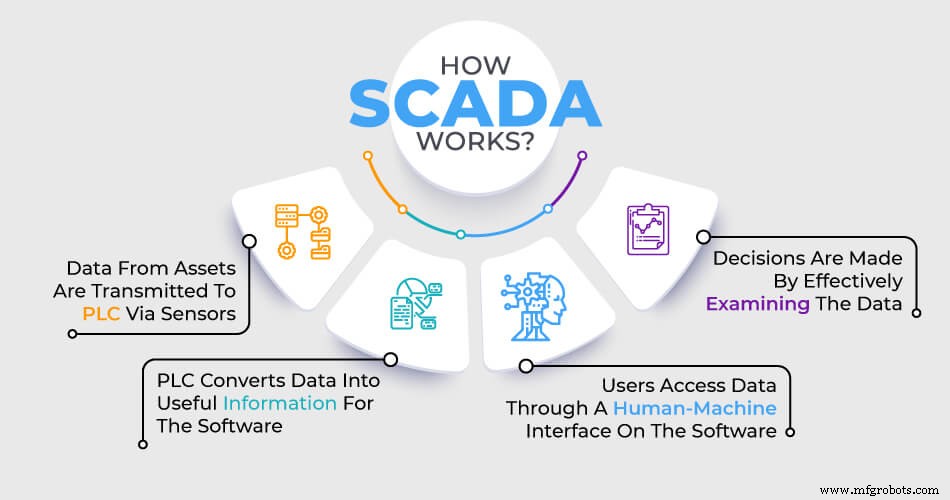
• Data from assets are transmitted to PLC via sensors
• PLC converts data into useful information for the software
• Users access data through a human-machine interface on the software
• Decisions are made by effectively examining the data
What is the Need to Technically Update the SCADA System?
There are many challenges in the existing SCADA system that need to be addressed for smooth functioning. This is only possible if the SCADA system is up-to-date with the latest trends and software. It must include a technology-based system that allows valuable insights for the managers to make accurate decisions. Also, it is observed that SCADA systems are vulnerable due to their unsophisticated bugs like buffer overflows. These kinds of systems are further exposed to information disclosure, which allows third-party to perform denial of service attacks or steal information.
Many other challenges in the SCADA/PLC system include:
• SCADA Application Redundancy
There lie many redundancies in the system that can be limited by the interfaces, computer infrastructure hosting applications, strategy failure, native operability, etc. Redundancies in SCADA systems are a complex one and the main question arises that what happens to the data when a software component fails.
• Direct Connectivity of SCADA with External Systems
SCADA systems are the visualization and data gathering tools, but limit the moderate storage systems in terms of data compression, or support multiple clients simultaneously. Also, when a SCADA system increases in size, it lays a negative impact on the number of clients or connected interfaces along with the system performance.
• Degraded Engineering
The safety of people involved with the SCADA system and industrial assets is of huge importance when it comes to defined requirements, machine design approvals, installation or transition of a management plan, test procedures, and similar. Also, it becomes very costly even to make the devices fit the standards or fixing the wires correctly. To keep that operational and maintenance costs lowered, it is mandatory for the managers to install a technically sound solution that provides better services too.
So, to meet these kinds of challenges, industries must involve IoT solutions that make sense to productivity as well as keep the costs pocket-friendly. Also, to gain growth in the business you can try for consultation on the upcoming or ongoing trends in the market in terms of better technology and solution to all business requirements.
Benefits of Implementing IoT with SCADA System
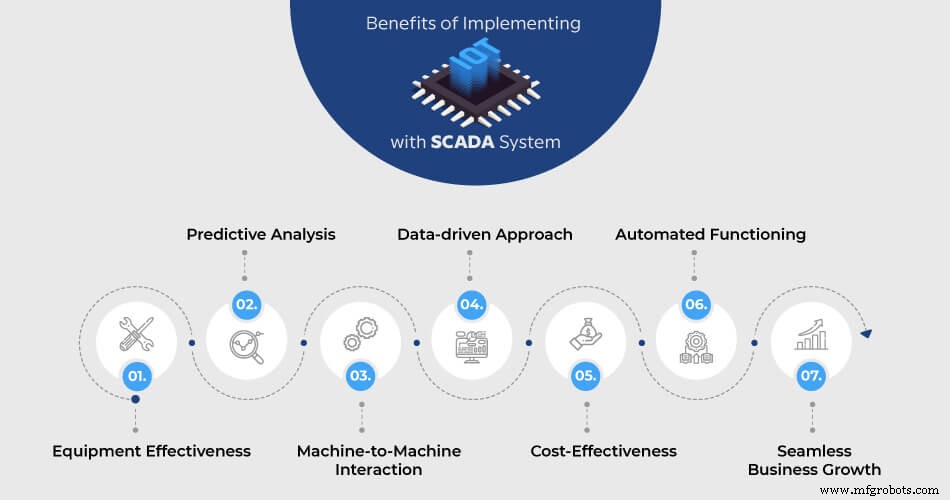
The Internet of Things technology is a rapidly growing tool that allows industries to scale up their game in the world of business. It provides an acute combination of efficiency and productivity through its data-driven approach and enables the equipment to work for themselves. With the rapidly transforming world, automation is gradually becoming the key to producing better results in terms of quality, costs, and customer viewpoint. IoT technology can offer the same in a reduced maintenance cost. A few benefits that make IoT a useful resource for the existing SCADA systems in businesses are:
• Equipment Effectiveness
• Predictive Analysis
• Machine-to-Machine Interaction
• Data-driven Approach
• Cost-effectiveness
• Automated Functioning
• Seamless Business Growth
With the effectively changing trends in the technical world, the use of IoT in the SCADA system would bring a positive change with its advanced capabilities of drawing more attention towards productivity. It is one of the great advancements in history that machines are now able to take care of themselves through technology. Even an effective report generation through IoT plays a huge role in providing better decision-making and suggesting strategies to improve business performance like never before.
The rising population and their direct demands are wanting the industries to pace up their production by not compromising the quality and it is very difficult for the conventional systems to work in the same quality as they did 40-50 years back. It thus requires change and improvement in our working zones and converting premises with IoT provides a technical solution to all the challenges being faced in the current times.
Internet of Things Technology
- Industry 4.0 & IoT: The Driving Forces Behind Advanced Industrial Transformation
- Smart Gas Monitoring: Key Safety Benefits for the Oil & Gas Sector
- How IoT Fuels Industry 4.0: Unlocking Key Benefits
- Industry 4.0: Transforming Asset Condition Monitoring for Unmatched Efficiency
- Discover How Machine Monitoring Systems Transform Industrial Operations
- How IoT and Emerging Tech Are Revolutionizing Healthcare: Key Benefits & Applications
- How Industrial IoT is Revolutionizing Transportation & Logistics
- Overcoming Challenges with IoT in the Oil & Gas Industry
- Industry 4.0 Unveiled: History, Benefits, and Key Technologies
- SCADA Systems & Industry 4.0: Revolutionizing Remote Process Control