



Choosing the Right Accuracy for Asset Tracking in Manufacturing & Healthcare
Accuracy and precision are critical when selecting an asset‑tracking solution for manufacturing and healthcare environments. The metric tells you how close the reported location is to the actual position. While many prospects assume that higher precision is always better, the optimal level depends on the specific use case, cost, and system complexity.
Consider the classic example of tracking infusion pumps in a hospital. Biomedical staff must locate these pumps for maintenance, so knowing the room is essential. Pinpointing the exact spot within the room is unnecessary; the engineer can find the pump once inside. This scenario illustrates room‑level accuracy.
At the opposite end of the spectrum is true X‑Y‑Z location tracking, required in automated warehouses. When a pallet sits on Shelf 6, Bay B, in Row C, you need shelf‑level accuracy to retrieve it efficiently. Simply knowing the row would not suffice.
Most deployments fall between these extremes and demand what we call Just‑Right Precision. In some areas room‑level accuracy is sufficient, while in others finer segmentation is needed. For instance, a storage room might benefit from knowing the pump’s quadrant to speed retrieval.
Technology That Enables Precision
Ultra‑Wideband (UWB) is the industry benchmark for centimeter‑level accuracy. Companies like Zebra use UWB to pinpoint barcode scans in automated warehouses. However, UWB’s high reader density and infrastructure requirements make it expensive, especially in complex buildings such as hospitals. Many UWB deployments create zones of coverage and report only the zone to the user, as room numbers are often the actionable information.
AirFinder achieves Just‑Right Precision by deploying location beacons at the granularity your use case demands. In a hospital, one beacon per room may suffice; in a storage area, 4‑6 beacons can provide finer resolution.
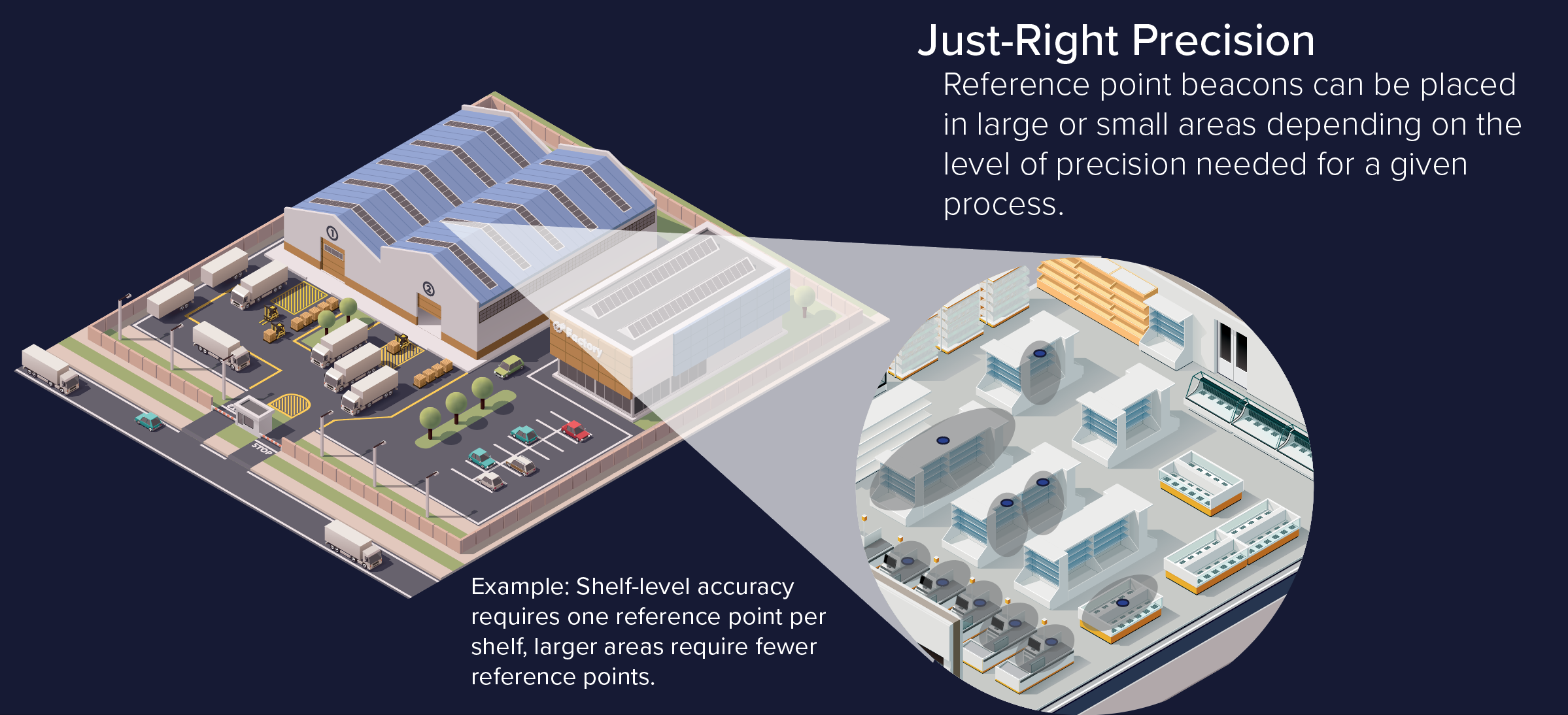
Unlike other BLE‑based systems that rely on centralized readers, AirFinder processes location data on the tag itself. Tags listen to fixed BLE beacons and calculate their position locally. This architecture means you can scale precision simply by adding more beacons—without expanding the reader network.
Other technologies commonly used in healthcare and manufacturing include Wi‑Fi‑based trackers. These work well if the facility already has suitable Wi‑Fi infrastructure. Wi‑Fi tags are generally larger and pricier than BLE options, and legacy or multi‑vendor Wi‑Fi setups can pose integration challenges. AirFinder offers a lightweight, cost‑effective alternative.
Don’t default to 1 cm accuracy for every RTLS or RFID installation. Many scenarios are better served with zone‑level (room‑level) accuracy, with the ability to increase precision where needed. This approach delivers a more economical, scalable solution.
Internet of Things Technology
- Asset Tracking: A Proven Solution to 2021 Supply Chain Shortages
- How AI and ML Revolutionize Asset Tracking: Enhancing Accuracy, Efficiency, and Insight
- Strengthening IIoT Asset Tracking: Proven Security Practices
- AirFinder vs. AirTags: Why AirFinder Leads in Commercial IoT Asset Management
- Asset Tracking: How to Monitor Your Heavy Equipment and Protect Your Bottom Line
- How IoT Asset Tracking Is Revolutionizing Manufacturing Efficiency
- How IIoT Enhances Asset Monitoring Systems: Boosting Reliability & Efficiency
- How IoT Revolutionizes Vehicle Tracking Systems
- Boost Productivity: How Asset Management Software Enhances Work Order Tracking
- Choosing the Right Number of Axes for Your Robotic Positioner