



IoT in Manufacturing: Transforming Production Through Connected Intelligence
For most of human history, skilled labor drove manufacturing. The Industrial Revolution in the 1700s introduced the first collaboration between people and machines, accelerating production and elevating quality. Today, the Internet of Things (IoT) is poised to usher in a new era—where data‑rich, networked assets deliver unprecedented efficiency, reliability, and uptime.
In practice, IoT for manufacturing means investing in smart sensors, connected machinery, and analytics platforms that reduce operational costs over the long haul. These assets never need breaks, miss deadlines, or require retraining, making them a reliable, cost‑effective lever for productivity gains.
Below we explore three real‑world use cases, detailed case studies, and practical change‑management guidance for integrating IoT into your plant.
Three Core Use Cases for IoT in Manufacturing
Work‑In‑Progress Tracking
Large, complex assemblies—think aircraft components—rely on precise tracking of parts throughout the build. Traditional barcode scanning falls short when a part goes missing; with RFID or sensor‑based tracking, you instantly locate items, preventing costly downtime and enabling real‑time exception reporting to catch misplacements before they derail the schedule.
Tool & Fixture Management
High‑value tools and gauges are essential to production flow. Misplaced fixtures can stall a line, jeopardizing delivery dates. IoT tracking ensures every tool is accounted for, protects government‑furnished equipment, and keeps you compliant with audit requirements.
Cold‑Chain Monitoring
Temperature‑sensitive products—vaccines, biopharmaceuticals, specialty foods—must stay within strict limits during manufacture, storage, and transport. IoT sensors provide continuous, tamper‑evident monitoring, guaranteeing product integrity and regulatory compliance.
Case Studies: IoT Driving Value Across Industries
Process Automation at an Automotive Foam Manufacturer
G2 Technologies partnered with a foam producer to deploy machine vision for defect detection. Foam rolls move at 600 ft/min, and a camera array scans each roll in real time, flagging tears and thickness variations. The result? A robust quality assurance loop, higher throughput, and the ability to offer defected products at a lower price point—boosting both revenue and customer trust.
Service‑Oriented Manufacturing with PTC’s ThingWorx
German maker Heidelberg, known for printing presses, leveraged ThingWorx to connect 10,000 machines and 15,000 peripheral systems. Remote monitoring and predictive maintenance now resolve over 70 % of issues before a customer is affected. PTC cites that this proactive support drives 40 % of Heidelberg’s sales, underscoring the business case for an integrated IoT platform.
Lights‑Out Automation with FANUC Robotics
A vehicle‑parts manufacturer implemented four dual‑spindle lathes, each paired with a robot and a vibratory bowl feeder. Sensors verify part placement, and the entire cycle runs autonomously, producing 320 parts per hour—no operator required. This lights‑out operation demonstrates how IoT‑enabled robotics can deliver round‑the‑clock production while minimizing human intervention.
Industry 4.0 in Germany
Germany’s Industrie 4.0 initiative—championed by Chancellor Angela Merkel—seeks to embed IoT across automotive, aerospace, and industrial sectors. The goal: create digitally connected factories that enhance agility, reduce waste, and sustain Germany’s competitive edge in high‑value manufacturing.
China’s Made in China 2025
China’s national program pledges $300 billion in funding to upgrade manufacturing with smart technologies, targeting new materials, robotics, and advanced logistics. The strategy aims to elevate Chinese products to global standards and promote international collaboration.
Managing Change: Getting Your Workforce on Board
IoT adoption can raise concerns—especially among seasoned operators who fear job loss or role erosion. Address this by:
- Secure early stakeholder buy‑in. Engage decision‑makers and potential skeptics from the outset, highlighting how IoT enhances job quality, safety, and skill relevance.
- Obtain internal approval before pilots. Launching pilots without full support risks mistrust and hampers adoption. Secure consensus first, then demonstrate tangible benefits through small‑scale tests.
Next Steps
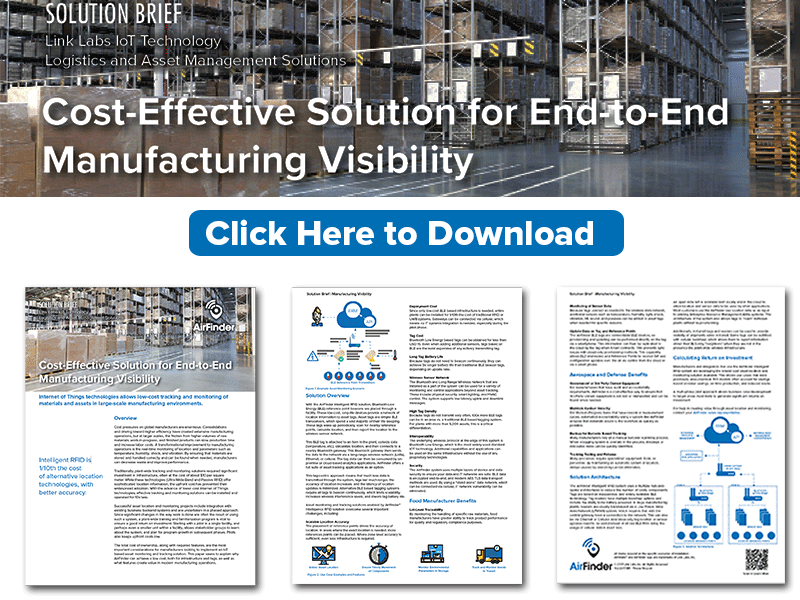
Need help choosing the right asset‑tracking platform? Download our free white paper on AirFinder’s intelligent RFID system—covering deployment costs, tag economics, security, and lot‑level traceability—to guide your decision.
Internet of Things Technology
- Debunking the Top 5 Myths About IoT in Manufacturing
- 5G for Industrial IoT: Transforming Connectivity and Automation
- How IoT Asset Tracking Is Revolutionizing Manufacturing Efficiency
- Revolutionizing Agriculture: How IoT Drives Efficiency and Sustainability
- How IoT is Driving the Next Generation of Manufacturing
- Manufacturing Leads IoT Adoption with Real-Time Innovation
- Top 4 Industrial IoT Applications Transforming Manufacturing
- Infographic: How IoT Drives Efficiency and Innovation in Manufacturing
- Mastering Overmolding: A Comprehensive Guide to Advanced Plastic Joining Techniques
- Centrifugal Water Pumps Explained: Operation & Benefits