



PICMG Approves IoT.1 Firmware Spec, Standardizing Smart Sensor & Actuator Interoperability
 \n
\n
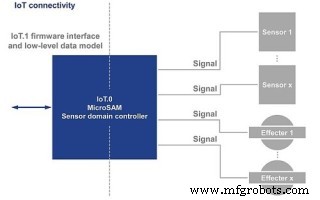
PICMG has ratified the IoT.1 firmware specification, establishing a unified communication standard between smart sensors, effectors, and local IoT controllers such as micro Sensor Adapter Modules (microSAM) defined in PICMG’s IoT.0 spec.
\nThe IoT.1 spec introduces a vendor‑independent firmware interface and a low‑level data model that enable seamless configuration of smart sensors and effectors, while delivering plug‑and‑play interoperability across higher‑level installation layers. It supports both sensing and profiled motion control, meeting the requirements of most emerging Industry 4.0 applications.
\nIoT.1 is the first PICMG product developed in partnership with the Distributed Management Task Force (DMTF). It builds upon and extends the Platform Level Data Model (PLDM) from DMTF, a low‑level messaging framework that supports topologies, eventing, and discovery. PLDM operates over multiple system buses—including I²C/SMBus, PCIe Vendor‑Defined Message (VDM) via MCTP, and RMII‑Based Transport (RBT) over NC‑SI—ensuring broad compatibility.
\n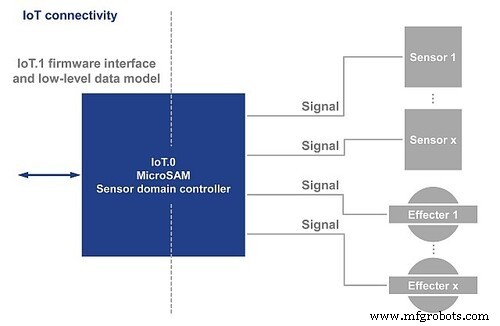
IoT.1 was crafted to deliver industry benefits in four key areas:
\n- \n
- Enabling sensor vendors to produce smart sensors without integrating control circuitry or proprietary software, by sourcing these components from PICMG‑compliant suppliers. \n
- Allowing controller manufacturers to build smart‑sensor or smart‑sensor‑component solutions that interoperate with offerings from other vendors. \n
- Facilitating integrators to combine sensors/effectors from multiple suppliers with controllers from various vendors into a single, cohesive system. \n
- Accelerating the adoption of smart‑sensor technology through open specifications and proven interoperability. \n
When paired with PICMG’s sensor‑domain network architecture and data model, devices connected to MicroSAMs (IoT.0) or other controller modules achieve seamless plug‑and‑play integration into the network.
\nIoT.1 was developed in collaboration with PICMG members Arroyo Technology, nVent, Triple Ring Technologies, Sandy Systems, and PICMG itself.
\nFor more information, visit PICMG’s industrial IoT overview: https://www.picmg.org/industrial-iot-overview/.
\nThe specification is available for purchase and download here: https://www.picmg.org/product/iiot_firmware.
\nInternet of Things Technology
- Verizon and AT&T Deploy LTE‑M1 to Power Nationwide IoT Coverage
- Smart City Evolution 2017: Itron’s Acquisition, Open Standards, and the City‑as‑a‑Platform Manifesto
- How IoT-Enabled Smart Alerts Transform Electric Motor Reliability
- Lean Strategies for Affordable Smart, Connected Products: Tips & Real-World Examples – Part 2
- Lean Strategies for Cost‑Effective Smart IoT Products – Part 1
- Securing the Smart Home: Why Biometrics Are Essential for IoT Cybersecurity
- How IoT Revolutionizes Agriculture: Key Benefits & Smart Farming Insights
- Enhancing Reliability with Smart Contracts: IoT Meets Blockchain
- Efficient IoT Sensor Provisioning: Secure Connectivity & Credential Management
- Smart Sensors in Industrial Machinery: Benefits, Drawbacks, and Workforce Impact