



2020 Create the Future Design Contest Winner: Low‑Noise Laser for LiDAR in Automotive/Transportation
LOW-NOISE LASER FOR LIDAR
John Jost, Nikolay Pavlov, Grigorii Likhachev, Tobias Kippenberg, and Pierre-Yves Cattin MicroRsystems SA (Lausanne, Switzerland)
Winner of an HP Workstation
Seeing the world around you in a new way opens ups many exciting possibilities. Light Detection and Ranging (LiDAR) is doing just that by using lasers to measure distances very precisely. It is currently one of the key enabling factors behind autonomous driving. The technology used in LiDAR is often limited to seeing things only a few hundred meters away. To overcome this problem, compact lasers with more precise colors are needed.
MicroR’s compact optical laser technology improves the purity of a laser’s color 1000x in a compact package with a range of colors for LiDAR markets where well-established technologies do not exist. MicroR will sell lasers that improve the performance and extend the range of LiDAR systems.
MicroR combines the technology of optical microresonators with integrated photonic chips to create compact, precise lasers. Optical microresonators act as optical filters for light. Filters are defined by a metric called the finesse and optical microresonators have the highest finesse of any optical filter. MicroR has a patent-pending technology to combine the best type of optical microresonator made from ultra-pure crystals with integrated photonic chips.
MicroR is bringing a high-tech laser product to market with the goal of product introduction in one year. LiDAR is an enabling technology for a range of new applications:
LiDAR automotive technology valued at $353 million USD in 2020 and growing at a CAGR of 29.6 %.
The wind monitor market currently valued at $400 million USD in 2020 and growing at a CAGR of 12%.
MicroR has contracts with both the European Space Agency and the Swiss Space Center for the laser technology; several laser manufacturers are working with early prototypes.
For more information, visit here .
HONORABLE MENTIONS:
CITS Combustion Engine Technology
Basil Van Rooyen, CITS Engineering PL, New South Wales, Australia

The Crankcase Independent Two-Stroke (CITS) technology retains the simplicity, low maintenance, and superior weight- and cost-to-power ratios of the two-stroke and eliminates their lubrication and emissions burden. A pivoting, low-resistance inlet valve with integrated bypass valve replaces the throttle for power control. The technology results in smoother running and quieter exhaust.
For more information, visit here .
Dual Radial Gap Electric Motor Vehicle Conversion Kit
Bryan Prucher, Lektromotiv, Clarkston, MI
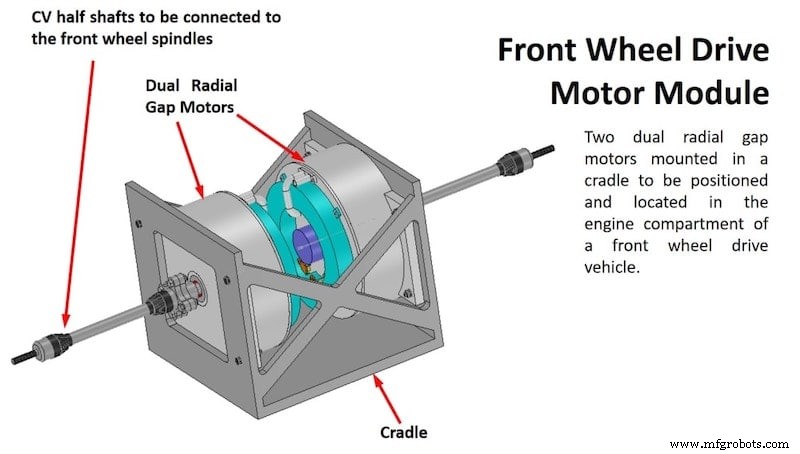
This e-vehicle conversion kit uses a dual radial gap, high-power-density, low-RPM DC electric motor in a direct drive application to convert conventional IC powered vehicles to full electric power. The kits can be configured to provide direct drive power to any front or rear drive vehicle.
For more information, visit here .
The Future of the Four Stroke Internal Combustion Engine
Jeff England, Gary Cotton, and Robert McLean, Grace Capital Partners, Little Rock, AR

GlideValve Engine Technology is an Electro-Pneumatic Valve Actuation System (EPVAS) that optimizes the engine “valve events” and virtually eliminates valve float. It increases the volumetric efficiency of an engine by moving air through the interior of the valve and sealing the valve with rings around the exterior.
For more information, visit here .
Second Generation RADIALcvt (Continuously Variable Transmission)
Jan Naude, Varibox CVT Technologies, Johannesburg, South Africa
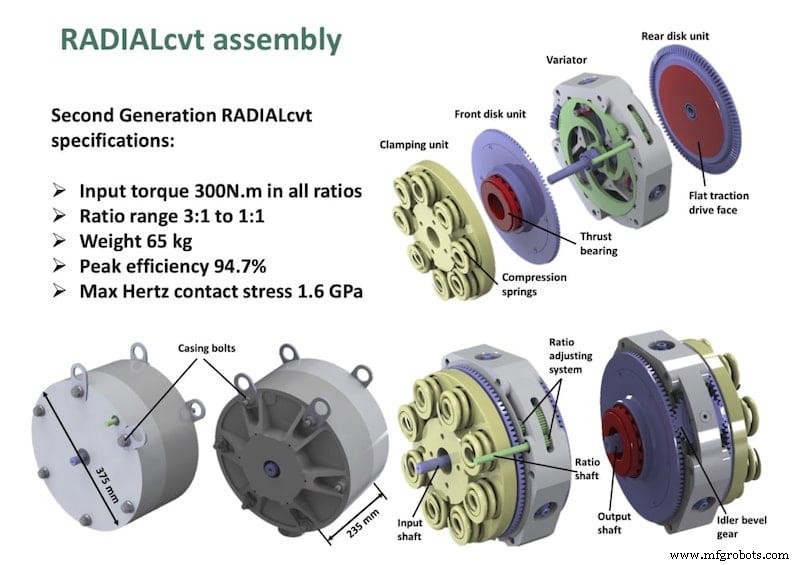
The RADIALcvt is a multi-parallel power path type of CVT that utilizes traction drive technology in a novel mechanical configuration that optimizes the factors contributing to high mechanical efficiencies in traction drives. It is for pure electric vehicles, hybrids, and ICE vehicles as well as for industrial applications.
For more information, visit here .
See the rest of this year's winners:
- GRAND PRIZE WINNER
- MEDICAL
- AEROSPACE & DEFENSE
- CONSUMER PRODUCT DESIGN
- ELECTRONICS/SENSORS/IOT
- MANUFACTURING/ROBOTICS/AUTOMATION
- SUSTAINABLE TECHNOLOGIES/FUTURE ENERGY
Sensor
- Borealis Introduces Fibremod: Advanced Carbon & Glass Fiber‑Reinforced Polypropylene for Lighter, Cost‑Effective Automotive Design
- IoT in 2020: How Advancements Are Shaping Our Future
- 2021 Create the Future Design Contest Winners: Celebrating Engineering Innovation
- Winner of 2021 Create the Future Design Contest: Electronics-Free Soft Walking Robot Leads Manufacturing/Robotics/Automation Category
- Halo Speculum Wins 2021 Create the Future Design Contest in Medical Category
- 2021 Create the Future Contest: Sustainable Technologies Winner – Multifunctional Bionanocomposite Fruit Coatings
- Freetouch Wins 2021 Create the Future Design Contest – Electronics/Sensors/IoT Category
- 2020 Create the Future Design Contest – Medical Category Winner: ‘A Chip Off the Old Box’ for Pain‑Free Defibrillation
- PrintIC Crowned Winner of 2020 Create the Future Design Contest – Electronics/Sensors/IoT Category
- Plasma vs. Laser Cutting: How to Pick the Best Technology for Your Workshop