



Intelligent Automation vs. RPA: Key Differences & Business Impact
By Priya Jain
The tech world loves the two or three-letter acronyms more than anything else.
Why?
Technologies like intelligent automation (IA) and robotic process automation (RPA) reduces tedious and repetitive tasks of employees, allowing them to concentrate on creative and innovative assignments.
So, before understanding why these processes are different, let’s explore what each term means and what impact it makes on your business.
What is intelligent automation?
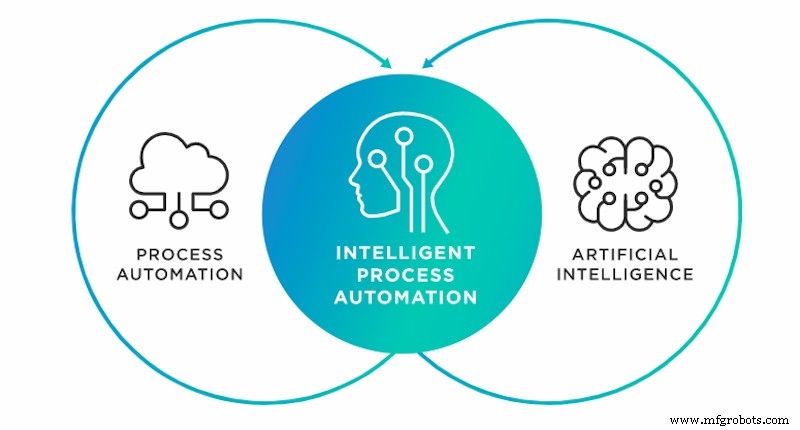
Intelligent automation is the automation of a company’s processes using automation technologies like business process management (BPM), robotic process automation (RPA), and artificial intelligence (AI) to streamline the decision-making process.
It contemplates the use of analytics and artificial intelligence in business.
The IA process helps a company free its resources and improve operational efficiencies. Unlike other automation technologies, IA links together the thinking and doing aspects. As a result, IA is widely used in many industries and sectors.
For instance, a vehicle manufacturer can use the IA to reduce manual errors in the production stage and increase vehicle production speed. A credit card service company can increase its accuracy in handling vendor invoices. An insurance provider can use the IA for faster claim processing.
The sky’s the limit for business benefits IA can bring along. This is because IA Is a proven strategic lever for improving business efficiency and reducing production costs.
Due to its applicability, companies worldwide are trying to use IA to improve resilience and manage the pressing challenge of meeting customer requirements.
Benefits of IA
Some key benefits of using intelligent automation are:
- Reducing cost by augmenting employees and improving productivity: With IA, companies can quickly scale their processes without increasing risk, compromising quality, or putting a strain on their employees. This results in improved ROI and higher efficiency.
- Improving customer experience: Providing high-quality products to the market and answering customer queries instantly can result in a positive customer experience.
- Improving process accuracy: One of the advantages of IA is using AI to drive critical decision-making. It uses a consistent approach for automating repetitive tasks.
- Addressing compliance issues: IA allows companies to leverage the task automation feature to ensure the business complies with regulatory and legal policies.
What is RPA?
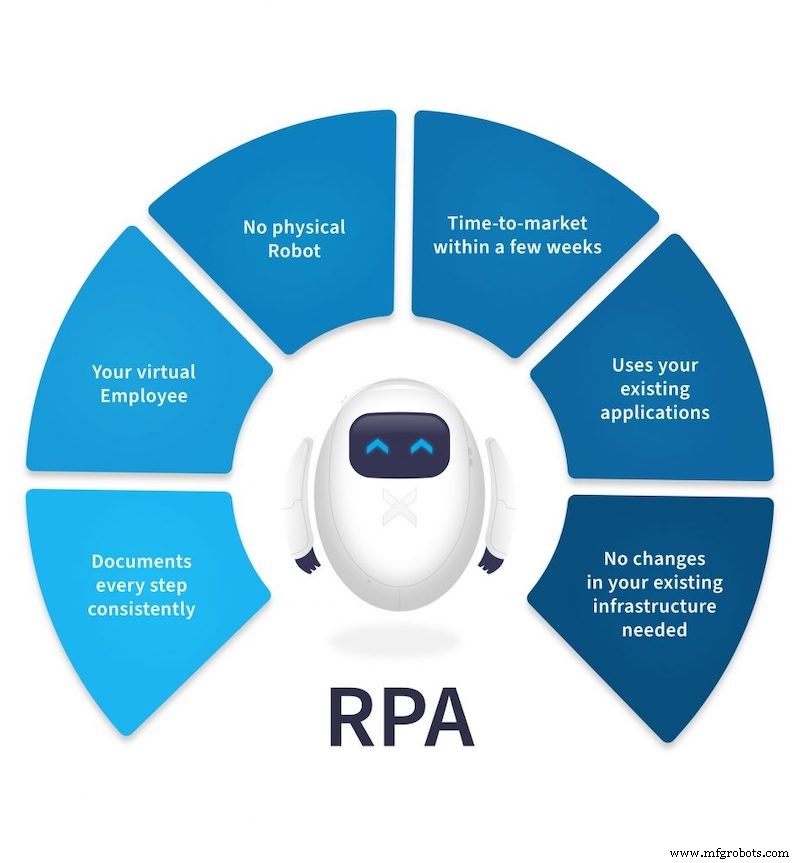
RPA is a noninvasive integration technology that makes It easier for companies to create and manage robots or bots that mimic human actions through the user interface of any system.
Unlike AI, where the system learns a new thing every iteration, RPA robots perform the same way every time. They cannot improvise or develop a better way of doing programmed tasks.
These RPA bots work like your virtual assistant and let you automate repetitive tasks that are not arduous but consume valuable employee time.
Interestingly, these robots can understand what’s on-screen, identify data and take a wide range of actions that otherwise requires a human.
Benefits of using RPA
Here are a few benefits of using RPA:
- Boosting productivity: As RPA automates mind-numbing tasks such as copying and pasting from one system to another, it gives time to employees to focus on other essential things. This can boost workplace productivity.
- Improving data security: Using RPA reduces the number of human touches a business requires for processing personal information. This automatically results in higher data security.
- Providing a better customer service experience: Rather than spending time on rote administrative tasks, employees can focus on customer experience. This can improve resolution time and improve customer satisfaction.
Intelligent Automation Vs. RPA: How do they Differ
From the above section, it’s clear that IA is not the same as RPA. There exists a vast difference between these two tech buzzwords.
The basic difference
RPA automates works that follow rules that have no variation. For instance, when you login to your bank account, you enter your username or login id and password. There is no variation in this process regardless of the number of times you use your online bank account.
RPA is the perfect tool for these processes. As a result, RPA is prone to facing scalability issues because when there occurs a process variation, RPA falls flat on its feet.
That’s what gave rise to IA, an advanced form of RPA. IA integrates every RPA quality and adds an extra layer of capability by introducing bots capable of learning and adapting to changes in real-time.
IA incorporates AI technologies such as machine learning and natural language processing (NLP) to handle exceptions and consistently learn from data patterns.
Type of data they can handle
The RPA is inefficient in performing tasks with variations. It can handle
only structured data. On the other hand, IA can deal with structured and unstructured data.
Due to this reason, IA can do wonders for cutting costs and improving productivity in a short time frame.
Using IA, you can extend capabilities and provide insights into process improvement across the company. This transforms the way you work and results in long-term success.
Limitations of both
Often, RPA can be problematic in the long run because you design a system that strictly follows a given set of rules. For instance, if a customer inputs incorrect data, RPA is not intelligent enough to complete the task.
That’s where IA comes into the picture. When RPA can no longer deliver intended results, companies can integrate IA. This allows the system to complete the entire task using decision-making techniques and AI reasoning.
Due to superiority in function and no limitations, RPA is the stopgap to an eventful IA integration.
The basic use
RPA is ideal for automating emails, downloading invoices into a particular folder, and creating bills in the accounting software. On the other hand, IA is processed to intelligently read the invoices and extract invoice numbers, product descriptions, due dates, and amounts due, among other fields.
Difference based on applications
The difference based on the application of RPA and IA are:
Retail
Retail companies widely use bots that have thinking capabilities on their own. These bots come in handy for improving efficiency by fulfilling customers’ orders. These bots can travel around the warehouse in the supply chain without colliding with other traffic. When companies use RPA in the retail sector, they primarily handle shipping status and customer orders. The RPA gives customers an estimated delivery date upon selecting a product.
Banking and finance
Banks and financial institutions use RPA to fetch customer information and fix appointments. This technology helps customers choose the right financial product based on their needs. Interestingly, RPA bots can renew an insurance policy.
On the other hand, banks widely use IA to process incoming and outgoing transactions. IA helps investigate payment issues while reducing dependency on employees. Also, IA helps in risk management by helping customers identify potential risks involved in a transaction.
Healthcare
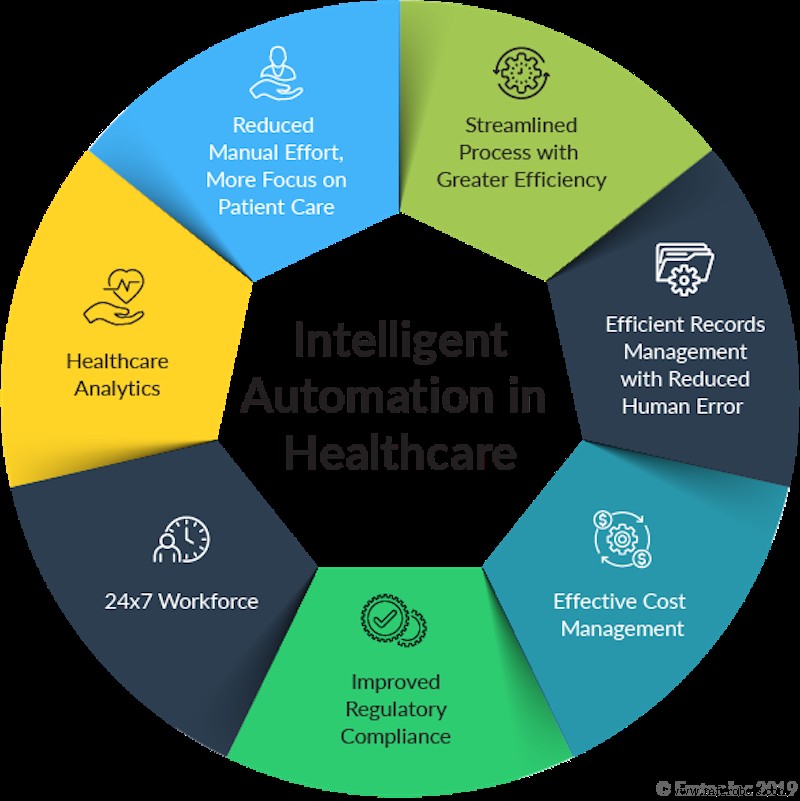
Hospitals and medical centers can use RPA to prepare and ingest health records and insurance claims. They also use RPA for appointment scheduling and cancellations or changes in the appointments.
IA is an excellent tactic for reducing manual processes and streamlining administrative processes related to billing, and automating clinical workflows.
Can they work together?
While IA is the brain of an operation, RPA is its hand. RPA is best for automating mundane rule-based tasks or mimicking human actions. Tasks like entering, reading, and extracting data are ideal for an RPA process. But IA is ideal for streamlining a process from end to end.
Due to this conflicting nature, both RPA and IA can work in the sink. IA can optimize processes using RPA for structured, repetitive, and mundane tasks.
Using IA and RPA on the same business process, you can automate and optimize your business from a tactical and process perspective.
IA + RPA: Providing end-to-end automation solution
RPA and IA will continue to evolve with the advances in automation technologies.
Starting with automation might be an uphill battle for various reasons, but the dividends you might receive over a period of time can help in your organization’s growth.
For building a layer of automation, you need the right mindset to provide a competitive advantage over others.
The choice of building and implementing RPA and IA depends upon the specific use case and business requirement. Before selecting an automation process, ensure it fits your purpose.
The ideal way to understand whether automation fits the purpose is to use a bottom-up approach.
Start by employing RPA solutions for error-prone and repetitive processes. Depending upon customer and employee feedback, prioritize areas for improvement and move to a sophisticated solution such as an IA.
With IA and RPA, you can transform your organization to serve employees, customers, and stakeholders better.
It could be a revolution your business has always waited for!

About the author: Priya Jain is a professional copywriter with 8 years of experience. She has an MBA and engineering degree. When she is not writing, you will find her teaching math, spending her day running behind her toddler, and trying new recipes. You can follow her on LinkedIn.
Automation Control System
- Aligning Business and IT: Proven Strategies for Automation Success
- From UI to AI: Navigating the Automation Landscape
- Intelligent Automation: Driving Successful RPA Implementations
- WiFi vs. Bluetooth: Key Differences and Similarities Explained
- RPA: Driving Intelligent Automation in Healthcare
- Laiye Expands to UK, Aiming to Revolutionize Intelligent Automation Across EMEA
- Leveraging Intelligent Automation to Transform Utility Operations
- Mastering the Journey to a Fully Automated Enterprise
- Elevating Digital Workers: How Intelligent Automation Drives Smarter, Faster Work
- AntWorks Unveils ANTstein SQUARE: Intelligent Automation Set to Outpace Traditional RPA