



Empowering Automation: Why Democratizing RPA Drives the Future
Joe Edwards is product marketing manager, Community and Learning, at UiPath.
Have you checked out the agenda for FORWARD III? There’s a whole track dedicated to democratizing Robotic Process Automation (RPA). What does that mean, you might wonder?
To us, it’s about making automation skills easily accessible for anyone to enhance their personal and professional lives.
When automation skills are democratized, truly marvelous things occur. Yes, organizations are transformed, employees become happier, and companies can better compete in the ‘automation first’ era.
But at the human level, there is more.
Take Florent Salendres, a developer highlighted in our Community blog, who first learned RPA to make his contact center job easier.

Or a recent project led by UiPath MVP Susana Gonzalez Cacheiro to empower women in RPA.
These examples highlight how individuals can transform their personal and professional lives with RPA.
By democratizing RPA, we're able to make our companies run more smoothly, make our teams happier and more productive, and, ultimately, create better experiences and results for our customers.
To join us in democratizing RPA, you can do three simple things:
Transform your organization by providing tools and resources that enable an employee-driven approach to automation
Make an RPA education accessible to everyone
Crowdsource innovation and support
In this blog series, we’ll explore each facet, and why it matters to you.
Let’s start with democratizing RPA within your company.
Transform your organization
If automation is something that only your IT team and a few RPA champions use, then it's simply a useful tool. Like other software, it'll offer healthy returns and and improved productivity. Automation, however, has much greater potential than that. Democratization is the key to recognizing that potential.
Transforming your organization in the wake of automation and preparing it for the automation first era requires robots that are ‘normalized,’ accessible, and distributed.
When everyone has a robot on their desktop, mindsets transform. Thriving organizations have an automation first approach, and believe:
If a process is repetitive or rules-based, unattended robots might be able to automate it entirely.
If a task requires complex, empathetic cognition, employees freed from repetitive labor can focus on that high-value work.
If a problem demands anything in the middle, employees can work out a mix of attended robots that will help them get it done in the fastest, most accurate way possible.
An automation first mindset isn’t something an executive declares. Getting to automation first requires leadership from the top-down and empowerment from the bottom-up.
Top-down, the C-suite should examine the entire organization through this lens: If it can be automated, it should be automated. One of the C-suite’s primary goals should be chasing inefficiency out of the organization and scaling automation throughout.
Meanwhile, leadership should also empower every single employee to drive automation through each of their roles.
That becomes easier with UiPath Connect Enterprise, launching this year, which helps employees connect to drive automation opportunities. A comprehensive tool that gives instant visibility to your automation projects across the enterprise, Connect Enterprise allows your organization to flourish as automation ideas come from both the top-down, and the bottom-up.
When anyone can suggest automations across an enterprise, you can uncover the “long tail” of automation ideas. These are the automation opportunities that only individual employees can describe. They’re the dozens of times an HR manager has to copy and paste information in different applications or the tiring manual workflow that a specialist has to do every time there is a data call.
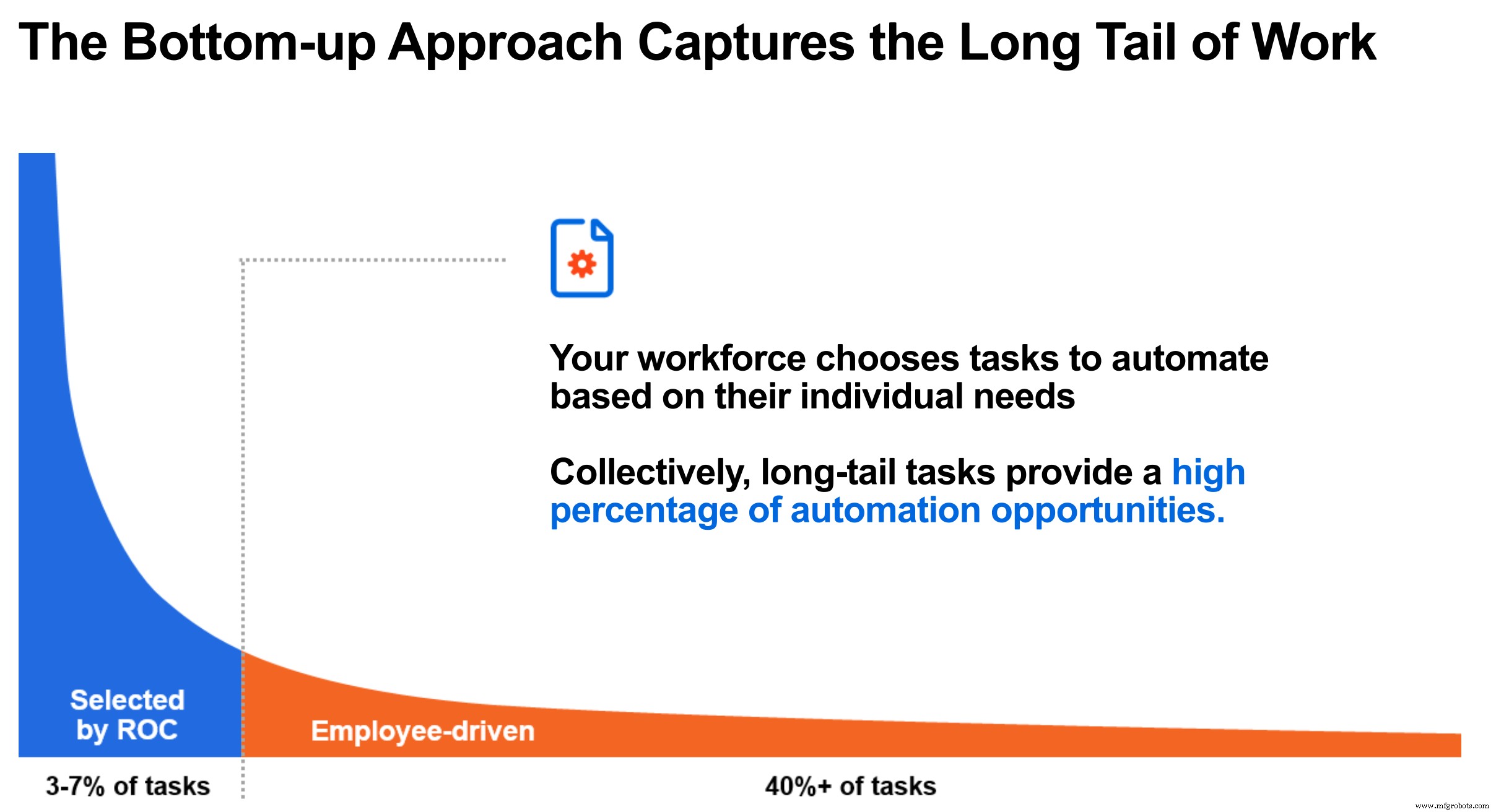
Source: How Savvy Organizations Are Using RPA to Thrive in the Automation First Era
No leader has perfect visibility into every detail of an organization. Once you empower your employees to think automation first too, they can start seeing even the smallest inefficiencies and annoyances in their day-to-day work as problems that should be solved. This, in aggregate, has a truly transformative impact on your organization.
With an automation first mindset and automation-capable employees, you can extend the benefits of RPA throughout your entire organization.
Where do you go from here?
We’ll be back with the next steps for making an RPA education accessible to everyone, and crowdsourcing innovation and support.
UPDATE: FORWARD III is over but you can still get FORWARD III presentations, videos, and guides delivered directly to your inbox when you sign up for your complimentary copy of the event pack.
Automation Control System
- Discover RPA Success: 3 Proven Ways Robots Outperform Traditional Solutions
- Automation in the Workplace: Understanding How Robots Impact Jobs
- Industrial Automation: The Key to Future-Ready Businesses
- Hybrid Service Models: The Future of Customer Experience
- How RPA Drives Business Resilience After COVID-19
- Automation: Empowering Tomorrow’s Workforce, Not Fear
- WEF Reveals Cobots as the Future of Manufacturing
- Automation & Collaborative Robots: Shaping the Future of Industrial Testing
- The Future of Automation: Self-Replicating Robots Reshaping Industry 4.0
- Determining the Optimal Level of Automation for Your Packaging Line