



3D-Printing Paves the Way for a Successful 19‑Hour Spine Tumor Removal
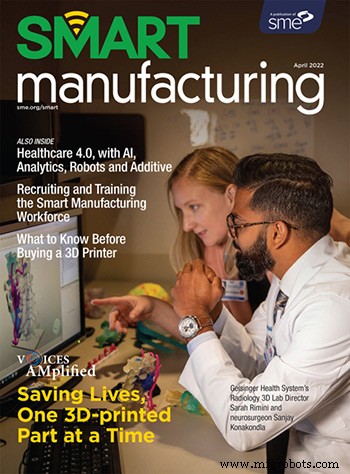
On our April 2022 cover, a neurosurgeon and a computed tomography/magnetic resonance imaging expert discuss how best to remove a cancerous tumor from a 64-year-old patient’s spine. The resulting procedure involved eight vertebrae and took 19 hours to perform—and, spoilers—was successful.
As explained in Kip Hanson’s feature, “Practice Makes Perfect,” the surgery’s success hinged on the neurosurgeon’s ability to prepare for it by studying a 3D-printed model of the tumor and the surrounding tissue. We’re used to thinking of additive as a technology for either making prototypes or else production parts. Here, it’s a tool in the arsenal of healthcare.
As Karen Haywood Queen explains in her feature, “Healthcare 4.0,” other familiar technologies—AI, analytics, robotics and augmented reality—are also in use to improve a wide range of medical practices.
For example, a robot’s precision, repeatability, and range of motion—the capabilities that make it invaluable in manufacturing and production—also make it an excellent partner in the surgical theater.
So, why should the manufacturing reader read about the healthcare field? Because as we use these common tools, we can learn from each other.
In Queen’s feature, we’re told that a benefit of robotic surgical assistance is that it extends the working life of experienced surgeons, who lose dexterity and steadiness as they age. This matters because, the feature notes, the American Association of Medical Colleges projects a shortage of 46,000 to 90,000 doctors by 2025.
The challenge of a dwindling, aging workforce? This is something our industry knows about: Smart technology is making it easier to integrate younger, less-experienced workers onto the shop floor. There’s been less discussion, however, about how it may be used to extend the working life of our own aging workers. We can learn from each other’s experiences.
Automation Control System
- Understanding Process vs. Discrete Manufacturing: Key Differences & Benefits
- Proven Growth Strategies from Five Leading Manufacturing Executives
- Midwestern Manufacturing Leaders Embrace Lessons from Recent Testing Challenges
- Ericsson Accelerates 5G Adoption in Manufacturing: Driving Efficiency and Innovation
- 2019 Manufacturing Forecast: How AI and Automation Shape the Future
- How Blockchain is Revolutionizing Manufacturing: Enhancing Security, Transparency, and Efficiency
- Autodesk Smart Manufacturing: Automate Your Workflow & Connect Product Development
- Operational Excellence in Manufacturing: Essential Insights for 2014 Leaders
- Harnessing Data-Driven Manufacturing for U.S. Industry Growth
- Expert Contract Manufacturing Services for Defense, Aerospace & Telecom