



Fanuc Launches Safer Collaborative Robot for Human‑Machine Partnerships
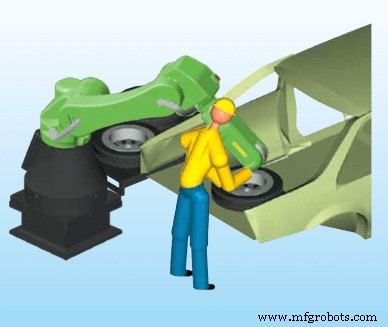
There are certain manufacturing processes that often require the agility of a human worker. Other tasks require the payload capabilities of a robot. Pairing a human worker and a robot counterpart on the factory floor has been a long sought after goal. This goal has traditionally brought about obvious challenges and safety concerns. This however is the case no longer. Fanuc has introduced a collaborative robot safe enough to pair with a human worker without the need for a guarding or safety fences.
Fanuc’s collaborative CR-35iA robot stops safely when it comes in contact with a human counterpart. It’s certified to meet the international ISO 10218-1 safety standard. The CR-35iA’s exterior cover reduces impact forces and pinch points by providing a soft barrier between the robot arm and the human.
Fanuc’s CR-35iA takes full advantage of intelligent functions such as iRVision, an integrated vision system. The robots end of arm tooling can also be equipped with a hand guidance tool used to teach the robot paths and movements. (See video to view this application in action.)
Fanuc’s collaborative robot product line comes in several shapes, sizes, and payload capabilities. The CR-35iA has a 35 kg payload.
Click the here and watch the video for more information regarding Fanuc’s excited collaborative product line.
Automation Control System
- Robots Achieve Precise Hand‑Eye Coordination for Complex Tasks
- Why Choose a Collaborative Robot for Your Workspace
- Soft Robots Detect Human Touch via Camera and Shadows—A Low-Cost, Touchless Solution
- Automation & Collaborative Robots: Shaping the Future of Industrial Testing
- Enhancing Robot Intelligence and Safety in Manufacturing
- Understanding Collaborative Robots: Definition, Applications, and Benefits
- Rapidly Deployable Collaborative Robots for Enhanced Productivity
- Collaborative Robots: Revolutionizing Human-Machine Interaction
- How Articulated Robots Revolutionize Machine Shop Operations
- Ensuring Safety in Collaborative Robot Operations