



Why High-Mix, Low-Volume Manufacturers Should Adopt Collaborative Robots
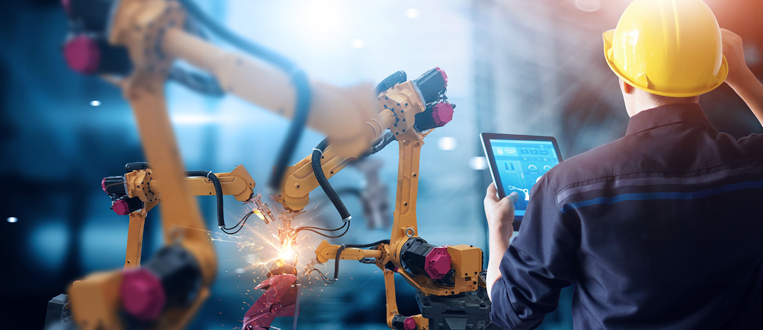
Collaborative robots are increasingly attractive to manufacturers who require flexible solutions for their growing product mix but may not have the scale of work or capital resources needed to justify larger investments in automation systems.
These collaborative robots, commonly referred to as “cobots,” can execute tasks with minimal programming and adapt to variations in part position and size. Humans work side-by-side with cobots to reduce the need for custom fixturing that can make high-mix, low-volume (HMLV) work inefficient. Cobots can also go to where the work is on the shop floor.
The Purdue Manufacturing Extension Partnership has identified manufacturers that have a lot to gain from cobot adoption. Investing in collaborative robots may make the most sense for:
- Manufacturers from 50 to 500 employees with a family product mix
- Owners who are looking for a fast payback period on capital investments (e.g., 6 months)
- Managers who can’t fill shifts, but can redeploy employees to more value-added positions
- Operators with repetitive or dangerous jobs
Thanks in part to work being done by the Measurement Science for Manufacturing Robotics program within the National Institute of Standards and Technology’s (NIST) Engineering Laboratory (EL), collaborative robots are now smaller, lighter and easier for small and medium-sized manufacturers (SMMs) to integrate and have improved interoperability within work cells.
Think of a Cobot as a Remote Assistant for a Shop Floor Operator
Human-robot collaboration has been found to be 85 percent more productive than either humans or robots working alone according to MIT research. The cobot operates much like an assistant for the staff member.
Pure robotics requires incredible amounts of programming and sensors to account for the many possible variables. For example, it’s far more cost effective for a person to bring and present parts to a robot for subassembly or welding than to train the robot to go elsewhere in a facility — with all of the safety and environmental factors involved — to gather materials and do the job.
Cobots, on the other hand, work with software for many machines and applications, which means they can quickly be redeployed to add flexibility to operations. They also are lightweight but reliable. Many cobots have warranties that account for enough operational hours to run continuously for several years.
The three most common types of cobots are:
- Fixed-base – often a single arm that does repetitive work with parts and tools.
- Mobile – especially useful for pick-and-place tasks and quick changeovers.
- Wearable – such as exoskeletons, which allow the user to leverage the benefits of being human and the strength and endurance of a machine.
Collaborative Robots Can Be Programmed to Do Many Applications
Tasks vary greatly with HMLV work, which creates challenges for productivity and overall equipment efficiency. But HMLV work often still includes monotonous routines that can result in mistakes and repetitive motions that can cause strains and injuries for workers.
Among the many applications that collaborative robots are being used for in HMLV shops are:
- Machine tending – This is the most common use of cobots, replacing the repetitive tasks of picking and placing parts or tools.
- Adaptive Assembly – The flexibility of a cobot allows it to drive a screw, tighten a bolt, snap on a part, apply adhesives, and more.
- Inspecting parts and products – Robots do not experience the mental fatigue that limits human inspections, and robots can do this task much more quickly when equipped with multiple high-resolution cameras and/or sensors.
- Welding – The flexibility of cobots is apparent with their increasingly common use for spot welding and arc welding. There is a severe shortage of certified welders; expect this use to continue to increase.
- Packaging and shipping – Tasks vary from applying shrink-wrap to boxing parts and loading pallets. Cobots are good candidates for performing heavy lifting tasks.
The versatility of cobots is among the most appealing benefits for HMLV work. It’s like having an employee who can master many different, often unappealing tasks.
Challenges When Implementing Collaborative Robots
NIST Labs continue to work on uniformity for cobots, so that systems of seemingly identical specifications may be measured, evaluated and compared in a repeatable and meaningful way.
Elena Messina, a group leader at the NIST EL’s Intelligent Systems Division provides these insight into challenges for increased use of cobots:
- SMMs may be aware of trends and potential benefits of robotics, but they often are hesitant to invest without certainty of success.
- Even with commercially available technologies, manufacturers may be left to their own resources to determine whether a collaborative robot will actually perform as expected. SMMs may lack a dedicated programmer, and programming complexity varies by cobot OEMs.
- It’s essential to have a clearly defined outcome in order to achieve proper integration and implementation. Otherwise integration can become more of an ongoing expense than anticipated.
Collaborative robots also have limitations, including:
- They often operate at a slower speed than standard automation.
- Many cobots have limited payload capacity and reach, though a few models are available that address those areas.
- Cobots for some dangerous applications may require additional safety infrastructure such as caging or area scanners.
MEP Centers Can Help You Benefit from Cobots
Manufacturers can benefit from the traditional robotic value proposition that cobots provide — doing repetitive tasks that free up human workers to do more complex work. Additionally, cobots can come at a significant savings compared to automation systems and position manufacturers for future innovation.
Collaborative robotics can be an intimidating frontier for SMMs, especially for those whose early efforts with automation and digital technologies did not go well. Your local MEP Center can guide you through the process of implementing collaborative robots and help you make an educated decision about your investment.
Industrial Technology
- Robots Revolutionize Appliance Production, Boosting Manufacturer Productivity
- 5 Key Strategies Manufacturers Seek for a Successful Holiday Season
- Why Collaborative Robots Are Perfect for High-Mix, Low-Volume Manufacturers
- Collaborative Robots vs. Human Workers: Which Are More Efficient?
- How Interactive Floor Plans Empower Facility Managers: Boost Efficiency and Visibility
- Premium Metals for High-Mix, Low-Volume Manufacturing Solutions
- Why Collaborative Robots Are Essential for Modern Metal Stamping & Punching
- Understanding Collaborative Robots: Definition, Applications, and Benefits
- Key Differences Between Cartesian Robots and Traditional Robotics
- Understanding Cobots: Collaborative Robots That Safely Enhance Human Workforces