



Transparent Wood & Carbon-Neutral Innovations: The Future of Sustainable Materials
Versatile, carbon-neutral, renewable. No, this isn’t the marketing slogan for a special new material that has just been developed, but three of the key features of a very familiar material – wood – a material that to this day still surprises us with its adaptability and continues to be at the forefront of materials development. In this article, I will dive into some of these exciting developments – from transparent wood to carbonised wood composites.
Firstly, a quick refresher on wood. Wood is a natural composite of cellulose fibres embedded within a lignin matrix. Cellulose acts as long bars along the length of the trunk and gives wood its tensile strength, while the lignin matrix grants wood its compressive strength.
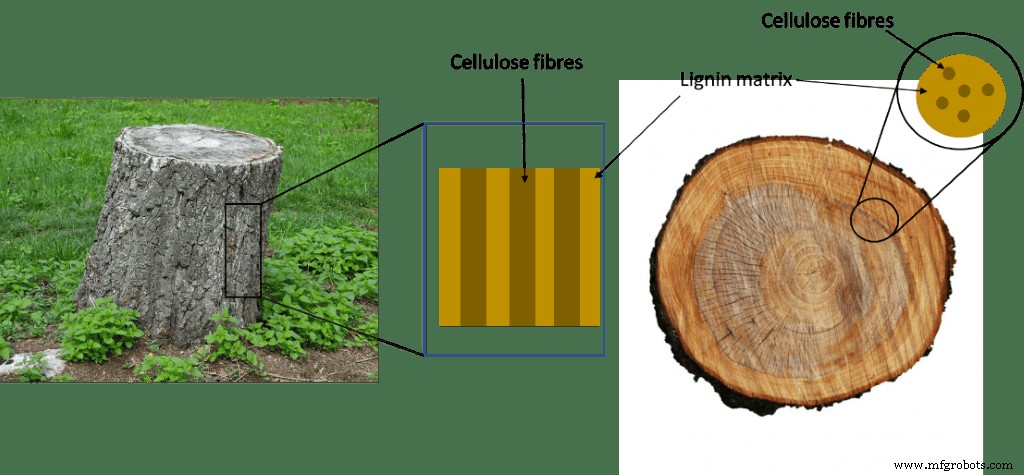
Figure 1: Basic microstructure of wood.
This article focuses on three examples that improve wood’s properties and expand its uses, namely densified wood, transparent wood, and nano-coating for wood. We will also explore wood as a source of high-quality carbon with an advantageous structure.
Densified wood
Wood is a widely used structural material due to its high specific modulus, high strength, low cost, and renewable nature [1]. However, wider usage today is impeded by the high variance in its properties [1]. This is due to the wide range of growing conditions a tree may undergo (e.g., soil type, availability of water and nutrients), leading to a difference in structures and variations in grain slop, ring width and prevalence of knots [1][2].
To overcome these natural variations, scientists and engineers have developed engineered wood products, including cross-laminated timber and glued laminated timber (glulam) [1]. These have greatly improved wood properties and have become environmentally viable alternatives to steel and concrete [2]. However, current engineered wood products require large amounts of adhesives and metals fasteners, which reduce their sustainability and recyclability, especially when certain adhesives are used as they emit toxic gases (e.g. Formaldehyde and Volatile Organic Compounds) [1].
As a result, research has focused on a variety of alternatives, and in particular, densified wood. This is where the density of wood is increased:
- Bulk densification: Throughout the volume of the wood [1] [2]
- Surface densification: Only on the surface layer of the wood [2]
- Infiltration densification: Throughout its volume via impregnation of voids using molten metals/sulphur or polymers [3]
This increased density leads to improved mechanical properties (Table 1) and expands the wood types that can be used, as low-density wood species can now be processed into viable structural materials [1]. All three of the methods hold promise.
| Species | Longitudinal tensile strength [MPa] | |
|---|---|---|
| Uncompressed | Compressed (80%) | |
| Oak (Quercus) | 115.3 | 584.3 |
| Poplar (Populus) | 55.6 | 431.5 |
| Western red cedar (Thuja plicata) | 46.5 | 550.1 |
| Eastern white pine (Pinus strobus) | 70.2 | 536.9 |
| Basswood (Tilia) | 52.0 | 587.0 |
One of the limiting factors for bulk densification is wood’s cell walls (lignin), which hinder densification and do not have a significant overall contribution to densified wood’s properties [3]. At the same time, there is ongoing research into decomposing wood down to the nanoscale and using the delignified nano cellulose material, which has excellent materials properties [3]. But research has struggled to scale-up/assemble this using 3D or 4D printing [3].
One partial solution is changing from a bottom-up approach to a top-down approach by fully delignifying and densifying wood. Effectively, this adds a preliminary step to the densification process and helps form a novel cellulose bulk material with improved mechanical properties compared to densified wood (elastic modulus ≈ 40 GPa and tensile strength ≈ 270 MPa) [3]. Also, it can be easily formed into complex shapes [3], opening applications further afield than structural applications and perhaps heralding a new type of fibre-reinforced biocomposites.
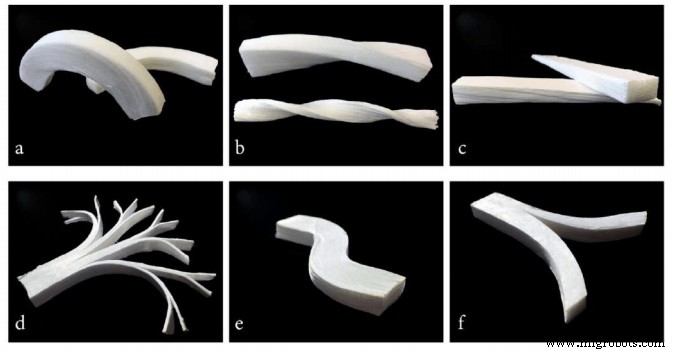
Figure 2: The cellulose bulk materials can be easily shaped into a variety of geometric forms. [3]
Transparent wood
As you may have noticed, the wood in figure 2 is near translucent. Well, it turns out that transparent wood is currently an area under investigation, and the first step in the process is delignification. This is followed by infiltration with a polymer with a matching refractive index, thus creating a near-transparent wood [4] with some residual scattering due to a few gaps that result from polymer shrinking during polymerisation [4]. Still, since polymer infiltration is a form of densification, this leads to strong and transparent wood. Polymer infiltration also reduces the anisotropic nature of wood by up to a factor of five [5]. This is due to the weak transverse direction of the wood being improved by the polymer, suppressing cell wall bending, the dominant failure mechanism in this direction [5].
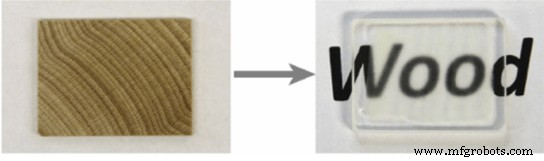
Figure 3: Before and after images of a wood sample that has undergone delignification and polymer infiltrations.[4]
Apart from being a fascinating material, it has a host of potential uses, including transparent roofs, windows and solar panel covers. Transparent roofs, sections, and windows can replace glass with their superior mechanical properties and thermal insulation. The high haze (measure of light scattering) value of transparent wood also means that it provides a softer, more diffuse light than traditional glass. This diffusion of light makes it also a very effective solar panel cover, increasing the path of light in the solar cell and allowing more time to extract energy leading to higher efficiency [4].
Nano-coating for wood
Here, we look at cases beyond altering wood’s properties, where coating it with nano-materials can help overcome some of the weakness of wood and improve its mechanical properties [6]. These weaknesses include flammability, photodegradation and water-absorption.
Nano-coating of wood can be done in two ways: nanoparticles are added to the coating to improve its properties prior to application, or nanoparticles are deposited directly onto the wood [6].
The second method has been used to reduce the flammability of wood via depositions of TiO2/ZnO particles. They are first mixed in a solution with ethanol, and then the solution-covered wood is sealed in an autoclave. This leads to the formation of nanoparticles with sizes ranging from 80-200 nm on the surface, increasing time to ignition fourfold [7].
Photodegradation is when absorbed UV radiation leads to photo-oxidation, resulting in surface discolouration and severe reduction in mechanical properties. Here, depositing a layer of ZnO generates a nanoparticle layer that reduces UV-induced ageing and the growth of fungal and microbial agents. This resistance to UV ageing is due to ZnO preferentially absorbing UV radiation and protecting the underlying wood [8]. When it comes to improving mechanical properties, nanosilica is used. Nanosilica particles possess high hardness and thermal properties. They can react when sol-gel reactions are used with polymers to form cross-linked network structures than can be applied on woods [6].
Carbonised wood composites/ceramics
This application uses arguably the oldest synthetic material, charcoal. Charcoal is carbonised cellular material produced under pyrolysis. It was used in the creation of cave drawings [9]. Nowadays, we still use charcoal for a variety of applications, including bio-templates for advanced ceramics and composites and barbecuing. Carbonising wood entails a two-step process [9].
- Step 1 is the decomposition of a bio-organic material (often wood but also natural fibres and paper) into a carbon template.
- Step 2 is converting the carbon template via either transformation or substitution into ceramic or composite structures.
Both methods require infiltrations of the carbon template by a chosen material as this is, by nature, a porous medium. The material should be either in a gaseous state, a liquid state, or in a nanoparticulate form [9].
Transformation involves mixing the carbon template with Si or Ti in different forms, including gas, molten or sol-gel [9][10]. Substitution is when a ceramic oxide is deposited on the template as sol-gel or nanoparticle and is then sintered [9][10].
Both of these pathways can generate either porous or dense materials with a microcellular morphology based on that of the initial wood [10]. This form of processing opens a host of design options as the composite’s geometry can now be altered easily by forming the wood template into the shape required – a far easier process than shaping or machining the end-product. There is also the option to tailor the morphology of the materials via the choice of wood for the template. For example, softwood gives monomodal pore distribution, while certain hardwoods give multimodal pore distribution [10].
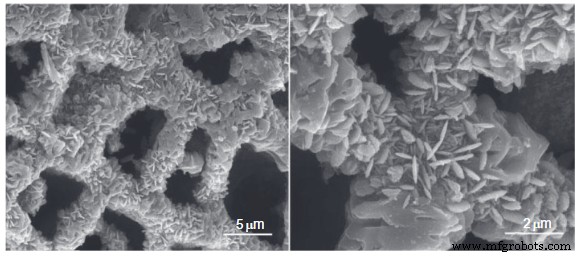
Figure 4: SEM image of TiC crystals that have formed on a carbonised wood substrate. [9]
These carbonised wood composites have yet to reach the mass market but are being considered for a host of applications, where their high porosity (filters, heat exchanger and catalyst support structures) and their formability (ceramics tubes and wear-resistant materials) could prove advantageous for many applications [9][10][11].
Carbon fibres from wood
Carbon fibres (CF) have an outstanding strength-to-weight ratio, which, when coupled with reinforced plastics, makes them extremely effective lightweight composites. However, due to their relatively high cost, they are restricted to mainly high-end applications, such as wind turbine blades, Formula 1 cars, and aerospace parts. They have yet to enter widespread use in automotive applications, the energy sector and construction [12], where their application could result in significant improvements in energy efficiency and reductions in CO2 emissions. For example, a 10% weight reduction in a car can improve fuel efficiency by around 7% [12].
CFs’ high cost is due to them being predominantly manufactured (>96%) using fossil-based polyacrylonitrile (PAN) [12][13], a relatively expensive material. It is processed into carbon fibres via solution spinning, a series of thermal treatments (200-350 ºC) and carbonisation (> 1000 ºC) [12]. To overcome this price issue, research has sought to find low-cost precursor materials, preferably from a renewable source, thus, avoiding the uses of fossil fuels.
Two materials have emerged as viable candidates, lignin and cellulose [12][13].
Lignin is used for its high carbon content, which enables a high yield of CF after conversion [12]. Cellulose is used for its beneficial molecular structure, which grants the ability to generate CF with equivalent mechanical properties to PAN CF [13]. Both of these materials, however, do suffer from issues, as lignin’s structural heterogeneity means the CF produced has inferior mechanical properties, and cellulose’s low carbon content means it has a low conversion yield (10-30%) [12][13].
As you can see, the disadvantage of one is the advantage of the other. Therefore, researchers combined both of these materials using 70:30 blends of softwood kraft lignin and kraft pulps (cellulose) [12], which was converted to filaments via dry-jet wet spinning and then CF via oxidation and carbonisation (1000 ºC) [13].
| Properties | Precursor materials | |||
|---|---|---|---|---|
| Standard and intermediate PAN [14][15] | Cellulose [12] | Lignin [12] | 70:30 lignin-cellulose blend [12] | |
| Tensile Modulus (GPa) | 200-400 | 500 > | 30-60 | 76 - 77 |
| Tensile Strength (MPa) | 4000 - 6000 | 2500 > | 400-550 | 1070 - 1170 |
| Yield (wt%) | 40-55 | 10-30 | 40-55 | 38-40 |
From table 2, we see this blend improves mechanical properties compared to lignin and improves yield compared to cellulose. Its mechanical properties and yield remain, however, lower than that of PAN CF. This is not a major barrier as the envisaged applications in energy, construction and automotive do not require a > 3GPa tensile strength offered by PAN-based CF. Therefore, the blend could adequately fulfil these requirements.
There are still a few issues before this enters mass manufacture, such as dynamic tension during manufacture and changing manufacture from batch to continuous. We are still years away from commercial-level production [13]. Nevertheless, the key to the mass market carbon fibre may be wood.
Conclusion
Hopefully, this article has shown that wood still has untapped potential as a structural/functional material and a base for processing into novel materials. This article covers a modicum of the current advances in the field, and any one of these topics deserves its own article, including hybrid timber materials or nanofillers for wood. To further emphasise the untapped potential of wood, there is active research by Kyoto University to send a wooden satellite to space. This is only the beginning in trying to reach the full potential of wood.
Industrial Technology
- Manufacturing Day: Evolution, Impact, and Industry Showcase
- Investment Casting Explained: History, Process, and Modern Techniques
- Mastering PWM in Arduino: Comprehensive Guide & Key Functions
- Smart Manufacturing: Definition, Benefits, and Implementation
- Underground Mining Explained: Methods, Applications, and Best Practices
- Graphene: The Ultra‑Strong, Ultra‑Conductive Carbon Layer Changing Technology
- S8050 Transistor Explained: Applications & Features
- Solder Mask Design: Proven Tips for PCB Reliability & Performance
- Anodizing Metals: A Professional Guide for Manufacturers
- Wood Varieties & Their Practical Uses: From Construction to Paper Production