



Understanding 3‑, 4‑, 5‑, and 6‑Axis CNC Machining: A Complete Guide
This is a 3 axis or a 5 axis CNC machine! You might have heard someone saying this. Ever wondered what is meant by 3, 4, or a 5 axis CNC machine?
Well, you have come to the right place, this is The Mechanical post and today we are going to discuss the different CNC machine axes.
You can download the PDF on Different CNC machine axes at the end of this article. This article is written by Peter Jacobs from CNCmasters.com These people are in business since 1990 so you know that you’re learning from the experts. More about the author at the end of the article.
Introduction
Milling is one of the most crucial techniques employed in CNC precision machining with applications ranging from mechanical components and medical to aerospace, optical, automobile, and more. Rotary cutters are employed in the milling process to remove material from a workpiece. This process gets executed by fixing the workpiece at an angle to the axis of the tool.
The axes of that milling machine dictate the type of job and the areas where it can be used on the workpiece. There are 3, 4, 5, and 6-axis machining, with unique characteristics, differences, and varying applications to suit different use cases.
Here is a brief overview of 3, 4, 5, and 6-axis CNC machines along with their definitions:
3-Axis Machining
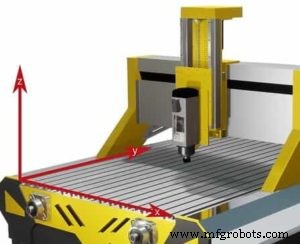
3-axis machining involves the workpiece remaining still with only the cutting tool traversing along the three axes to mill the part. 3-axis machines have applications in the case of machining 2D and 2.5D geometry.
Since 3-axis machining only operates on the three axes, the process becomes relatively simple and enables removing the material in these three axes described by back to front, side to side, and up and down.
The 3-axis milling has its limitations and thus cannot be used to design features on an angle to the X-Y-Z coordinate system, regardless of the feature being planar.
Applications of 3 axis CNC machine
The 3-axis machine is best suited for:
- Automatic/interactive operation
- Drilling holes
- Milling slots
- Cutting sharp edges
4-Axis Machining
The process involved in 4-axis milling is similar to the one involved in 3-axis machining, where a cutting tool removes material from a piece to construct the needed shape and profile. 4-axis machining is an economically viable process of machining components, which is theoretically possible on a 3-axis machine.
However, with 4-axes machining, milling is performed on an additional axis besides the 3-axis of rotation. A 4-axis CNC machine works on the X, Y, and Z axes, alongside yet another axis of rotation around the X-axis, referred to as the A-axis.
Mostly, the workpiece will get rotated to facilitate the cutting process around the A-axis. 4-axis milling is implemented when holes and cut-outs must be made around a cylinder or the side of a piece.
Applications of 4 axis CNC machine
4-axis machining is multifunctional and is considered optimal for:
- Engraving curved surfaces
- Intermittent cutting
- Continuous cutting
5-Axis Machining
5-axis machining covers all the axes of 4-axis machining alongside yet another rotational axis.
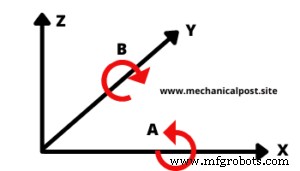
Apart from the 3 traditional axes i.e X, Y, and Z, there are 2 rotation axes called the A and B axis. This is how we get the 5 axes. 5-axis milling machines are competent enough to deliver precise and intricate components used for artificial bones, titanium pieces, aerospace products, car molds, oil and gas machine parts, architectural, medical, and military purposes.
This multidimensional rotation and tool movement facilitates an unprecedented precision, finish and speed on the B-axis during the construction of a piece.
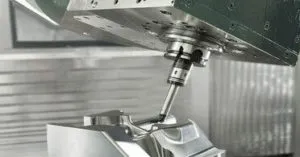
This machining technique can deliver intricate parts, which are critical for high-level such as including aerospace applications.
5-axis machining offers the option for single-step machining (reducing lead time), boosting the convenience of access to the part geometry, and enhancing the tool life and process efficiency by having the table tilted for the optimal cutting position.
5-axis machining is beneficial when a great degree of intricacy and precision is required.
Applications of 5 axis CNC machine
This process is ideal for:
- Feature accuracy
- Higher quality finishes
- Enhancing productivity
- Cutting intricacies in components
- Machining complicated shapes
You might also like to read
- G codes and M codes of CNC machine.
- What is water jet machining?
- Different types of screw threads
6-Axis Machining
The 6-axis machining process is similar to the 5-axis; however, it features an additional rotation axis about the Z-axis which can substantially boost speeds compared to 5-axis configurations.
A 6-axis machine has the potential of converting the raw metal bars into the final product by turning from both ends of the fixture with no flaws in the manufactured part. 6-axis milling is an efficient solution, primarily for the components that are intricate and demand unmatched precision.
6-axis CNC machines facilitate some arduous tasks such as drilling holes of various diameters and providing different speeds and cutting patterns. The final product quality delivered by a 6-axis machine is the best amongst all other CNC machines.
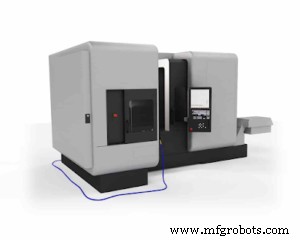
The 6-axis machines are typically utilized for volume machining of steel, cast iron, aluminum, and model-making materials.
This machine uses a specific 3-axis milling head to allow simultaneous 6-axis CNC machining, thereby cutting production times by a staggering 75%.
Applications of 6 axis CNC machine
This machining process is ideal for:
- Achieving the highest possible precision
- Fast and accurate speeds
- Reduced process time
- Manufacturing parts with the best level of intricacies
Difference Between 3, 4, 5, and 6-Axis CNC Machining
3, 4, 5-Axis Machining
The fundamental distinction between 3-axis, 4-axis, and 5-axis machining lies in the movement’s intricacy that both the cutting tool and the workpiece can move through, relative to each other. The greater the complexity of the motion between the two parts, the greater the complexity in the final product’s geometry.
The number of axes on a CNC machine measures the type of work that can be performed, the level of detailing in the final part, and the workpiece locations that can be manipulated.
The type of machine you should choose depends on your specific requirements, timeline, and budget. Aerospace parts demand unparalleled precision and thus, demands 5-axis machining. However, if you require a CNC machine to drill holes, a 3-axis machine should get the job done just fine.
6-Axis Machining
This machining process delivers the highest level of precision in minimal time, and thus, is reserved only for the most complicated processes in terms of designing and intricacies.
Here are some notable differences:
Blazing Speeds
The 6-axis CNC mill delivers high speeds without compromising accuracy. Besides the additional axis of freedom, specific tool movements accompanied by the tool’s transitions are more easily operable than any other machining process.
Multiple Operations in a Single Machine
6-axis milling machines let users carry out operations such as milling, facing, drilling, and turning on a single machine. The machine centers only need to modify the corresponding tool or the software control system for different operations.
Enhanced Productivity
6-axis machines deliver the best surface finishes and quick cutting rates. This process also renders a smoother motor performance and offers enhanced control, acceleration, and deceleration in S-curves. Check out this informative video by CNC Titans on different machining axes. (*not sponsored)
Final Words
CNC machining is operationally beneficial across several manufacturing-intensive industries, with some notable advantages being enhanced product quality control, standardization, and higher precision.
CNC machining employs CAD technology to automate the cutting and shaping of parts. The numbers of axes in a machine establish the type of movement achievable by that specific CNC machine.
About the Author: Peter Jacobs

Peter Jacobs is the Senior Director of Marketing at CNC Masters. He is actively involved in manufacturing processes and regularly contributes his insights for various blogs in CNC machining, 3D printing, rapid tooling, injection molding, metal casting, and manufacturing in general.
Industrial Technology
- Understanding CNC Machine Axes: Choosing the Right System for Your Manufacturing Needs
- What Is CNC Machining? A Historical Overview & Modern Capabilities
- Discover the Advantages of 5‑Axis CNC Machining
- CNC Machining Explained: Precision Manufacturing for Metal & Plastic Parts
- CNC Machining Explained: Precision Metal Fabrication
- 3-Axis vs. 5-Axis CNC Machining: Which Is Right for Your Project
- CNC Machining: Comparing 3‑Axis, 4‑Axis, and 5‑Axis Systems for Optimal Precision
- Understanding 5‑Axis CNC Machining: Advanced Precision for Complex Parts
- 5-Axis CNC Machining Explained: Precision and Efficiency for Complex Parts
- Discover Why CNC 5‑Axis Machines Are Revolutionizing Precision Machining