



Advanced Honing & Lapping Services for CNC Turned Parts
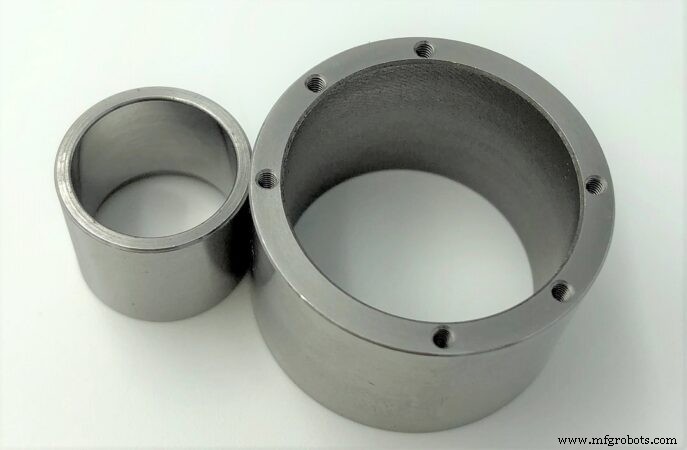
Approximately 30% of the components that Pioneer Service manufactures for our clients require grinding after the machining process. Standard grinding (both centerless and centered) produces a finer surface finish and/or more precise dimensions than can be achieved during the turning process on a CNC Swiss or CNC Turning Center.
Additionally, there are two types of specialty grinding services that are used for finishing ID (internal diameter), specific feature (tapers, slots, flats, holes), and extremely fine finish and tight tolerance requirements on an OD (outside diameter). These processes are honing and lapping.
What’s the difference between honing and lapping?
With standard grinding, a wheel with varying levels of grit (sharp particles) is rotated against the surface of the machined component. Material on the component is removed during the process to achieve a specified finish or dimension.
Honing and lapping are more like polishing processes than grinding processes. Much less material is removed during the process, but the surface of the component achieves an extremely fine finish or tight dimensional tolerance. They are often specified when the application requires a tight fit between mating parts, which is common in the aerospace and medical industries.
Photo: Item (1) shows an ID that has gone through a honing process for a polished finish. Item (2) shows a turned part with a standard finish on the ID.
Technically, lapping is performed on the outside diameter of a part. Honing is used when parts need finishing on a bore, a drilled hole or the ID of a tube. However, the terms are commonly used interchangeably which creates some confusion.
Do I need to use honing or lapping?
In the honing process, a stone (called a hone) with a specified grit level is rotated against the component with a controlled pressure and in a specific pattern. Lapping involves moving the component past stationary plates that have been treated with a grinding “paste.” Visually, lapping usually produces a matte finish and honing produces a mirror finish.
There are a variety of types of equipment used to achieve a honing and lapping requirements depending on the component features:
- Flat (to achieve a specified flatness and parallelism requirement)
- Cylindrical (for both ID and OD surfaces to achieve a specified size, straightness, roundness, concentricity and micro-finish)
- Taper (for ID and OD tapered surfaces)
- Holes and slots (both open ended and closed) can be honed to achieve a specified micro-finish
- Counter bore (to achieve a specified straightness or micro-finish)
- Dual surface (produces both a smooth and textured surface simultaneously (aka plateau honing)
Machines have automated many of these processes, but sometimes small quantity runs are completed by hand.
While Pioneer Service’s equipment is not set up for honing or lapping, we do have a series of stellar partners with which we can complete the job exceptionally. Have a project you’d like us to review or quote? Contact us!
Industrial Technology
- Precision Turned Parts: Advanced Heat Treatment for Optimal Strength and Performance
- Achieving Precise Surface Finishes on CNC Swiss Lathe Components
- Centerless Grinding for Precision Machined Components: Enhanced Surface Finish and Tolerance
- SNK America Prodigy GT-27 Lathe Enhances Precision with Polymer Base and Advanced C‑Axis Features
- Essential PCB Components & Their Applications: How They Drive Modern Electronics
- Market Trends in Aerospace and Precision Aircraft Components
- High-Precision Aircraft Components: Engines, Wings & More
- Precision Turned Components: Definition, Process, and Applications
- Precision Flat Lapping Services: Advanced Applications for Industrial Surface Finishing
- Honing vs. Lapping: Key Differences for Precision Metal Finishing