



Optimizing Solar Panel Wiring: Series-Parallel Configuration Guide
Series-Parallel Connection of Solar Panels to the Battery and Inverter
For small residential loads, the series-parallel combination of solar panels is less common (but possible) wiring connection to the batteries, AC and DC load through charge controller, battery and UPS/inverter. For different possible wiring systems, we may connect the solar panels and batteries in series, parallel or complex i.e. series-parallel connection according to our needs and designed system.
In this tutorial, we will show the basic wiring of photovoltaic panels in Series-Parallel connection to a single or multiple batteries, charge controller, AC and DC load via charge controller and an inverter.
- Related Post: How to Wire Batteries in Series-Parallel to a Solar Panel?
This arrangement is needed when we want to double the level of voltage (voltage is additive and current is same in series connection) as well as the charging current (current is additive and voltage is same in parallel connection) from solar panel to the batteries and other load points. In this case, we will have to connect multiple solar panels (photovoltaic array) in series parallel connection to the batteries and load points.
By connecting the photovoltaic panels in series-parallel configuration, we get benefits of both connections i.e. doubling the level of voltage and increasing the current rating from solar panels to the batteries and AC/DC load.
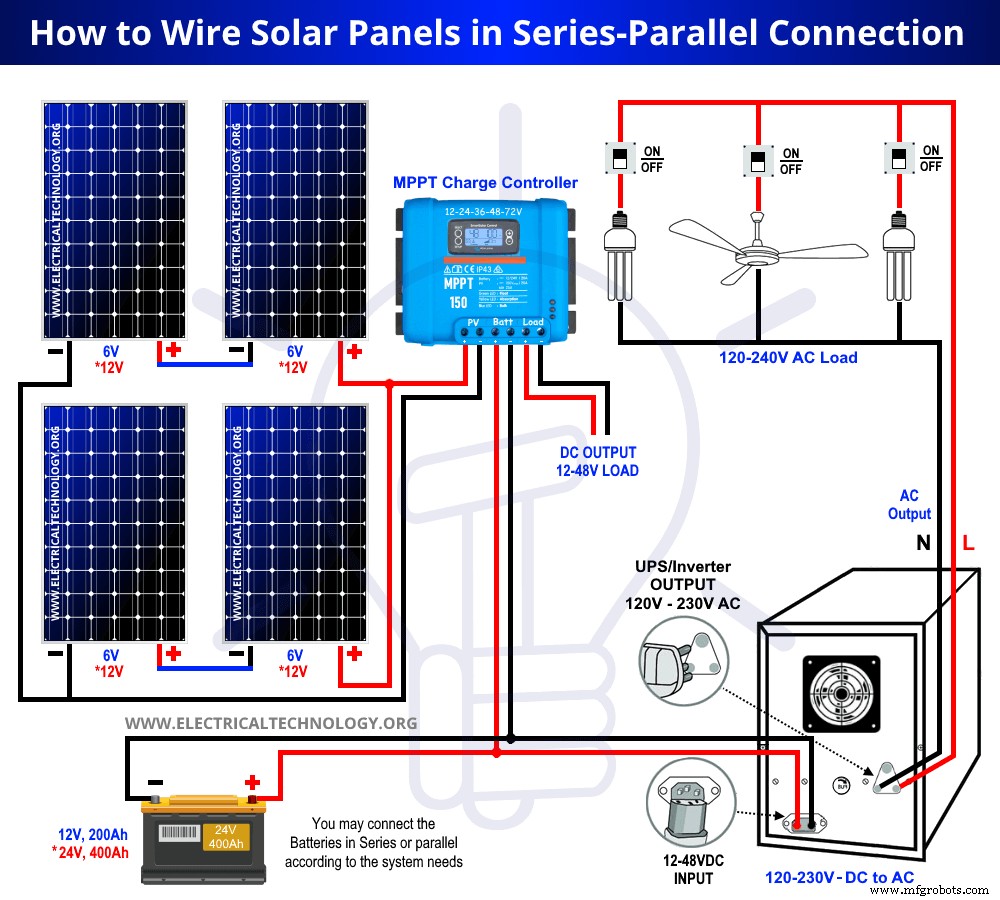
Voltage & Current in Series-Parallel Connected Solar Panels
Suppose we have 12V, 10A ,120W solar panels connected in series-parallel connection.
A set of two solar panels connected in series
Series Voltage:
V1 + V2 ….. + Vn
12V + 12V = 24V. … (Voltage is additive in series connection)
Series Current:
I1 = I2 ….. = In
10A = 10A = 10Ah … (Current is same in series connection).
Now, we have two sets of series connected solar panels. If we connect these two set in parallel:
Parallel Voltage:
V1 = V2 ….. = Vn
24V = 24V = 24V … (Voltage is same in parallel connection
Parallel Current:
I1 + I2 ….. + In
10A + 10A = 20A … (Current is additive in parallel connection).
Finally, we get 24V, 20A from four PV panels each of 12V and 10A i.e. we doubled both the voltage and current capacity of solar panels e.g. voltage from 12V to 24V and amperage from 10Ah to 200Ah by connecting PV panels in series-parallel configuration.
Wiring Photovoltaic Panels in Series-Parallel Connection
To do this wiring, make two sets (pairs) of PV panels and connect them in series. This way, you will have two pairs of solar panels connected in series. Now, connect the two sets of series connected solar panels in parallel as shown in the following fig. Now, you are having four 12V, 10A solar panels connected in series-parallel configuration.
As a next step, you can connect these solar panels to a charge controller. A basic DC load (12 or 24V) can be directly powered up by connecting it to the charge controller.
The AC load can be powered up in two ways. Firstly, it can be directly powered up by solar power during the normal sunshine (day). Secondly, the AC load (120V/230V AC) can be powered up by the stored power in the batteries using an inverter during shading (or night). Keep in mind that the number of solar panels and batteries depends on the load requirements where solar panels keep charging the batteries as well as power up the AC load.
The following solar panel and battery wiring diagram shows how to wire a four 12V Solar Panels in series-parallel connection to a 24V, 400Ah battery with an automatic inverter system. Note that the number of solar panels and batteries depends on the system’s design and load requirements i.e. multiple batteries and solar panels can be connected in series, parallel or series parallel connection to increase the Ah rating and storage capacity. (we have discussed them in previous post).
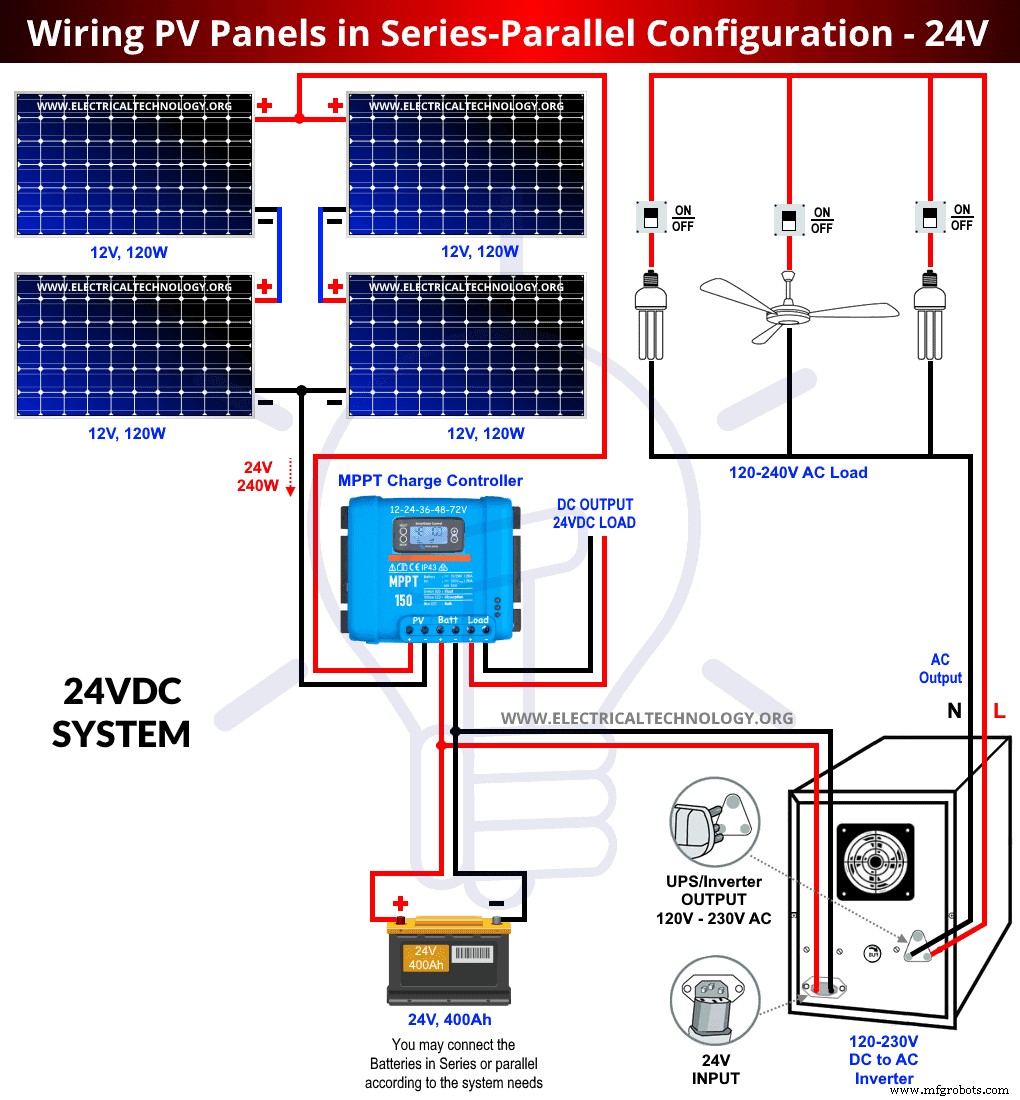
This wiring is fully automatic due to auto UPS wiring i.e. no need to install an auto or manual changeover / ATS switch to change between the solar power or battery storage power to the load points.
Good to know:
- Current is additive while voltage is the same in parallel connection.
- Current is the same while voltage is additive in series connection.
- Only the same rated solar panel can be connected in series, parallel or series parallel connection.
- A 12V solar panel can only be connected in (series, parallel or series-parallel) with another 12V solar panel.
- A 12V solar panel should not be connected (in series, parallel or series parallel) to a 6V or 24V solar panel.
Related Solar Panel Wiring & Installation Diagrams:
- How to Wire Solar Panel & Batteries in Series for 24V System?
- How to Wire Solar Panel & Batteries in Parallel for 12V System?
- How to Wire Solar Panels & Batteries in Series-Parallel Connection?
- How to Wire Solar Panels in Series & Batteries in Parallel? 12/24/48V System
- How to Wire Solar Panels in Parallel & Batteries in Series? 24V System
- Basic Components Needed for Solar Panel System Installation
- How Much Watts Solar Panel You Need for Home Appliances?
Industrial Technology
- Wire Two Switches in Parallel to Control a Single Light
- How to Wire Solar Panels in Series & Batteries in Parallel: 12/24/48V System Guide
- 24V Solar System Wiring: Parallel Panels & Series Batteries Guide
- How to Connect Solar Panels: Series, Parallel, and Series‑Parallel Configurations
- Connecting Batteries in Series-Parallel to a Solar Panel: A Step‑by‑Step Guide
- Step-by-Step Guide: Wiring Batteries in Parallel with Solar Panels & UPS for Reliable Power
- Step-by-Step Guide: Wiring Batteries in Series for Solar Panels and UPS Systems
- Step-by-Step Guide: Wiring a Solar Panel to a 12V DC Load and Battery
- Connecting a Solar Panel to 120‑230V AC Load via Inverter & UPS – Step‑by‑Step Guide
- Optimizing Solar Panel and Battery Wiring: Series-Parallel Configurations Explained