



Industry 4.0: Harnessing AI & Smart Tech to Transform Manufacturing
Since the dawn of the First Industrial Revolution in the 18th century, the manufacturing industry has striven to attain the highest quality and efficiency at the lowest speeds and cost. As we well know, the combination of these two goals often led to severe exploitation, as human laborers were expected to bear the brunt of the manufacturing process.
Today, we are on the precipice of a new age in industrial manufacturing, one which relies less on manual labor and more on highly skilled workers and sophisticated machines, software, and robots. You’ll likely have heard the terms ‘Fourth Industrial Revolution’ and ‘Industry 4.0’ thrown around, but the fact is, they are very real, and we are seeing how smart technologies such as artificial intelligence can truly transform production practices.
What is Industry 4.0?
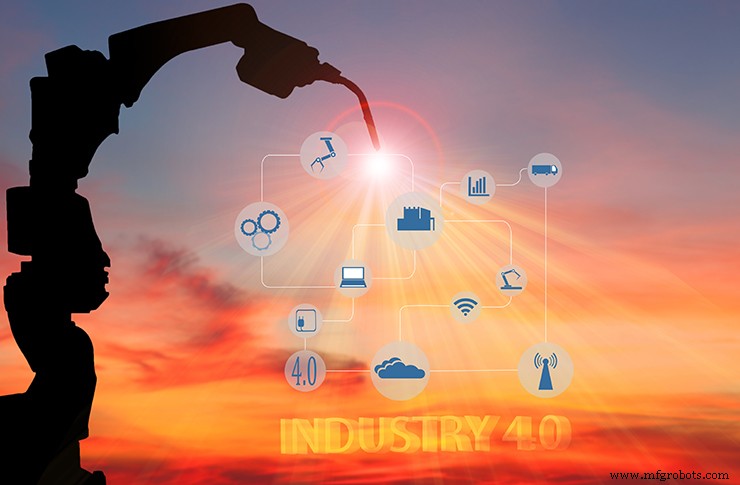
Before we dive into the ways cutting-edge technologies are shaping the manufacturing sector, let’s take a quick look at what ‘Industry 4.0’ actually refers to. In short, the term references a growing trend for smart factories, where manufacturers rely on increasingly intelligent machines—equipped with web connectivity, machine learning, and AI capabilities. The general idea is that industrial processes such as manufacturing will become increasingly autonomous and streamlined in terms of the production chain and maintenance.
Industry 4.0 is based on several technological breakthroughs and factors which, when combined, result in a highly efficient and intelligent process. The various technologies used in smart factories are automation, robotics, sensors and cameras, connectivity and artificial intelligence (AI), which can be seen as the brains of Industry 4.0.
Learning about Artificial Intelligence
Artificial intelligence, for its part, is a quickly evolving field in which machines are programmed to learn through experience and adapt to different situations and tasks accordingly. The technology, which is highly publicized for applications such as autonomous vehicles or Apple’s Siri, is driven by advanced algorithms and natural language processing.
In the manufacturing sphere, artificial intelligence offers several benefits—some of which are already being leveraged and many which have yet to be implemented. Integrating machine learning and pattern recognition technology on the factory floor can help to optimize several steps along the process chain, from production to quality control, maintenance and more.
Beneficial uses for AI in manufacturing
The manufacturing process comprises more than just the physical creation of parts and products, it also involves designing, production preparation, process monitoring, post-processing, quality inspection, machine maintenance, supply chain orchestration and more. In other words, there is a lot to think about and plan.
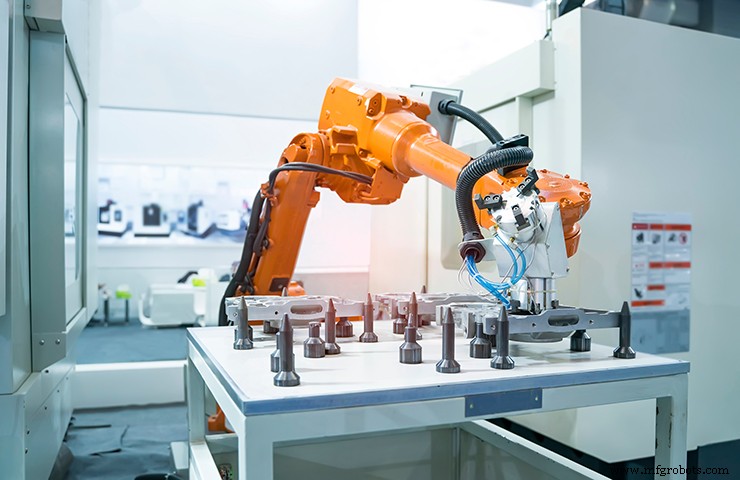
Understandably, manufacturing companies and services are incredibly interested in how smart technologies and processes can simplify, automate and in many cases improve each step in the manufacturing chain. While it would be exhaustive to consider all of the ways AI can be used to improve manufacturing practices, we’ll take a look at some of the key impacts machine learning is having and will have on the sector.
- Part design and construction AI is playing a role in innovative product design through generative design software, in which certain parameters and performance requirements—including material, load conditions, weight, and strength—are input and the software automatically generates the best design that meets the requirements. The AI-driven software does not have the same constraints as a human designer and can come up with wholly new and innovative design solutions.
Presently, most robotic production and assembly systems require extensive programming and coding to execute tasks. In the future, however, it will become increasingly common for robots to interpret CAD files directly and produce parts without the need for programming. In other words, AI will enable robots and machines to understand a CAD model and determine the best course of action for manufacturing it most efficiently.
- Quality inspection Manufacturing facilities and factories must integrate stringently quality check and inspection processes to ensure that parts being produced are up to the customer’s requirements. In industries such as aerospace or healthcare, quality checks, and certifications are of the utmost importance and must be thorough.
Today, inspection processes are dominated by either manual visual inspections or by heavily programmed visual inspection systems—both of which are time-consuming, complex and potentially error-prone. AI-powered inspection technologies, however, could facilitate a quality inspection by quickly and efficiently detecting imperfections or defects in manufactured parts. In some cases, the process could be completed in just seconds, dramatically speeding up the time-to-market.
- Machine maintenance Moreover, AI algorithms are finding important applications in machine and technology maintenance on the factory floor. That is, AI-powered software and sensors are being developed that can detect when a system or process is compromised. For instance, the technology could notify manufacturing teams if a 3D printing system was behaving differently or if a batch of raw material was inconsistent with qualifications.
The overall idea with AI in machine and process maintenance is that it becomes predictive, meaning that potential errors and problems can be detected early on and addressed before they occur, reducing the number of failed parts and upping productivity.
Artificial intelligence is also making it possible for manufacturers to collect vital information and data about their manufacturing systems, which can lead to improved machine usage and optimized product development.
- Supply chainsAI is not only influencing manufacturing on the factory floor but is also impacting management tasks, such as supply chains. There are many ways artificial intelligence can be used to improve supply chain management. For instance, the technology can be used to plan efficient routes for shipment and transport, it can forecast inventory supply and demand and it can even help companies select the best supplier for their needs.
Crucially, AI can optimize supply chains by predicting and forecasting market changes, taking into account such elements as locations, economics, consumer patterns and more. Intelligent quoting software, such as that offered by RapidDirect, can also drastically improve the manufacturing process, enabling customers to receive instant and accurate quotes.
Industrial Technology
- Smart Factories: Driving Innovation in Automotive and Food Production
- Smart Ports & Connected Containers: How IoT Technology is Revolutionizing Shipping Operations
- Automation's Transformative Role in Modern Manufacturing
- Industry 4.0: Key Skills for Smart Factory Workforce
- Revolutionizing Lean Manufacturing: How Industry 4.0 Drives Efficiency
- Industry 4.0 Unveiled: History, Benefits, and Key Technologies
- Smart Manufacturing: Definition, Benefits, and Implementation
- Industrial IoT & Smart Manufacturing: Transforming Plant Operations
- How Advanced Manufacturing Systems Propel the Textile Industry
- How Industry 4.0 Will Transform Manufacturing: Key Impacts & Opportunities