



Unlock Precision and Efficiency: 5 Essential Benefits of 5-Axis CNC Machining
Are you on the fence about 5-axis CNC machines? Dive into the details of our infographic to discover how and why they open up a whole new world of manufacturing options and time-saving opportunities.
The throughput and accuracy that is possible on 5-axis machines are difficult to argue against. For those shops looking for new, profitable areas of work, these powerhouse machines offer precision combined with speed—and enable success for many of today’s automotive, aerospace and medical-parts makers.
Do more machine axes automatically mean more parts will be built in less time? Not necessarily right out of the gate. Like anything that is new, expect a learning curve. Undoubtedly, there is more upfront simulation, testing and trial and error than you may be used to, so preparation and testing are key—as well as the need for machinists with strong programming aptitude and experience.
But with the right training and practice, it’s hard to deny the productivity of these machines. Case in point: Sirris Manufacturing was tasked to help cut hefty 10-week lead times in the automotive industry for gearbox parts. The time-to-market for new cars and trucks is expected to move to 36 months from 48 months. Sirris cut lead times roughly 2700 percent by using an “alternating milling strategy in which first the left flanks and then the right flanks were machined,” it notes in published research. But due to pitch errors, it had to use a more nuanced tool-wear strategy to produce a quality part.
Sirris found greater accuracy and efficiencies using techniques available with the flexibility of a 5-axis machine. “[A]ctive compensation of the tool wear is required, which was only possible using a 5-axis strategy combined with a straight endmill. Combined with a tool cleaning operation, measuring and compensating after every flank allowed for the fabrication of a ground quality gear in 24 hours, which implies that instead of 10 weeks lead time, now only a few days are sufficient.”
Here are the top reasons why 5-axis machines are so powerful.
Expand Expand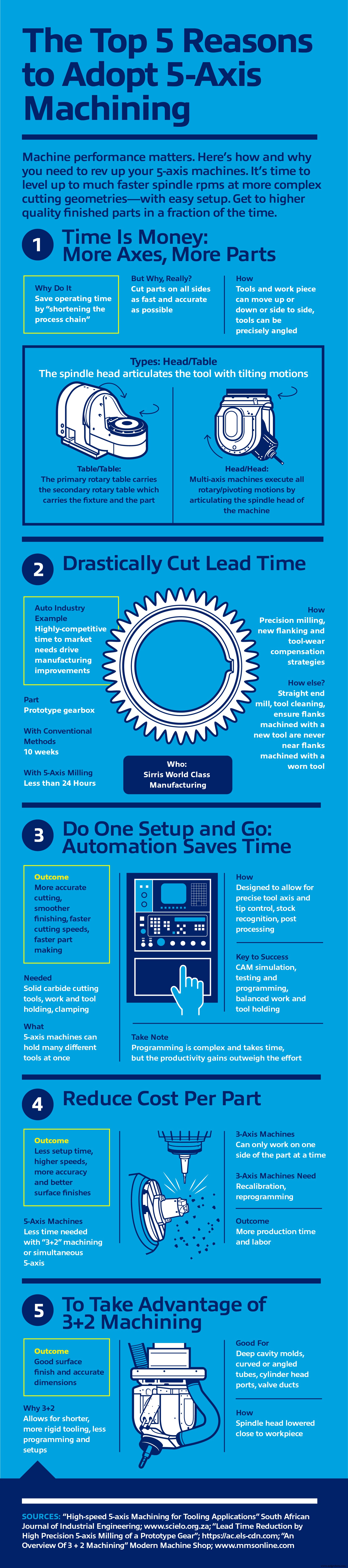
Spotlight on 5-Axis Machining
Here is a collection of the best articles on multiaxis-machine productivity and techniques, CAM/CAD systems and the future.
Optimize the Shop: Make the Move from 3-Axis to 5-Axis CNC Machining
What You Need to Know About Multiaxis CNC Machining
Learn How to Push Your 5-Axis Machine’s Output
Video: Pushing CNC Machine Speeds to the Limit
Overcoming the Top Technical Challenges in Metalworking
How to Maximize Throughput and Part Quality When Threading
How to Plan for and Invest in a New CAD/CAM System
Tooling Matters: Boost Productivity By Saving One Second of Cycle Time
Ask an Expert: Georgia Tech Professor on the Future of Machining
Industrial Technology
- Why a Vertical Machining Center Is Essential for Modern Metal Fabrication
- Leading Industrial Robot Suppliers in the UK – Your Guide to Cutting-Edge Automation
- Master 5-Axis CNC Machining: Comprehensive Guide & Industry Benefits
- 3‑Axis vs 5‑Axis Machining: What You Need to Know
- Why 3+2 Machining on 5‑Axis Machines Enhances Accuracy and Efficiency
- Why 5‑Axis Machining Is In Demand: Trends, Benefits, and Future Outlook
- Unlock Precision: Top Benefits of 5‑Axis CNC Machining
- 5-Axis CNC Machining: Unlocking Precision, Efficiency, and Design Freedom
- Top Benefits of Boring Machines for Precision Machining
- Master 5‑Axis CNC Machining: Expert Guide for Precision Manufacturing