



Selecting the Ideal Threading Insert for Reliable Metalwork
The production of thread connections is a common application in the metal working industry. Most metal working industries produce parts that are characterized by external or internal threads, from tiny dental screws to large thread joints for pipelines associated with the oil and gas industry.
There are a wide variety of thread types produced in National and International Thread Type Standards. Thread types differ in shape and dimension, where each standard defines a specific thread type. In many cases, a thread type standard characterizes a specific requirement for an industrial branch or main field of application. For example, UNJ and MJ thread type standards are associated with the Aerospace industry, and NPT and BSPT standards are associated with the oil and gas industry for pipelines, pipe connectors, and fittings.
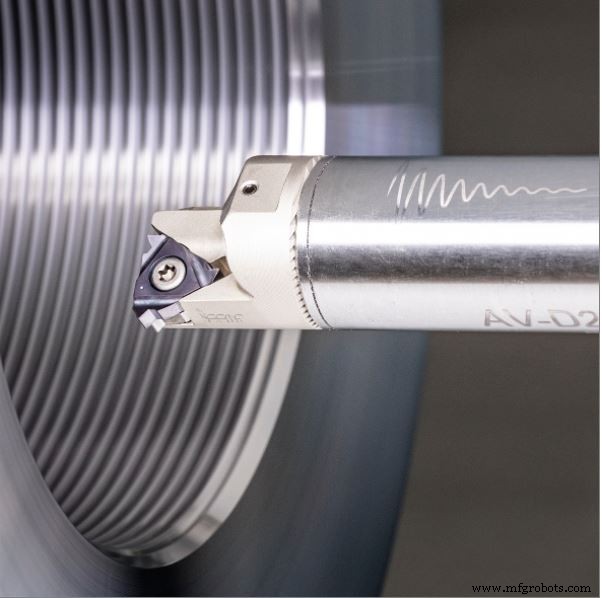
Thread turning applications are one of the most productive and common methods for producing threads in rotary workpieces.
Today's market of indexable cutting tools provides a wide variety of thread turning tools and inserts. The different geometries and clamping methods of the inserts are advantageous and must be chosen appropriately for each application.
A successful thread type turning application depends on the selection of the right threading tool. There are simple steps to selecting an indexable threading tool correctly; first, identify if the thread is external or internal for which to choose a right- or left-hand tool.
After choosing the feed direction corresponding to the thread type, the thread designation will be determined according to the part drawing and application.
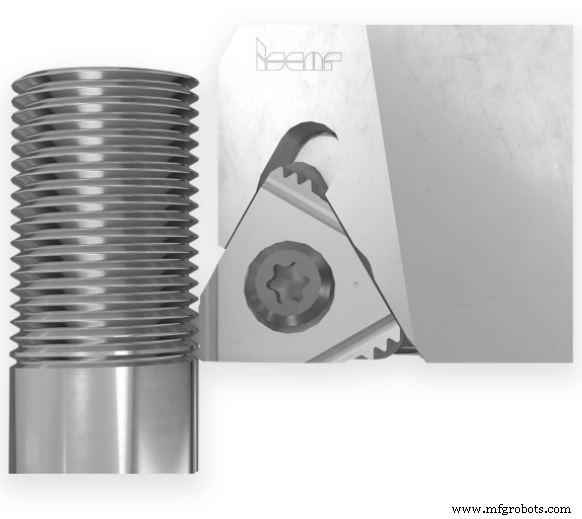
Typically, the thread designation is in accordance with metric or imperial systems depending on the thread type standard. In most cases, the thread designation includes the following parameters:
- Standard classification
- Thread pitch
- Number of starts
- Nominal diameter
- Thread length
- Tolerance class
The moment we have the values of the thread diameter, thread pitch, and the number of starts, we can calculate the thread lead (Helix) angle φ. This value will be very important for the next steps of the anvil selection if a possible solution relates to lay-down inserts. For such a tool, the found lead (Helix) angle determines the choice of anvils.
Aside from setting the correct lead (helix) angle, the anvil also supports the insert’s cutting edge and protects the tool in case of insert breakage.
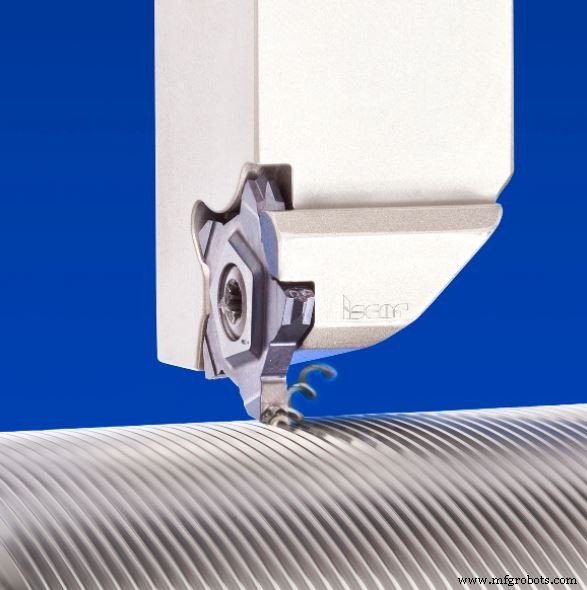
There are two types of threading inserts: full profile and partial profile. Full profile inserts produce specific thread types, i.e., round (Rd) in accordance with DIN 405, British Standard Whitworth (BSW). Partial profile inserts require a precise pre-turning operation.
ISCAR’s laydown family of inserts offers a wide range of thread type standards for both internal and external applications. Laydown inserts can be divided into 3 main types:
- G-type – General-duty inserts with deflector for machining various engineering materials, including the production of short chips.
- M-type – Press-to-size inserts with sintered-shaped chipbreaker for efficient chip control. Although these inserts are press-to-size, they ensure the same thread accuracy as the G-type insert. When threading at too small depths of cut, the chipbreaker efficiency drops and the M-type inserts are less recommended.
- B-type – Peripherally ground inserts with a pressed chipbreaker. Efficient chip control with a sharp cutting edge is the ultimate combination for long chip materials and the first choice for ISO M stainless steel. When machining small parts, it is beneficial to use sharp-edged inserts with a chipbreaker to reduce cutting forces and consequently prevent vibrations.
One of the most common goals of the tool user is to improve productivity. Therefore, in addition to the three main insert types mentioned above, and the G-type subfamily, a multi-tooth insert was created. The main purpose of the multi-tooth insert is to increase productivity by reducing the cycle time. The multi-tooth insert is equipped with two or three teeth, while each tooth has a different role. Before using the multi tooth insert, it’s important to ensure the thread area is not next to the shoulder, or that there’s a wide release groove to complete a full thread along the part. In addition to the ISO Standard laydown insert, ISCAR has a diverse group of captive pocket inserts. Captive pocket inserts are divided into internal threading and external threading types according to their application. Contrary to the ISO Standard laydown insert family, the clearance angles are already ground.
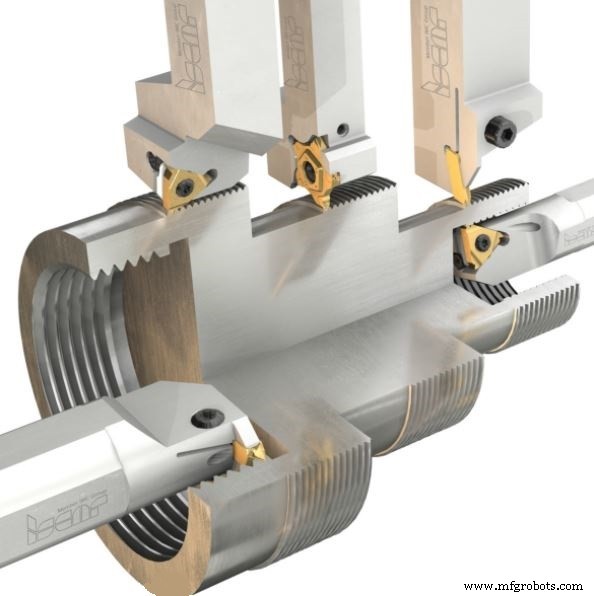
PENTACUT is one of ISCAR’s successful captive pocket insert families. PENTACUT threading inserts have a wide assortment of benefits:
- 5 cutting edges and a cost-effective solution.
- Equipped with a molded chipbreaker for efficient chip control.
- Strong design for better conditions and productivity.
- Sub-family of partial profile inserts specially designed for working close to the shoulder with diverted cutting edges.
- For right- and left-hand threading.
- Ability to machine between walls.
Ensuring the right carbide grade for the application is an important step. The grade selection has a direct proportion with the part material, machining stability, and application attributes. Grade recommendations can be found in the ISCAR catalog. Remember, picking the right grade can significantly increase the tool life of the insert.
ISCAR's wide diversity of inserts covers most of the market’s demand for threading standards. With advanced solutions per specific applications, ISCAR can offer tailor-made solutions according to any customer request.
ISCAR’s vast experience with threading applications has brought about tremendous results in the metal working industry.
Previously Featured on ISCAR's Latest Articles.
Industrial Technology
- Choosing the Right Freight Carrier: A Strategic Guide for Large and Small Shippers
- Top Factors to Evaluate When Selecting Reliable CNC Machining Services
- MIG vs TIG Welding: The Definitive Guide to Choosing the Best Method
- Choosing the Best CNC Machining Service in China: A Practical Guide
- 5 Essential Tips for Selecting the Ideal Order Management System
- Choosing the Right Materials: Essential Steel Facts
- Choosing the Right LED Power Supply: A Comprehensive Guide
- Choosing the Right Laser Cutting System for Maximum ROI and Precision
- Choosing the Right Press: Expert Guide to Mechanical, Hydraulic, and Servo Options
- How to Select the Ideal Robot Design for Your Application