



Career Spotlight: Path to Becoming a CNC Programmer
The role of CNC programmer is central to most modern machine shops. Read on to discover the job responsibilities, training and education required to enter this field and create a career path to success.
With manufacturers facing a skills gap problem that could result in millions of unfilled jobs over the next several years, attracting and retaining skilled talent is crucial.
According to the National Association of Manufacturers, 4 million manufacturing jobs will likely be needed over the next decade, and 2.1 million could go unfilled if we do not inspire more people to pursue modern manufacturing careers.
This means that, in the years ahead, there will be a stronger demand for workers who can perform the specialized metalworking and machining tasks that are in demand at modern machine shops, which includes the role of CNC programmer.
But how do you become a CNC programmer, and what qualifications do you need? And how much does a CNC programmer typically earn? Here’s what you need to know about joining this potentially rewarding field.
What Does a CNC Programmer Do?
Manufacturers use computer numerically controlled (CNC) programming to tell CNC machines how to cut and fashion parts.
A CNC programmer will typically determine the sequence of actions needed to make a part, and then write the programming instructions for the computing module that is used to run the CNC machines.
The programmer’s calculations will consider the material used and the best approach for the cutting tools, plotting out each step for cutting the materials to fashion components used in a variety of items, from washing machines to aircraft.
Depending on the shop, CNC programming may be performed by CNC programmers, or by machine operators.
Aside from programming the CNC machine, these professionals may also be responsible for reading and interpreting design blueprints and adjusting existing software and codes to make improvements to the produced parts. They may also maintain part quality and safety standards, and maintain CNC equipment, or intervene if any adjustments need to be made to the CNC cutting program.
CNC Programmer Job Salary: How Much Can You Earn?
The earnings potential for a CNC programmer depends on his or her years of experience.
A CNC machine programmer working in the United States who is at the most senior levels of the field, with more than seven years of experience, can expect to make a base salary of $107,000, on average, according to Salary.com, with the range typically falling between $84,700 and $115,000.
The inclusion of a bonus or another type of special payment raises the median base salary for this position to $108,800, with the range falling between $86,100 and $116,200.

The salary range can vary widely depending on many other important factors, including geographical location, education, number and level of certifications, or additional skills, and the number of years a programmer has spent in your profession, says Salary.com. And CNC programmers working on producing complex parts, such as those made for the aerospace and advanced medical parts industries, can usually expect above-average pay.
At the lower end of the field, a CNC machine programmer with up to two years of experience would make, on average, $54,500 as of September 27, 2021, with the range typically falling between $48,000 and $65,100.
A person in this role would typically be fairly junior and be responsible for the basic upkeep and corrections to programs, reporting to a supervisor or manager and working on projects of limited complexity and in a support role.
With the inclusion of a bonus, the median base salary for this position rises to $55,100, with the range falling between $48,400 and $66,500, as the chart below shows.

What Are the Recommended Training, Education and Certifications?
If you’re interested in becoming a CNC programmer, you’ll likely require a high school diploma or a GED equivalent.
You’ll also likely need to demonstrate some form of technical training, particularly in CNC skills, which may be acquired through specific training programs or university classes and can help you advance in your career.
Some companies may offer to train their employees. If your employer does not offer such training, or if you are looking to earn the appropriate certifications on your own, there are several ways to acquire training and credentialing, according to the website Learn.org.
For example, while some CNC programming professionals complete apprenticeships that include both classroom and shop training, others may pursue a certificate or an associate degree in CNC operation and programming.
A bachelor’s degree in engineering is preferred for some specialized programming positions.
Another option is to major in machine tool technology, which exposes you to working with CNC tools. Or you may earn qualifications in metalworking and related technical skills at various colleges and training facilities around the nation that meet the standards set out by the National Institute for Metalworking Skills (NIMS).
By earning these credentials, an individual can “secure a competitive edge when applying for jobs because they have demonstrated that their skills meet the industry-established standards,” says NIMS.
Where Are CNC Programming Skills in Greatest Demand?
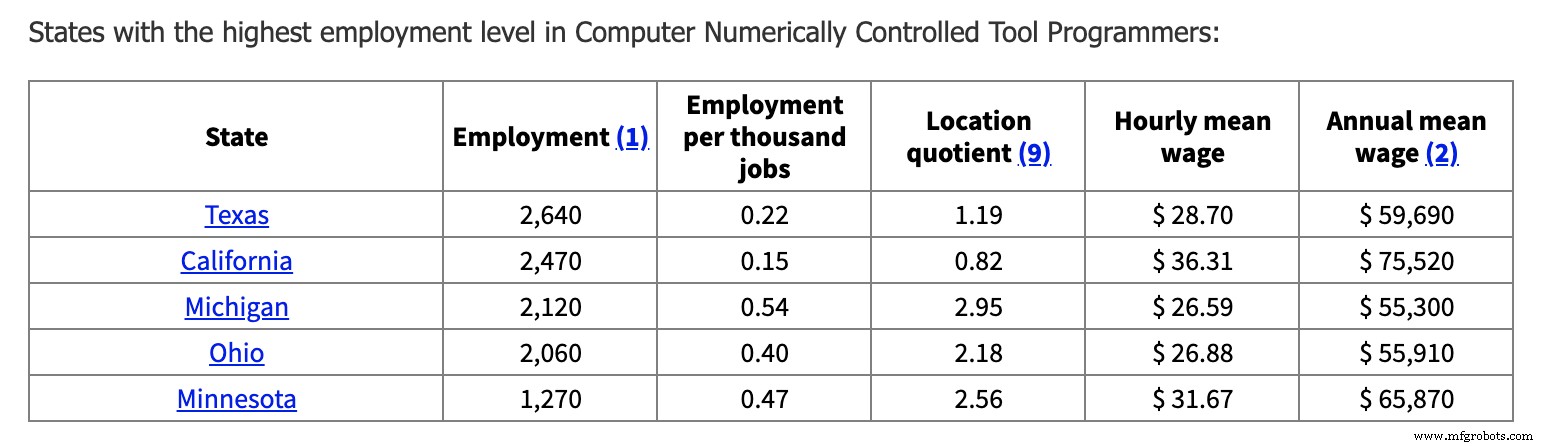
If you’re considering a career as a CNC programmer, it’s worth knowing which regions of the U.S. have the highest employment levels for these positions.
According to data from the U.S. Bureau of Labor Statistics (BLS), as of March 31, 2021, Texas has the highest employment level for CNC tool programmers, followed by California and Michigan. See the table below for more information.
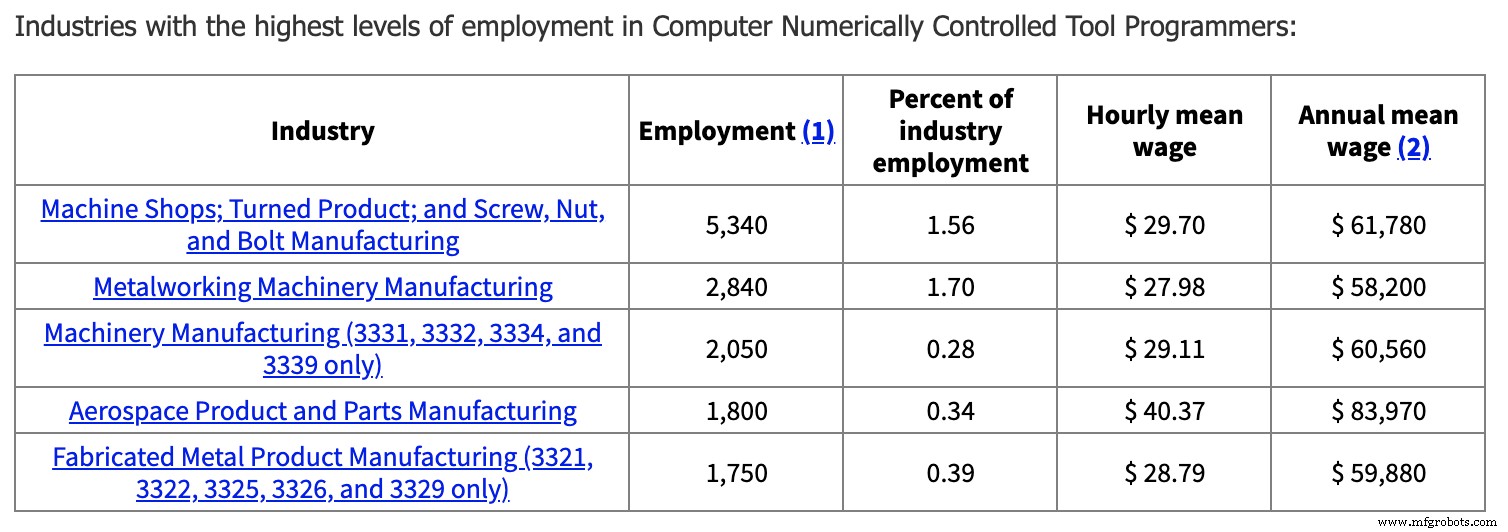
CNC machining plays an important role in a variety of industries, with the most prominent ones being machine shops, metalworking and machinery manufacturing, and aerospace parts manufacturing, according to the most recent BLS data.
Other important industries that use CNC machining include:
- Medical, where CNC machines are used to create specialized parts and medical devices, such as implants, and to strict regulatory requirements.
- Automotive, where CNC machines make engine parts and other automotive components.
- Defense, where manufacturers follow specific government regulations to make products such as weapons and aircraft components.
- Aerospace, where the production process for parts must meet strict regulatory requirements to produce parts such as engine components for aircraft, or landing gear parts.
CNC machining is used for cutting, milling and drilling almost any material in many more industries, including oil and gas, electronics, power generation and many other manufacturing sectors.
Are you considering a career as a CNC programmer? What questions do you have about the field, and what are your experiences in the manufacturing sector? Share your questions, thoughts and insights in the comments below.
DO YOU HAVE WHAT IT TAKES TO BECOME A CNC PROGRAMMER?
The role of CNC programmer is central to most modern machine shops, and it’s a skill in high demand.
Those entering the field should be capable of fulfilling some of the basic requirements of the job.
Take our poll to see how you compare with others considering this career.
Which of these job requirements best match your skills and competencies?
Industrial Technology
- How to Become a Digital Champion in Manufacturing: A Practical Guide
- How to Become a CNC Machinist: Training, Skills, and Career Path
- Become a Machinist in Quebec: Path to a High-Demand Career
- CNC Machinist Career Guide: Skills, Education & Industry Outlook
- Expert Guide to Maintaining CNC Machine Tools for Peak Performance
- Expert Guide to Repairing CNC Machine Tools
- Master CNC Machining: Proven Strategies to Become a Skilled CNC Programmer
- Cut CNC Machining Costs: Proven Strategies for Affordable Precision
- Understanding CNC Programmers: Roles, Responsibilities, and Impact on Modern Manufacturing
- Master CNC Programming: A Beginner’s Guide to Fanuc Controls