



Understanding IUID: A Guide to the DoD's Item Unique Identification Program
With resources dispersed around the globe, asset management is an important function for the military and defense industry. In addition to large assets like planes, weapons, and heavy equipment, there are also many smaller instruments and parts that must be kept organized and properly stocked. Over time, it became necessary to develop a unified way of monitoring high-value equipment and items, especially those that could be dangerous in the wrong hands.
The Item Unique Identification (IUID) program, also referred to as Unique Identification (UID), was created by the U.S. Department of Defense (DoD) in 2004 as a means to create a reliable tracking system for important assets. Each item is assigned a unique code that is captured on an attached asset tag or label and the item’s associated data stored in a centralized database. This system allows military personnel to access records, perform maintenance, and transfer assets in a way that avoids any confusion about the location or usage history of a specific item.
Because it is a complex system, there can be some confusion and misconceptions about how the UIUD program is managed and what the requirements are for any vendor or supplier that works with the U.S. government, as well as those that manufacture parts or supplies used by government entities. This post will provide an overview of the basic program definitions, what the marking requirements are, and how the UIUD registry can be used.
What Does IUID Stand For?
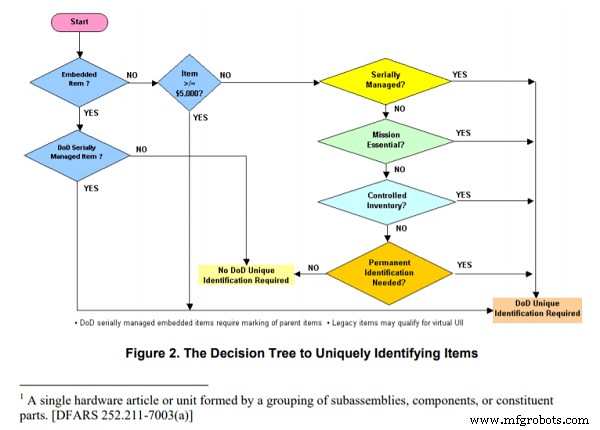
Screenshot via Office of the Under Secretary of Defense for Acquisition & Sustainment
The terms IUID and UID can be used interchangeably to describe the DoD system for using unique and ambiguous identifiers for an item to distinguish it from other similar or different entities and relationships. Each sequence of numbers or characters assigned to an item is called a unique identifier (IU) or a Unique Item Identifier (UII). When discussing an item in this program, it is referring to a single piece of hardware or a unit that is formed by a grouping of components or parts.
In simple terms, all items with a cost over $5,000 or that have a special designation are required to have a UI assigned to them. The detailed regulations for the IUID program are supported by a large series of documents. A few of the most important UIUD reference materials have been compiled by the U.S. Navy, including:
- DFARS 211.274 – Item Unique Identification and Valuation Requirements
- DFARS 252.211-7003 – Item Unique Identification and Valuation
- DODI 8320.04 – Item Unique Identification (IUID) Standards for Tangible Personal Property
- SECNAVINST 4440.34 – Implementation of Item Unique Identification within the Department of the Navy
- MIL-STD 130 – Department of Defense Standard Practice Identification Marking of U.S. Military Property
The majority of the specification and marking requirements that pertain to IUID labels are contained in MIL-STD-130, and you can also find additional barcode requirements in MIL-STD-129. Browsing through these documents will give you a good overview of how the various components of the program intersect.
What Does an IUID Number Look Like?
An IUID number, or code, is composed of an alphanumeric series of characters and is always accompanied by a 2D data matrix barcode when applied to the item. There are three primary ways in which the UII sequences are determined.
- Serialization with the Enterprise Identifier. This form of a UII is a combination of the issuing agency code (IAC), enterprise identifier (EID), and the serial number for the item. They are joined, in that order, to construct a UII and are mostly used for items that already have an EID assigned to it.
- Serialization within the Original Part, Lot, or Batch Number. The format for this style of UII combines the IAC, EID, original part number, and serial number. It is similar to the previous format but used for items that also have a relevant and obvious part number that can be used.
- IUID Equivalents. If an existing commercial identifier meets certain requirements, it can be adopted into the UII for the item. One example of an acceptable identifier code format for this situation is Vehicle Identification Numbers (VIN). The format for this constructed IUID number is the IAC followed by the EID and individual commercial code.
What are the IUID Marking Requirements?
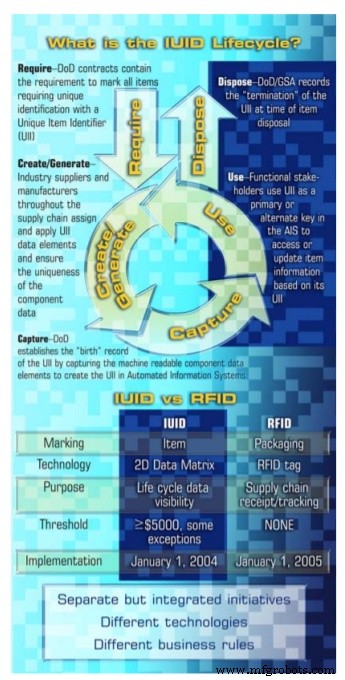
Screenshot via Office of the Under Secretary of Defense for Acquisition & Sustainment
While it is necessary to consult the most recent regulations to understand the exact marking requirements, we’ll outline a few of the basic parameters here. The primary marketing requirements include:
- Proper placement of the IUID mark
- Ensuring the mark is readable and legible
- The proper cell size for the 2D data matrix barcode symbol
- The proper image contrast that the mark should have
- The clear space that should be reserved for a quiet zone around the barcode
In addition to these details for designing a proper IUID mark, there are also suggestions for protecting the mark, minimizing attachment failures, and how to ensure an adequate production quality when fabricating the mark.
What is the IUID Registry?
The IUID Registry is a centralized database of all pertinent IUID information that is housed within the military’s Wide Area Workflow (WAWF) e-Business suite. Government employees and supporting contractors can apply for a Common Access Card (CAC) for access to the system. Useful data provided for each item includes the UII, initial value, chain of custody, and an explanation for how it is currently marked.
The IUID program is an important consideration for any defense contractors working within the industry. Knowing about this system can add value to an organization beyond simply ensuring compliance. This is a robust system that implements standard requirements to ensure high-quality IUID labels that can be used to reliably track assets located anywhere.
Industrial Technology
- Hydraulic Systems Explained: Fundamentals and Real-World Applications
- Understanding the FDA’s Final Rule on Unique Device Identification (UDI)
- 12 Common Misconceptions About Implementing Item Unique Identification (IUID)
- DoD IUID Registry Update: Submit Item Data via iRAPT
- U.S. DoD Reaffirms Ongoing Commitment to Item Unique Identification (IUID)
- DoD Reaffirms Commitment to Item Unique Identification Standards
- Understanding Unique Identification (UID): Purpose, Implementation, and Benefits
- TPU Filament Explained: A Comprehensive Guide to 3D Printing's Flexible Material
- Key Benefits of Lightweight Metals: Boost Performance & Efficiency
- Essential Guide to Solenoid Wiring: Best Practices & Tips