



Essential Secondary Containment Rules: 3 Key Strategies to Control Workplace Leaks and Spills
Secondary containment helps to prevent harm by containing hazardous material spills. But do you understand the required regulations and how to provide adequate spill control for your containers and equipment? Here’s what you need to know.
Imagine this scenario: The primary container you use to stockpile the metalworking fluids that keep your machining equipment running smoothly (and prevent debris from building up) is leaking. The fluid is in danger of running out into the public sewer system, potentially contaminating the surrounding water table.
Thankfully, the primary container sits within another container, and what could have been a harmful fluid leak has been contained, and your metalworking fluids will not pollute the environment or cause unnecessary harm to others.
This scenario is not uncommon. Any workplace that uses chemicals, oil or other potentially damaging liquids faces the potential for a spill. These events can occur when a product leaks or pours from its primary container, which could be anything from a large drum to a small bottle.
Indeed, a company’s hazardous materials and waste, including petroleum-based products, should be stored in a way that, if a container leaks or ruptures, the spilled contents will not contaminate ground or surface water.
Secondary spill containers help mitigate the potential damage from these events, which can have a damaging effect on workers or the local environment. They use protective coatings and linings that provide a barrier between vats, tanks or vessels that contain potentially hazardous chemicals, keeping the outside world safe from their contents.
Secondary containment requirements are tied to the specific guidelines offered by the Environmental Protection Agency (EPA) and the Occupational Safety and Health Administration (OSHA).
Neither organization defines what a secondary containment system should look like. Instead, they offer guidelines on the spill volume that a company should be able to contain, given that one facility will have different scenarios and needs than another.
Although not all companies are required to do so, prudent ones who use and store potentially damaging liquids should consider drawing up a Spill Prevention, Control, and Countermeasure (SPCC) Plan, as recommended by the EPA. Safety managers should also update the plan at least every three to five years, or when a major change takes place at the facility, suggests UltraTech, a manufacturer of spill containment, stormwater management, facility protection and construction compliance products.
Here are three more recommendations from UltraTech about smart secondary containment:
No. 1: Understand Secondary Containment Requirements
 It’s important to understand secondary containment requirements.
The potential for adversely affecting human health and the environment is always present when working with or storing chemicals. To ensure the safety of everyone and everything around your facility, it’s important to understand secondary containment requirements.
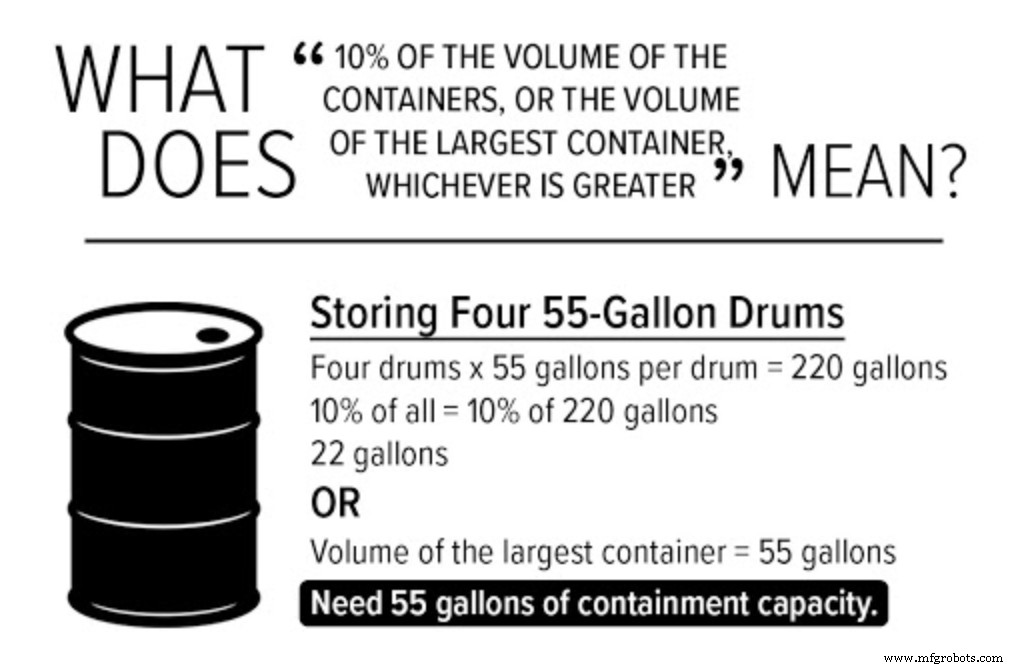
Federal law states that all secondary containment systems must have sufficient capacity to contain at least 10 percent of the total volume of the primary container or 100 percent of the volume of the largest container—whichever is greater. Individual states and municipalities may have even stricter regulations, but those requirements can’t be less stringent than the federal law.
As UltraTech notes in the graphic above, if you are storing four 55-gallon containers of a fluid, the capacity of your secondary containment system must be at least 55 gallons. Why? Because 10 percent of the total (22 gallons) is much less than 100 percent of the largest container, which holds 55 gallons.
No. 2: Best Uses for Spill Pallets and Spill Decks
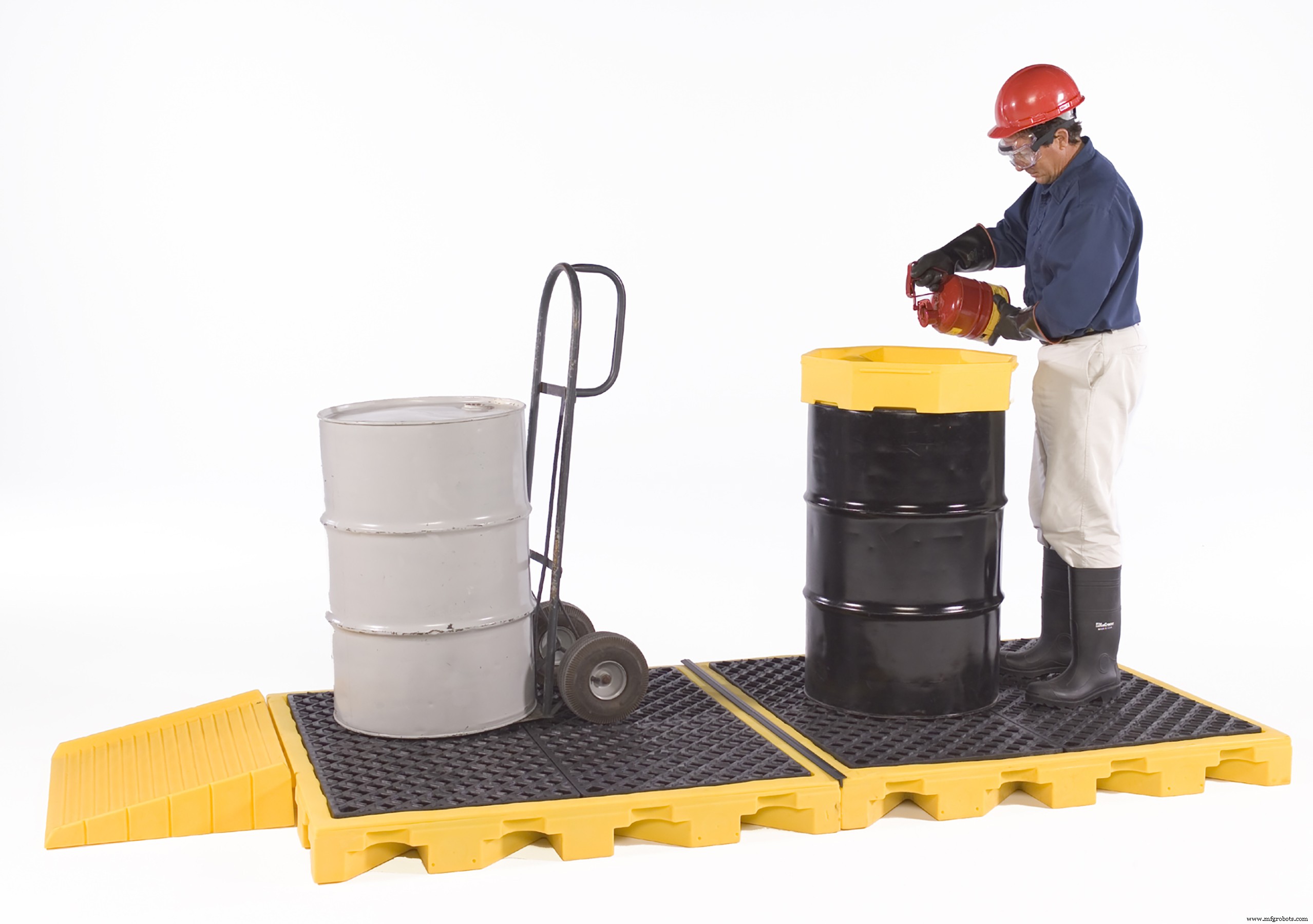 Drums can be loaded and safely stored on spill pallets until needed.
These products are among the most common types of secondary containment equipment available.
Spill pallets include sump capacity—usually, the capacity required by law or a bit more—either built into the deck itself or using an auto-expanding bladder system.
Typically, these spill containment products can hold between one and four 30-to-55-gallon drums, or one or more IBC tanks. Some may even be fitted together to create a greater amount of spill containment capacity.
They are usually made from polyethylene, so they are compatible with a wide range of chemicals, while fluorinated polyethylene pallets can withstand chlorinated solvents. Steel spill pallets are best used for flammable liquids because they can withstand higher temperatures.
When storing chemicals outside, the best option is to use hardtop spill pallets. They make accessing the IBC tanks or drums inside easier, given that hardtop spill pallets have doors on the front and back, and ramps are often used to make loading and unloading the drums and tanks easier.
When considering storage approaches, remember that IBC spill pallets position the tank higher, meaning that an IBC can be retrieved more easily than a drum given that liquids are dispensed at the bottom of an IBC instead of at the top of a typical 30- or 55-gallon drum.
No. 3: Secondary Containment for Special Circumstances
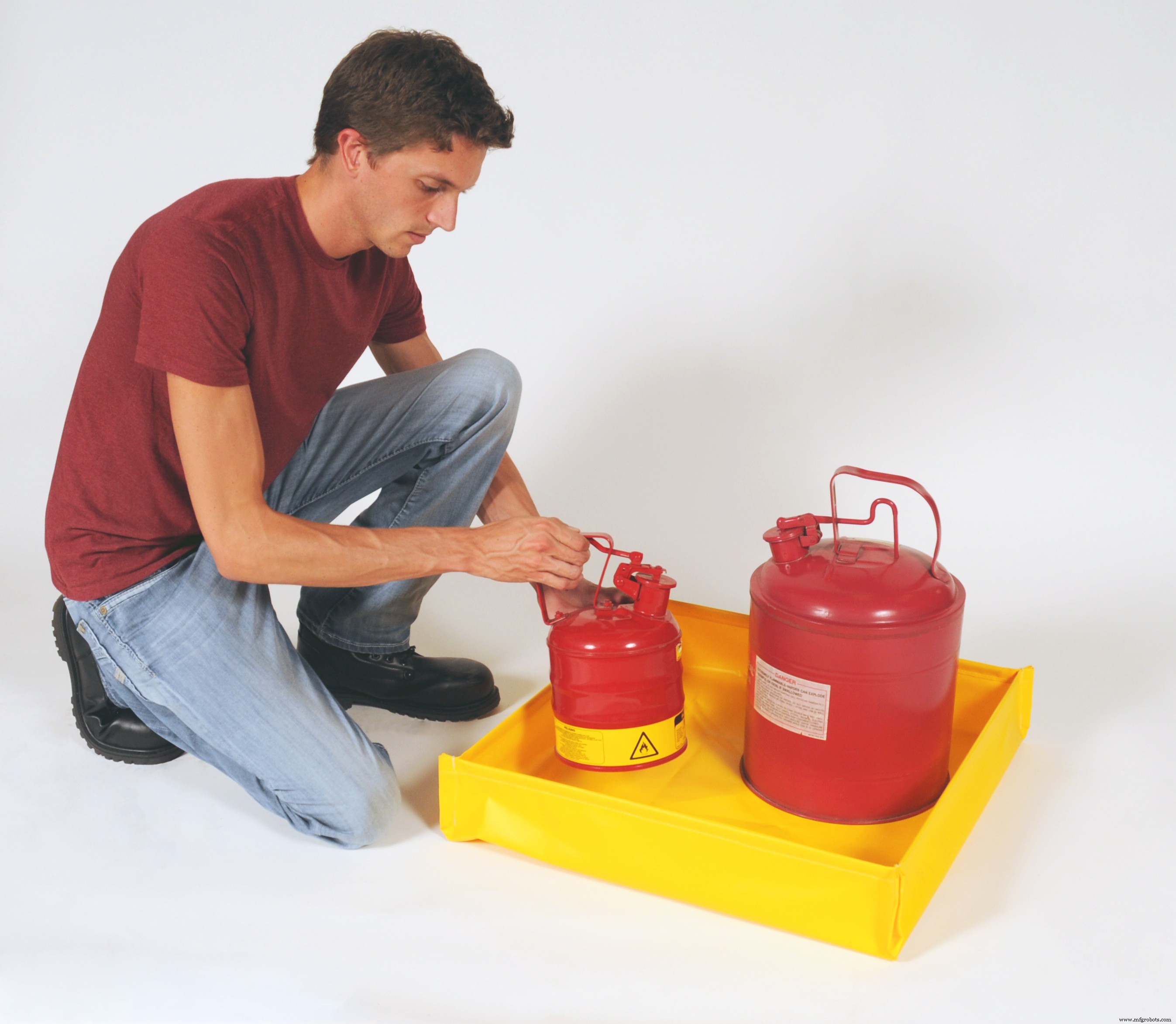 Multipurpose trays are useful for the long-term storage of smaller containers on shelves.
Not every spill or leak will be from a drum or an IBC. Here’s a handful of special circumstances and the secondary containment options to consider for each one:
- Shelving systems: Liquids and chemicals are frequently stored on shelving units inside facilities, and these containers may have spills or slow drips that can pool under the shelves, leading to chemical or fall hazards for workers. Low-profile spill containment trays are a good option for containing these spills. Placed under the shelves, these trays are typically made from chemical-resistant polyethylene. They may sometimes be ordered in custom sizes for various containment capacities.
- Line and hose containment: A dripping hose can or line can be contained by placing smaller pipe trays directly underneath the connection, which is usually cradled by the tray, providing support and keeping the connection off the ground. Another solution connects the pipeline through a bulkhead fitting at the back of the unit so any leaks or drips can be captured by a small sump.
- Multipurpose utility trays: Available in various sizes, utility trays may be used for storing or mixing chemicals or other liquids in containers of various sizes to capture drips, leaks or spills. These multipurpose containers can be used for the long-term storage of smaller liquid containers on shelves, pallets or floors, or used as temporary containment solutions for leaky machine parts or equipment.
- Containment berms: These products are designed for larger spills—from vehicles or large containers. They are often placed under tanker trucks, railroad tanker cars, or drums and IBCs with larger volume capacities.
What strategies or technologies are you using to minimize spills in your facility? Share your thoughts in the comments below.
Industrial Technology
- 5 Key Insights on How Automation Shapes the Future of Work
- Key Principles for Manufacturing Medical Devices: Design, Accuracy, and Compliance
- Top 9 Insights on Anodizing Sheet Metal: Enhance Durability & Aesthetics
- Essential Insights into Metal Casting: Techniques, Applications, and Advantages
- Mastering Two‑Shot Injection Molding: Key Benefits & Process Overview
- Design for Manufacturing (DFM): 3 Key Insights to Reduce Costs and Speed Production
- 5 Surprising Facts About Titanium: Strength, Weight, and More
- Key Insights into Quick Turn PCB Assembly Services
- 8 Essential Insights About ISO 9000 for Quality Management Success
- Titanium Tubes: 6 Key Insights for Engineers