



Lightning vs Lightning Arrester: Key Differences in Electrical Systems
Lightning is a natural process occurs in cloudy and stormy weather. Lightning not only produce enormous light but it also possesses a huge amount of potential gradient (10kv/cm) and current in the range of 10kA to 90kA. But technically we can define the lightning as “An electric discharge b/w cloud and earth, between clouds or between the charge centers of the same cloud is known as lightning”.
Lightning is a natural process which produces a huge spark in the clouds when the clouds are charged up to a high potential gradient with respect to earth and a neighbor cloud that the medium strength is destroyed. There are so many theories circling around about the lightning. But here we will discuss the theory which is the most accepted. When the warm air rushes up into the sky, the friction b/w the air and tiny particles of water causes the building of charges. When the water drops are formed, the large drop becomes positively charged and the smaller drop becomes negatively charged.
These drops accumulate on the clouds, so the cloud may possess positive or negative charges. The charge on a cloud may become so great that it may discharge to another cloud or earth and we call this phenomenon as lightning.
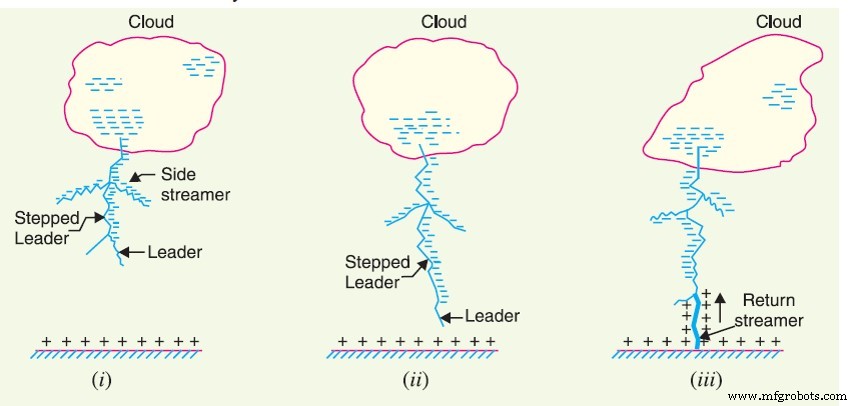
Mechanism of lightning discharge
Let us now discuss the manner in which the lightning discharge occurs. When a cloud having charges passes over the earth. It induces equal and opposite charges on the earth below. When the potential gradient reaches up to 5kv/cm to 10kv/cm to break down the surrounding air and the lightning stroke starts.
- As soon as the air breakdown by the cloud, a streamer called leader streamer starts from the cloud towards the earth and carries the charge with it. If the potential gradient is not maintained, the leader streamer stops and the charge is dissipated without the formation of a complete stroke. As shown in figure (a).
- In many cases, the leader streamer continues its journey towards the earth, until it makes contact with earth or some object on the earth. It may be noted that the leader streamers have sufficient luminosity and it gives rise to the first visual discharge. As shown in figure (b).
- The path of leader streamer is the path of ionization. Therefore a complete breakdown of insulation occurs. The downward leader having a negative charge and when this leader contacts with earth then returning streamer follows the same path, traveling upward having a positive charge. This neutralization process causes a sudden spark called lightning. As shown in figure (c).
Get to know what are lightning arrestors and their types:
The earth screening and overhead ground wires provide sufficient protection against direct lightning stroke but they often fail to provide protection against the traveling waves, which may reach to the apparatus. Lightning arrestors or surge diverters provide the required protection to the devices against these surges.
The above figure shows the basic form a surge arrester. It is clear that it is consists of a spark gap in series with a nonlinear resistor. One end of the diverter is connected to the protected part of the device and the other end is grounded. Under normal conditions, the surge diverter remains offline and conducts no current. But on the occurrence of lightning stroke the air insulation b/w the spark gap ionized and it conducts high current to the ground.
Types of lightning arrester:
- Rod Gap P: It is the simplest form of lightning arrester. It is consists of two 1.5cm rods which are bent at right angles with a gap in b/w. One rod is connected to the line and the other one is connected to the ground. The distance b/w gap and insulator must not be less than 1/3rd of the gap length so that the arc may not reach the insulator and damage it. As shown in the following figure.
- Horn Gap Arrester: This type of surge diverter is consists of two horn-shaped metal A and B separated by a small air gap. These horns are so constructed that the distance b/w them gradually increases towards to the top as shown in the figure. These horns are mounted on a porcelain insulator. One end is connected to the line with series resistor R and choke coil L while the other end is connected to the ground effectively.
- Multigap Arrester: This type of lightning arrester is consists of a series of metallic cylinders insulated from each other and separated by small air gaps. As from the figure the first cylinder A is connected to the line and the other to the ground with a series of resistors. Connecting the gaps with the ground with the help of a series of resistors is to decrease the effect of traveling waves. Such arresters can be installed where the system voltage does not exceed 33kv.
- Expulsion Type Arrester: This type of lightning arrester is commonly used in those systems where the system voltage is up to 33kv. This type of lightning arrester is also called the”protector tube”. The basic parts of the expulsion arrester are shown in the figure. Initially, the arrester is consists of rod gap in series with a second gap enclosed in fiber tube. The gap in fiber tube is formed by two electrodes. The upper end is connected with the rod cap and the other end is connected with the ground. The expulsion type arrester can perform the limited number of operations as during each operation some of the fiber material is used up.
- Valve Type Arrester: The most important and effective type of lightning arrester is valve type arrester. It is consists of two assemblies 1) series spark gaps 2) nonlinear resistor discs in series (made of tyrite or metrosil ). The nonlinear resistors are connected in series with the spark gaps. Both the assemblies are enclosed in tight porcelain container as shown in the figure below.
A Complete Guide for EE Students | How Does an Electrical Substation Work?
How The Corona Effect Can Influence the Overhead Transmission Lines
Industrial Technology
- AC vs DC Generators: Key Differences Explained
- Chain Drive vs Gear Drive: A Comprehensive Comparison
- Belt vs Chain Drives: Key Differences Explained
- Turning vs Milling: Key Differences Explained
- Machining vs. Grinding: Key Differences Explained
- Joining vs Welding: Key Differences Explained
- Forehand vs. Backhand Welding: Key Differences Explained
- Key Differences Between Ships and Boats Explained
- Fabrication vs. Machining: Key Differences Explained
- Casting vs Forging: Key Differences and Applications