



Knurling Explained: Tools, Common Issues, and Tips for CNC Lathe Success
Screwdrivers, tool handles and grips of a range of products are often knurled. It’s not a complex technique but provides real benefits. What is knurling and why to apply it? Based on the knurling on CNC lathe machines, we’ll discuss the uses, tools, problems and tips during the knurling process.
What is Knurling?
Knurling is a manufacturing process and technique of creating concave and bumps on the surface of workpiece, presented as the pattern of straight, angled or crossed lines is rolled into the material, the knurling operation is usually performed on the lathe machine, including CNC turning lathes. The crossed knurled patterns including diamond and square, with different angles.
What is the Purpose of Knurling?
1)Knurling offers a better grip for fingers to grasp the knurled parts and products through increasing the friction.
2)Knurling can be used to repair or make up the wear on machined part with the raised area.
3)Knurling is also a method when assembling low precision components.
Knurling Tool – Tools of Knurling on Lathe Machine
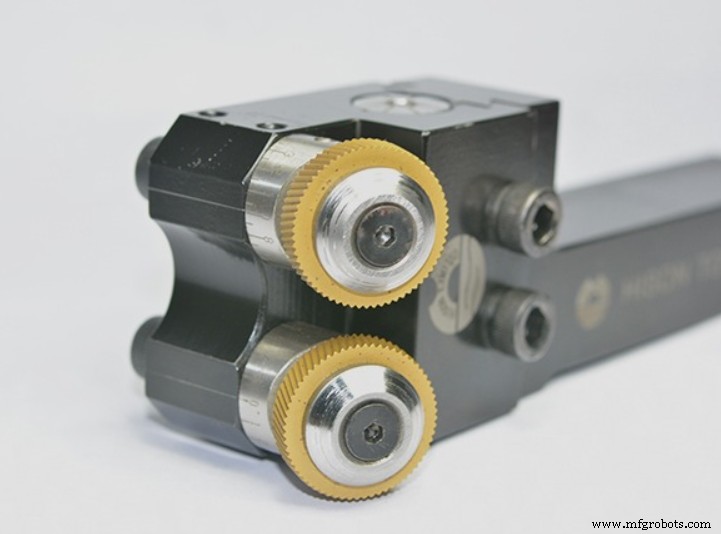
Knurling operation requires knurling tool, which is a handle with a knurling wheel. A knurling tool is used to press the desired knurled pattern on surface or section, how does it work on lathe machine? When the turning lathe is set, the chuck mounted and start rotating at a low speed, the knurling tool press against a piece of round section of the workpiece, then increases the pressure slowly until the pattern is formed.
Common Problems and Tips for Knurling on (CNC) Lathe
During the knurling process, there may be disordered, unclear and even wrong patterns made due to some reasons such as the rotary speed of tool is too high; insufficient rigidity of fixtures or tool turret; do not start cutting after the pattern to roll clearly; metal chips prevent the knurling process. Effective measures should be taken to solve the problems.
Tips for Knurling on Lathe
1)The force is very large when knurling on lathe, the workpiece must be clamped firmly.
2)When installing or assembling the knurling tool, the cutter face should be vertical to the part.
3)The beginning of knurling is important, press the tool onto piece without pause, so as to roll the pattern at once.
4)Turn on the tool after the pattern is produced clearly.
5)Apply appropriate lubricating fluid, the mechanical oil can be used.
6)Clean the chips frequently.
7)The rotating speed should not be too high.
8)Replace better quality coolant, increase water pressure to clean the area to be processed.
9)Use double wheel knurling tool, because the contact area with the product is smaller, and the tool tip is easy to be washed. In addition, double wheel knurling tool produce more clear pattern and reduces radial force.
Industrial Technology
- Drilling Explained: Definition, Process, and Expert Tips
- Understanding Capstan & Turret Lathes: Features, History, and Applications
- Mastering Lathe Machine Operations & Cutting Tool Selection
- Lathe Machines Explained: Types, Functions, and Applications
- Understanding Milling Machines: Functions, Applications, and Benefits
- Sheet Metal Welding: Techniques, Benefits & Expert Tips
- Stainless Steel CNC Machining: Tips, Surface Finishes, and Key Properties – Expert Guidance
- CNC Machining: Common Issues & Effective Solutions for Speed, Feed, and Depth Optimization
- Capstan & Turret Lathes Explained: History, Features, and Applications
- How to Prevent and Repair Punch & Die Chipping: Proven Solutions