



Essential Guide to 3D Printing with Nylon: Performance, Challenges, and Best Practices
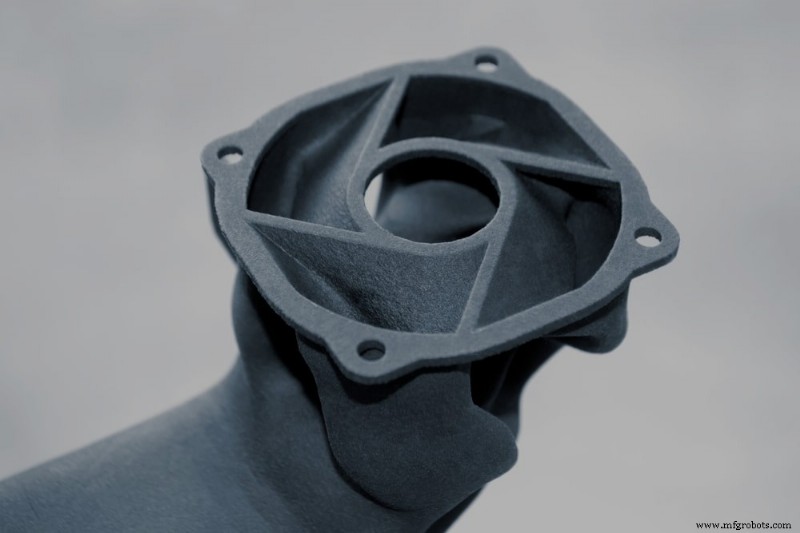
Nylon is a strong engineering plastic known for its resistance to heat, abrasion, friction, and chemicals. Nylon’s semi-crystalline microstructure provides an excellent rigidity to flexibility ratio, and it can be combined with or reinforced by other materials to improve its performance and characteristics. Nylon can be used in a variety of applications across sectors, from textiles to switch housings to food packaging.
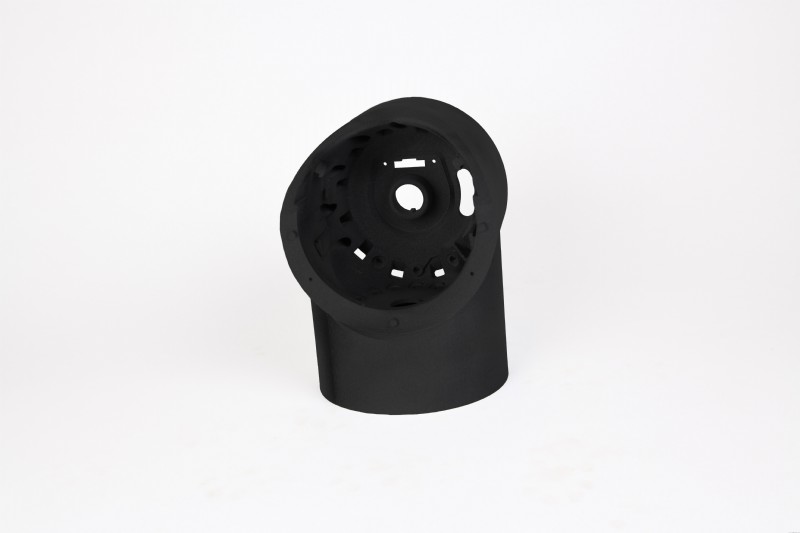
Nylon is an excellent 3D printing material, but there are some key considerations and design tips you need to keep in mind to achieve the best results. Here’s everything you need to know about 3D printing with nylon, broken down by additive manufacturing process.
3D printing nylon with Multi-Jet Fusion
HP Multi-Jet Fusion (MJF) technology prints quickly, captures the more intricate details of your design, and offers high dimensional accuracy. During this process, the MJF printer distributes a layer of powder onto the building platform. Then, a chemical fusing agent is sprayed on top of each new layer of powder, helping the powder absorb energy from the printer’s infrared light and form the final part.
There are a few key considerations for 3D printing nylon with MJF:
- You’ll have to design your part with at least 1mm thick walls. However, if you’re designing a living hinge, the minimum wall thickness should be 0.3mm.
- The minimum thickness for walls and the minimum distance between two features, also known as the channel gap, should be 0.762mm.
You should always include escape holes in your design to remove nylon powder after printing.
In addition, make sure your design includes enough space between features and avoid designing large or flat parts when using nylon for powder-bed additive manufacturing processes. If you don’t, your final part will be susceptible to warp. For more design guidelines for MJF, check out our guide.
3D printing nylon material with fused deposition modeling
Though nylon and nylon-based composites are best suited for additive manufacturing processes like MJF and Selective Laser Sintering (SLS), you can also 3D print nylon using fused deposition modeling (FDM). With FDM, the nylon filaments are melted and the molten material is extruded through a nozzle onto the platform. The part is then built layer by layer.
When 3D printing nylon filament, keep in mind that:
- Unlike MJF, you may need to include support structures in your design.
- Preheating your platform, switching off your printer’s cooling fans, or using a printer with a heated chamber or an enclosure can minimize warping.
- Your printer needs to have an all-metal hot end capable of handling temperatures above 250°C and a bed that can reach up to 65°C.
Also, nylon absorbs a lot of moisture from the air, which can lead to poor layer adhesion, surface roughness, tiny holes, and bubbles. Special steps must be taken to keep nylon material moisture-free in order to avoid these issues.
3D printing nylon with Fast Radius
Keeping these tips and design considerations in mind can help you create functional 3D printed nylon parts. If you plan to use nylon for your next 3D printing project, consider working with an experienced manufacturer to simplify and accelerate the process and ensure the best results.
When you partner with Fast Radius, our team of design experts will make sure your design is optimized for manufacturing and print your part using the latest additive technology. Ready to 3D print high-quality nylon parts quickly and cost-effectively? Contact us today to get started.
To learn more about the cost of 3D printing, common uses for additive manufacturing, and similar topics, visit our resource center.
Ready to make your parts with Fast Radius?
Start your quoteIndustrial Technology
- Key Design Principles for Optimizing Metal 3D Printed Parts
- 4 Key Design Principles for Successful 3D Printing
- Onyx: The Next Leap in Production‑Ready 3D Printing
- VDMA Unveils Comprehensive Roadmap for Additive Manufacturing and Industry 4.0
- Mastering HIPS Filament: A Comprehensive Guide to 3D Printing Success
- Essential Factors for Accurate Injection Molding Material Cost Evaluation
- Essential Guidelines for Manufacturing High-Impact Critical Components
- Expert Guide to CNC Machining of Plastic Parts: Key Design & Manufacturing Tips
- Essential Guide to Designing Effective Jigs and Fixtures
- Essential Factors for Successful Medical Device Manufacturing