



Green Sand vs. Resin Sand Casting: Which Process Delivers Better Quality and Cost Efficiency?
The term casting refers to a manufacturing process whereby molten metal is poured into 3D molds. Due to the infinite variety of mold shapes, sizes, and configurations that are available, casting allows manufacturers to create nearly anything they want out of metal.
Sand casting is just one of many metal casting processes. It’s characterized by using sand as all or part of the mold material. Sand casting is excellent for small production runs thanks to its generally low overall costs. The versatility offered by the process is also something to consider. Fabricators are able to create both ferrous and non-ferrous large metal components with a wide range of customization options.
Sand Considerations
Deciding which sand to utilize for your project may require more consideration than you anticipate. The industry offers a wide variety of sand choices that can seem almost daunting at first glance. Certain key factors should always be taken into consideration when selecting sand for your project. These include:
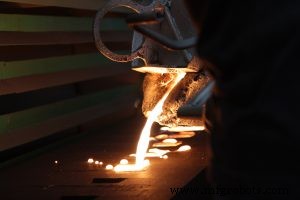
Iron molten metal pouring into the sand mold
- Strength: The ability of the sand to retain its shape during the casting process.
- Permeability: The sand’s physical makeup and whether it allows trapped gases to vent through it.
- More permeable sand helps to reduce porosity in molds.
- Less permeable sand oftentimes provides a higher quality surface finish.
- Sand grains’ size and shape determine permeability.
- Thermal stability: Sand is able to resist damage like cracking from heat that’s released by molten metal.
- Collapsibility: The ability of the sand to compress as the casting solidified.
- If sand can’t compress, the casting will not shrink freely.
- This can lead to cracking.
- Reusability: The ability of the sand to be reused for future projects (such as other sand molds).
Green Sand Casting
Green sand casting offers a cost-effective route and is the most traditional sand casting processes. This renders it a common choice amongst manufacturers and project leads. The material used is sand that’s bonded by water and clay—and best of all, it’s recyclable.
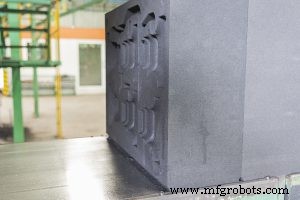
Green Sand mold in casting line; before pouring
Capabilities
- Suitable for producing small and medium-sized castings that weigh mostly less than 50 kgs.
- If the item is produced using automated molding lines during the process, green sand casting can also produce large castings up to 500 kgs.
Downsides
- Because the casting process is dependent on the fact that it is carried out in a mold box, finished product sizes are constrained to the size of the box.
- Molds that have been green sand casted exhibit decreased surface strength compared to molds that have undergone more traditional processes.
Resin Sand Casting
In the resin sand casting process, resin and sand are first mixed together. Following that, the mixture is self-hardened through chemical reaction to produce exceptionally hard molds.
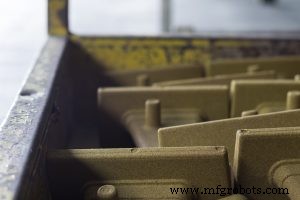
Resin Coated Sand products for casting process
Capabilities
- Resin sand casting typically produces accurate results that are superior to other sand-casting methods.
- This process also results in increased surface strength when compared to other sand-casting options
- The nature of resin sand casting can help reduce defects such as sand holes, air holes, and shrinkage.
- More flexibility with sizing
- Resin sand casting can produce large iron castings. These castings can range from dozens of kilograms up to several tons.
Downsides
- Resin sand casting is a more expensive casting method.
- This type of casting calls for specialized molding equipment.
Impro’s Casting Solutions
Regardless of your company’s needs, the team at Impro has the expertise that you need to produce nearly any metal part or component. Our knowledgeable staff can assist you in selecting from a wide range of casting processes. Impro is dedicated to ensuring that you’re guided to the proper materials and methods for your organization’s unique needs.
With a host of choices available to you, it can be tough to know what’s best for your short-term and long-term goals. If you’re still trying to figure out which casting process is right for you, download our Comparing Casting Processes eBook today. You’ll have the opportunity to learn more about different casting methods and which may be suitable for your specific needs.

Industrial Technology
- Sand Casting Explained: The Fundamentals of Metal Mold Fabrication
- Furan Resin Sand Casting: Process, Benefits & Limitations
- Understanding Green Sand Casting: Definition, Process, and Applications
- Expert Resin Sand Casting: Advanced Capabilities & Precise Processes
- Sand Casting vs. Centrifugal Casting: Choosing the Right Metal Part Production Method
- Sand Casting vs. Shell Mold Casting: Choosing the Right Metal Casting Process
- Sand Casting vs Forging: Choosing the Right Metal Fabrication Method
- Sand Casting Explained: A Proven, Cost‑Effective Metal Fabrication Method
- Exploring Sand Casting Equipment: Types & Applications
- Choosing Resin Sand Casting: When and Why It’s the Right Process