



Advanced 3D Printing Solutions for Precise Microfluidic Devices
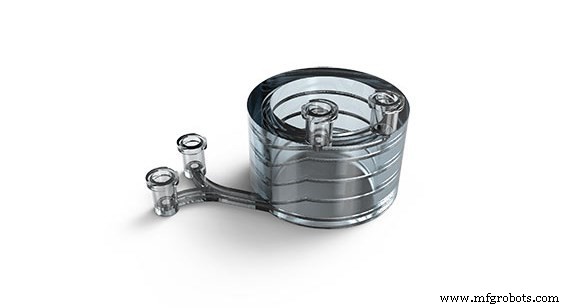 Stereolithography is capable of producing ultrafine features that are found in microfluidic designs.
Manufacturing small volumes of microfluidic devices or "a Lab-on-a-Chip," has traditionally been difficult using CNC machining or injection molding, but Protolabs offers microfluidic fabrication through 3D printing for just this.
Microfluidics typically requires very flat surfaces, and clear and thin/shallow features that are difficult to produce in a mold that is milled and hand polished. These tiny features are not easily distinguishable, requiring careful polishing and injection molding pressures can sometimes role the edges ever further, not to mention the effect that the ejector pins have on the part surface. Ejector pins play a huge factor in removing the part from the mold, and can cosmetically impact microfluidic devices that are molded. We will continue to injection mold microfluidics, but please first discuss these projects with a customer service engineer at Protolabs.
Why Use 3D Printing for Microfluidics Fabrication?
3D printing microfluidics changes all of this as ejector pins are a non-factor. We use stereolithography (SLA) to produce parts using an ultraviolet laser drawing on the surface of a thermoset resin, primarily our Somos WaterShed XC 11122 material. High-resolution SL is able to produce features as thin as 0.002 in. layers to provide the fine detail that microfluidics require. We recommend channel sizes of 0.025 in. square cross sections with a minimum wall thickness of 0.004 in. for X and Y dimensions and 0.016 in. for the Z dimension. Of course, we can produce features smaller than this, but it would need to be carefully reviewed by our engineers before the build begins.
Creating Clarity
Whether you’re creating a microfluidic part for a medical device or have a new lens design, be sure to explain your concerns as we can create a special build to produce the clarity required for these parts. These down faces don’t have the support structures typically required using SLA, so these surfaces will have your highest clarity. The up facing surfaces would have the next best finish followed by any vertical surfaces. To provide optimal clarity, the surfaces are then sanded down or polished to remove any visible layers on the flat surfaces. Not that on lenses and clear parts only (not on microfluidic parts), we do apply a clear urethane coating that improves on the clarity of the parts.
If you intend to create a new microfluidic part or require fine details with a clear surface, we strongly encourage you take a look at high-resolution SLA for microfluidic fabrication as it may dramatically shorten your development time and reduce the potential high cost of molding modifications if the design isn’t right the first time.
Learn more about microfluidics at protolabs.com or contact one of our customer service engineers at ADMIN@MFGROBOTS.COM or 877.479.3680.
Industrial Technology
- Harnessing 3D Printing in Higher Education: Benefits, Case Studies, and Resources
- Professional Guide to 3D Printing Durable Molds
- Tinkercad for 3D Printing: A Comprehensive Review for Beginners
- Is SketchUp Ideal for 3D Printing? A Comprehensive Review
- SolidWorks for 3D Printing: What You Need to Know
- Blender for 3D Printing: Pros, Cons, and Alternatives
- Explore the Versatile Applications of 3D Printing in Industry and Healthcare
- 10 Strongest 3D Printing Materials for Ultimate Durability
- Essential Pre-Print Checklist for Reliable 3D Printing
- Revolutionizing Healthcare: How 3D Printing Is Transforming Medical Applications