



Accelerating ADAS Deployment: Key Challenges Automotive Teams Must Address
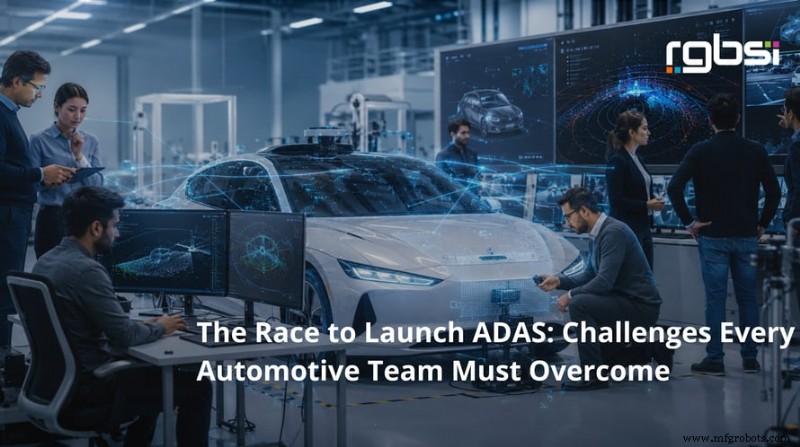
The race to deliver smarter, safer vehicles has never been more intense.
Automakers face mounting pressure to bring Advanced Driver Assistance Systems (ADAS) to market faster than ever. Consumers now expect features such as lane centering, adaptive cruise control, automatic emergency braking, and driver‑monitoring systems to function flawlessly from day one. Meanwhile, regulators are tightening safety standards and competitors are accelerating innovation cycles.
Yet many ADAS programmes still experience delays before vehicles hit production lines.
Why? Developing ADAS is no longer just about building features. It involves validating intricate software, integrating diverse technologies, meeting evolving regulations, and proving safety across millions of driving scenarios.
For automotive manufacturers and suppliers, understanding these challenges is essential to mitigating risk and keeping launch timelines on track.
1. Validation Is Becoming More Complex Than Development
Building an ADAS feature is only part of the puzzle. Demonstrating that it operates safely in the real world is often the greater hurdle.
An automatic emergency braking system, for example, must react correctly in countless situations—day and night, rain and shine, urban traffic and open highways. It must detect vehicles, pedestrians, cyclists, road signs, and unexpected obstacles while making split‑second decisions.
No engineering team can physically test every possible scenario on public roads. Consequently, companies rely on a blend of real‑world testing, high‑fidelity simulation, Software‑in‑the‑Loop (SIL), and Hardware‑in‑the‑Loop (HIL) validation. While these methods broaden coverage, they also generate enormous testing workloads.
Why this matters: Validation now consumes a significant portion of ADAS development timelines, making it a leading cause of delayed launches.
2. Sensor Integration Is More Difficult Than It Looks
Modern ADAS systems depend on multiple sensors working together seamlessly.
Cameras identify lane markings and objects. Radar tracks distance and speed. Lidar provides detailed environmental mapping. GPS and other sensors establish vehicle positioning.
Each sensor perceives the world differently. A camera may struggle in low‑light conditions, while radar can see through fog and rain but offers less visual detail. Combining these data streams into a single, accurate view of the environment requires sophisticated sensor‑fusion algorithms and extensive calibration.
Even minor integration issues can create performance inconsistencies that necessitate additional testing and rework.
The reality: As sensor architectures become more advanced, integration challenges continue to grow, especially for programmes operating under aggressive launch schedules.
3. Software Complexity Is Creating New Bottlenecks
Today's vehicles are increasingly software‑defined, and ADAS is a major driver of that transformation.
Modern ADAS platforms process vast amounts of data in real time. They rely on advanced perception algorithms, artificial intelligence models, and high‑performance computing to make driving decisions within fractions of a second.
Balancing performance with practical constraints—processing power, memory, thermal limits, and production costs—is a constant challenge. When software requirements exceed hardware capabilities, teams often face redesigns, optimisations, or extra validation cycles, all of which can impact programme timelines.
Why this matters: ADAS innovation is accelerating, but software complexity is becoming a major source of development risk.
4. Regulatory Requirements Continue to Evolve
The regulatory landscape for ADAS is shifting rapidly.
Governments and safety organisations worldwide are introducing new requirements related to vehicle safety, cybersecurity, software updates, and driver‑assistance functionality. Standards such as ISO 26262 and ISO/SAE 21434 are gaining prominence throughout the development process.
Different regions often have divergent expectations for testing, documentation, and compliance. This creates a challenge for global programmes: a feature ready for one market may need additional validation before it can be released elsewhere.
The impact: Regulatory readiness is no longer a final approval step—it is a continuous activity throughout the product development lifecycle.
5. Data Quality Can Make or Break ADAS Performance
Artificial intelligence plays an increasingly important role in ADAS development.
However, AI systems are only as good as the data used to train them. Development teams need vast amounts of high‑quality data representing diverse road conditions, weather patterns, traffic behaviours, and geographic regions. Capturing rare but safety‑critical scenarios can be particularly challenging.
Even when data is available, labeling, validation, and model retraining require significant effort.
The challenge is not simply collecting more data—it is ensuring the right data is available to help systems perform reliably in real‑world conditions.
6. Safety and Cybersecurity Requirements Add Additional Layers of Review
As vehicles become more connected, safety and cybersecurity can no longer be treated as separate activities.
ADAS systems must demonstrate that they can operate safely during faults while also protecting against potential cybersecurity threats that could impact vehicle operation.
This requires extensive analysis, documentation, testing, and cross‑functional collaboration between software, hardware, systems, quality, and compliance teams.
The result is a development process that is rigorous but often time‑consuming. For many programmes, safety certification and cybersecurity validation become critical milestones that directly influence launch readiness.
The Road to Faster ADAS Launches
The demand for advanced driver‑assist technology will continue to grow as vehicles become smarter, safer, and more connected.
At the same time, the challenges facing development teams are becoming increasingly complex. Validation demands are expanding, software architectures are growing more sophisticated, regulatory expectations are evolving, and safety requirements remain uncompromising.
The organisations that succeed will be those that address these challenges early—investing in robust testing strategies, stronger systems‑engineering practices, scalable validation environments, and cross‑functional collaboration throughout the development lifecycle.
ADAS innovation is not slowing down. But bringing these technologies to market successfully requires more than breakthrough features—it requires the ability to navigate the development challenges that stand between innovation and production.
Ready to accelerate ADAS development while reducing validation, integration, and compliance risks? RGBSI supports automotive manufacturers and suppliers with engineering, validation, testing, software development, and program management expertise that helps bring advanced vehicle technologies to market faster and with greater confidence.
About RGBSI
At RGBSI, we deliver total workforce management, engineering, quality lifecycle management, and IT solutions that provide strategic partnership for organisations of all sizes. As an organisation of engineering experts, we understand the importance of modernisation. Our engineering solutions give clients agility and value by optimising the value chain to meet industry protocols and full product specifications. Learn more about our automation and digital engineering services.
RGBSI's Smart Transportation Products
We offer a range of hardware products designed to enhance efficiency, safety, and connectivity across the transportation sector.
- Acoustic Vehicle Alerting System (AVAS): enhance pedestrian and cyclist safety by generating vehicle sounds at low speeds, tailored for electric and hybrid vehicles.
- Intelligent Controller Unit: centralise control and monitoring for fleet management with real‑time data on vehicle health, location, and driver performance.
- Bus Driver Console (BDC): enhance driver communication and efficiency with an intuitive, robust interface designed for challenging environments.
- Reverse Parking Assist System (RPAS): improve vehicle safety during reversing with a wide‑angle camera and automatic activation, ensuring clear visibility even in low‑light conditions.
- Container E‑Lock: secure cargo with advanced electronic locks, offering real‑time tracking, tamper alerts, and encrypted communications.
- Advanced Telematics System: optimise fleet routes, monitor vehicles remotely, and schedule maintenance with real‑time data on vehicle location, speed, and condition.
- DMS Cameras: enhance road safety by monitoring driver behaviour, detecting signs of fatigue and distraction, and issuing alerts to prevent accidents.
- ADAS Cameras: improve vehicle safety with lane departure warnings, adaptive cruise control, and automatic emergency braking.
Learn more about our products.
Industrial Technology
- Semiconductor Lasers Now Emit Microwaves and Capture Radio Signals, Paving Way for Ultra‑Fast Wi‑Fi
- How COVID‑19 Is Reshaping Global Sourcing of Precision Machined Parts
- Optimizing Your Manufacturing Marketing Budget: Smart Spending Strategies
- Eddy Current Testing Explained: 5 Key Insights for Reliable Metal Inspection
- Maintaining Customer Connections: Manufacturers’ Strategies During COVID-19
- Introducing Rinku Modi, DVIRC’s New Chief Financial Officer
- Top 85+ Electrical Engineering Final Year Projects to Inspire Your Career
- TSOP‑1738 Infrared Receiver: Step‑by‑Step Circuit Connection Guide
- Facebook Posts as Predictive Health Tools: Detecting Diabetes, Depression, and More
- Implementing Industry 4.0: Practical Steps for Machine and Component Manufacturers