



AI in Healthcare: Transformative Benefits, Use Cases, and Market Outlook
AI is no longer a pilot concept; it is reshaping diagnostics, therapeutics, operations, and patient engagement across the industry. Hospitals deploy machine‑learning models for image interpretation and predictive analytics, pharma harnesses generative AI to accelerate drug discovery, and payers automate claims and fraud detection with natural‑language processing.
Fortune Business Insights estimates the global AI‑in‑healthcare market at $39.34 billion in 2025, projecting growth to over $1 trillion by 2034—a compound annual growth rate of 43.96 %.
The FDA has cleared more than 1,451 AI‑enabled medical devices, with 295 new authorizations in 2025 alone, setting a new record. These approvals are dominated by radiology and medical‑imaging applications (76 % of devices), followed by cardiovascular and neurology solutions.
What’s driving this shift? Below we outline proven benefits, current deployments, and emerging opportunities for health‑care organizations that want to stay ahead of the curve.
AI’s Expanding Footprint in Health‑Care
Health‑care institutions generate terabytes of data—from imaging studies to clinical notes. AI blends machine learning, deep learning, computer vision, and natural‑language processing to unlock insights that were previously hidden in this noise.
These insights power more efficient diagnostics, personalized therapies, and data‑driven operational decisions, enabling organizations to modernize ecosystems and deliver outcomes that were once considered unattainable.
According to the Menlo Ventures 2025 State of AI in Healthcare Report, total AI spending in health‑care reached $1.4 billion in 2025, nearly tripling from the prior year. Adoption is outpacing the broader economy at a rate of 2.2×, with 22 % of health‑care organizations deploying domain‑specific AI tools—a 7‑fold increase from 2024.
Key drivers include clinical decision support systems, AI‑powered imaging, precision‑medicine platforms, and advanced data‑analytics pipelines.
Takeaway: The infrastructure race is heating up. In January 2026, OpenAI acquired the health‑care startup Torch for roughly $100 million to embed a “unified medical memory” into ChatGPT Health. That same week, Anthropic launched Claude for Healthcare, offering HIPAA‑ready products. Google DeepMind, NVIDIA, and Microsoft are also scaling specialized platforms.
Organizations that wait risk adopting commodity tools instead of building competitive advantages.
1. Data‑Driven Decision Making
Clinicians often juggle high‑volume, highly sensitive data. AI aggregates, validates, and surfaces insights in real time, freeing clinicians to focus on patient care.
Cloud‑based AI analytics scan millions of patient records, uncovering patterns that inform real‑time clinical decision support and proactive care pathways.
2. Enhanced Diagnostic Efficiency
Incomplete histories and high caseloads increase diagnostic error. AI models that self‑assess confidence—like the MIT CSAIL system—route uncertain cases to clinicians, improving accuracy by 8 % over human or AI alone in cardiomegaly detection.
Computer‑vision algorithms have become standard for detecting anomalies in CT, mammography, and chest X‑ray studies.
3. Cost Reduction
AI investments translate into tangible savings. According to Menlo Ventures, U.S. health‑care organizations are realizing 5 %–10 % reductions in spending through predictive analytics, NLP‑driven workflow automation, and computer‑vision‑based image analysis.
Projected savings include:
- Robot‑assisted surgery: $40 billion
- Virtual nursing assistants: $20 billion
- Fraud detection: $17 billion
4. Surgical Assistance
AI enhances pre‑operative planning and intra‑operative navigation via CT, ultrasound, and MRI integration. Robotic systems—such as the FDA‑cleared platform used by the Cleveland Clinic for prostatectomy—combine AI with modular robotic arms to improve recovery times by 35 % and reduce complications by 22 % within the first year.
Intuitive Surgical’s Da Vinci remains the most widely adopted robotic platform for minimally invasive cardiac, urologic, and gynecologic procedures. Mayo Clinic supports over 300 AI initiatives, expanding robotic programs across specialties.
5. Patient‑Centric Care & Remote Access
AI empowers self‑diagnosis, drug development, monitoring, and personalized care. Advanced chatbots can triage acute events—e.g., detecting an ongoing heart attack—while automated platforms handle repetitive tasks.
Telemedicine solutions, enriched with AI, mitigate provider shortages and extend high‑quality care to underserved regions.
Two high‑growth categories:
- Ambient AI documentation: Tools like Microsoft’s Dragon Copilot auto‑generate clinical notes from clinician‑patient dialogue. In March 2025, Kyndryl partnered with Microsoft to deploy these solutions in health‑care settings.
- Remote patient monitoring: Wearables and connected devices feed continuous data to machine‑learning models that flag deterioration before it becomes critical.
6. Seamless Information Sharing
Efficient data exchange is critical. AI algorithms sift through vast data sets, making knowledge discovery fast and secure. 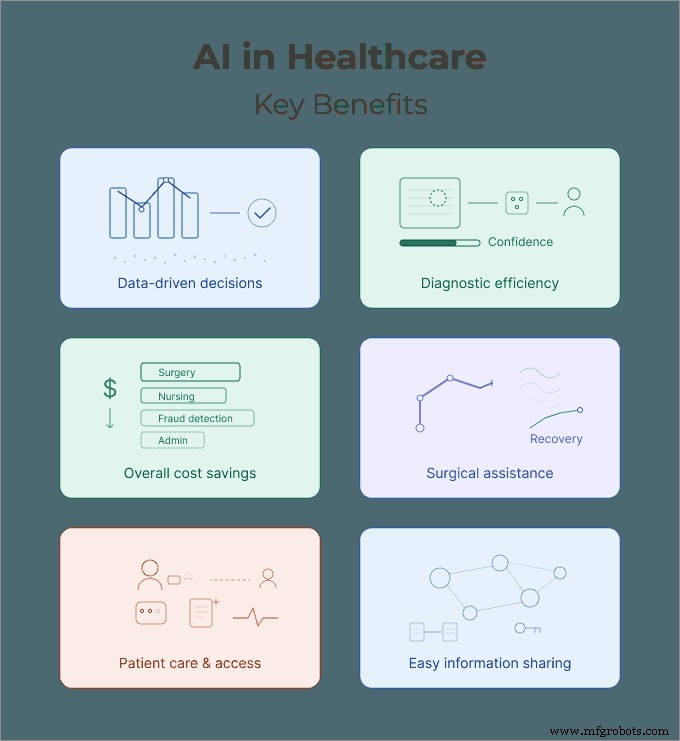
Practical AI Applications in Health‑Care
From disease prediction to personalized medication, AI’s influence spans the entire continuum of care.
1. Disease Prediction
Intelligent data mining and AI uncover patterns that enable early detection. Deep‑learning models—such as Ezra, which provides full‑body MRI screening—enhance diagnostic accuracy across specialties.
2. Personalized Treatment
High‑throughput analysis of biomarkers and genomics informs individualized therapy plans. Companies like GNS Healthcare and Oncora Medical leverage machine learning to match patients with the most effective treatments. Generative AI now creates synthetic patient data, accelerating clinical trial enrollment and reducing costs.
The generative‑AI market in health‑care is projected to grow from $3.3 billion in 2025 to $39.8 billion by 2035.
3. Real‑Time Triage & Prioritization
AI‑enabled prescriptive analytics—exemplified by Jvion and Enlitic—prioritize patients in real time, blending clinical, socioeconomic, and behavioral data. Conversational AI, with a market expected to reach $59.12 billion by 2030, automates intake, routes emergencies, and mitigates clinician burnout.
4. Drug Discovery
Deep learning has accelerated drug development. In 2025, Insilico Medicine released rentosertib, the first drug whose target and molecule were discovered entirely by AI, achieving a 98.4 mL improvement in lung function at a $6 million cost—versus $100–$200 million and 6–8 years for traditional pathways.
The Recursion–Exscientia merger combined cellular imaging and AI‑driven chemistry, powered by NVIDIA’s BioHive‑2 supercomputer. An estimated 15–20 AI‑originated drugs are slated for pivotal trials in 2026.
5. Optimized Standard of Care
Digitized records, coupled with Bayesian learning, allow AI to continuously refine treatment protocols, integrating seamlessly with EHR systems to update standards of care across entire health systems.
Regulatory Landscape
The FDA is the benchmark for AI in health‑care. By 2025, it had authorized 1,451 AI‑enabled devices, including 295 new clearances—a record.
Key milestones:
- Predetermined Change Control Plans (PCCPs): 2025 guidance permits iterative model updates without new reviews, covering roughly 10 % of 2025 clearances.
- Foundation‑model AI: Aidoc’s CARE1, cleared February 2025, was the first foundation‑model‑powered clinical AI device.
- CPT 2026 codes: 288 new codes address digital health and AI services, removing reimbursement barriers.
- EU AI Act: High‑risk obligations take effect between 2026 and 2027, imposing global requirements for AI medical devices.
At Imaginovation, we embed compliance from day one—audit trails, model versioning, data provenance, and HIPAA‑compliant architectures—avoiding costly retrofits.
Future Directions
Agentic AI in Clinical Workflows
Next‑generation AI coordinates multi‑step workflows: scheduling, lab ordering, referrals, and prior authorizations. Health copilots from OpenAI, Anthropic, and Google act as proactive decision support assistants.
Ambient Clinical Intelligence
Systems like Microsoft’s Dragon Copilot and Abridge automatically transcribe clinician‑patient conversations, extract structured data, and generate documentation—eliminating a major time sink.
Beyond Radiology
Computer vision is expanding into digital pathology, ophthalmology, and cardiology. The FDA recently cleared an at‑home blood‑pressure monitor that detects atrial fibrillation using AI—showing diagnostics moving closer to patients.
Foundation Models & Clinical LLMs
General‑purpose foundation models—Google’s Med‑PaLM, NVIDIA’s BioNeMo, Insilico’s Chemistry42—are being fine‑tuned for biomedical language, molecular structures, and clinical reasoning.
Predictive & Preventive Care at Scale
Wearables, continuous glucose monitors, and remote‑monitoring platforms generate unprecedented data volumes. Machine‑learning analytics transform this data into actionable signals—identifying patients at risk, personalizing dosing, and revealing population‑level trends.
Building AI‑Enabled Health‑Care Solutions with Imaginovation
AI is moving from pilots to production. Whether you need ambient documentation, predictive analytics, patient engagement tools, or clinical decision support, we help you move from concept to compliant production.
Our deep experience in AI development, machine‑learning engineering, custom health‑tech software, and HIPAA‑compliant architectures has enabled health‑care organizations to deploy futuristic digital solutions.
Let’s discuss how AI can transform your organization.
Industrial Technology
- Precise Ultrasonic Distance Sensing with Arduino – Step‑by‑Step Guide
- Three Essential Lessons Retailers Must Learn Amid Year-Long Disruption
- Step-by-Step Guide: Wiring Two Switches in Series to Control a Single Light
- Silent Tools™ Plus: Enhancing Industry 4.0 with Embedded Connectivity
- Choosing the Optimal Turning Insert for Heat‑Resistant Alloys & Titanium
- Why PCBs Fail: Key Causes and Prevention Strategies
- Sustainable E-Commerce: How Online Retailers Can Deliver On Time, Cut Costs, and Protect the Planet
- How 3D Printing Revolutionized Manufacturing: A Journey Through Its Evolution
- How COVID-19 Accelerates 3D Printing Adoption Across Industries
- Maximize Efficiency: 4 Proven Tips for Your Waterjet Cutter