



ITMK 3: Kobe Steel’s Eco‑Friendly Iron Nugget Production Process
ITmk3 Process of making Iron Nuggets
ITmk3 process is also known as Iron making technologies (IT) mark 3 and is one of the coal reduction technologies. IT mark 1 is the iron making process by blast furnace (BF) while the IT mark 2 is the iron making by direct reduction mostly by gas based reduction processes (Fig 1). This process has been developed by Kobe Steel and is environmental friendly.
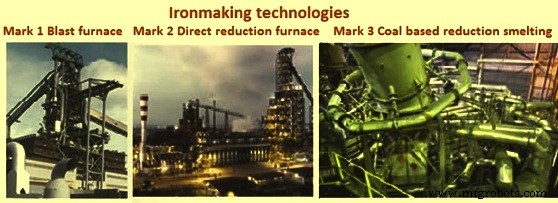
Fig 1 Iron making technologies
Development history
The laboratory testing of the process was carried out during 1996 to 1998. During the period 1999 to 2000 a small pilot plant of capacity 3,000 tons per day was constructed and operated at Kakogawa Works of Kobe Steel, Japan. In the years 2002 to 2004 a pilot demonstration plant of 25,000 tons per year was constructed and operated at Minnesota, USA. The construction of first commercial plant of capacity 500,000 tons per year started at Hoyt Lakes Minnesota in 2007 and the operation in this plant started in January 2010.
ITmk3 process
ITmk3 process is a rapid ironmaking process which includes reducing of ore, carburizing and melting iron and separating slag, all at relatively low temperatures. The four step process consists of (i) agglomerating iron-ore and coal, (ii) reducing and melting of the agglomerates, (iii) separating of metallic iron from slag, and (iv) treating of exhaust gases and recovering of the heat.
In this process, iron ore concentrate and non-coking coal (reducing agent), limestone (flux), and bentonite (binder) are mixed together and agglomerated into green self reducing pellets. These pellets are fed into a rotary hearth furnace (RHF) where self reducing, fluxing dried green balls are reduced, carburized and smelted. The product is granular iron called iron nuggets. The process on the iron carbon (Fe-C) phase diagram is shown in Fig 2.
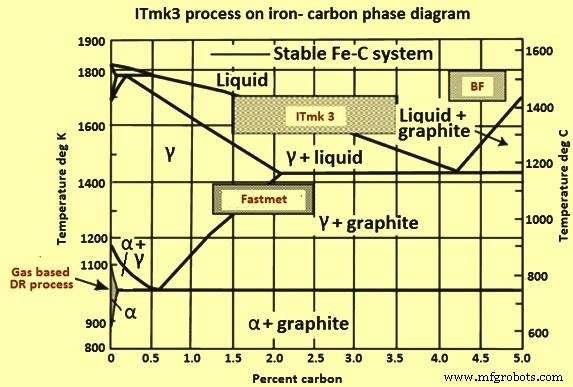
Fig 2 – ITmk3 process on iron- carbon phase diagram
ITmk3 process produces high purity granular iron (Iron nuggets) by using iron ore fines and non coking coal. The process is distinctive with reduction, carburizing melting and slag separation (Fig 3). The process occurs at lower temperatures (around 1350 deg C) and hence different from conventional iron making by blast furnace (BF). In the ITmk3 process the reduction reaction takes place in 10 minutes unlike 8 hours in BF and 6 hours in the gas based direct reduction processes.
During the process, the reduction of iron ore is taking place in several steps. These steps are shown in Fig 3.
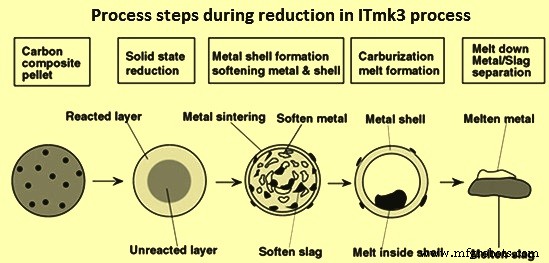
Fig 3 – Process steps during reduction in ITmk3 process
The main features of the process are given below.
- The process utilizes low grade iron ore fines which are grounded in fine particles and beneficiated in order to produce high grade iron ore concentrate. This concentrate is converted into green pellets.
- Non coking coal is used as a reductant.
- The pellets are charged into a rotary hearth furnace (RHF), heated to 1350 deg C, reduced, melted and separated into metal and slag.
- The molten iron is solidified into nuggets inside the furnace, discharged after cooling and separated from the slag.
- The process is simple and uses conventional equipment. Further the small retention time also facilitates the start up and stopping of the plant. Iron ore fines and pulverized coal are agglomerated into composite pellets.
The flowsheet for the ITmk3 process is given in Fig 4.
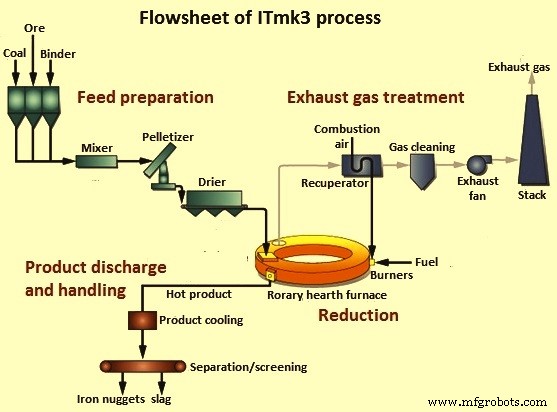
Fig 4 – Flowsheet of ITmk3 process
The reactions between iron ore and coal remain the same as for the general iron making process and are given below.
FexOy + yCO = xFe + yCO2
CO2 + C = 2CO
C(s) = C (carburized)
Fe(s) = Fe(l) (melt)
The last two reactions are additional reactions in the ITmk3 process. These additional reactions are for the separation of metallic iron from the slag.
Product of the ITmk3 process
ITmk3 produces slag free iron nuggets (Fig 5) which have similar chemical and physical properties as those of pig iron. It has metallic iron content in the range of 96 % to 97 %, C content in the range of 1.7 % to 3.5 %. Sulphur content of the iron nuggets is around 0.5 %. The density of iron nuggets is in the range of 6.5 grams/cubic centimeter (g/cc) to 7.0 g/cc. Iron nuggets have better meltability than pig iron produced from BF hot metal since it has a low melting point and higher thermal conductivity. Iron nuggets are having size which helps in easy transportation and handling. They do not reoxidize and also do not generate fines during handling. Another advantageous feature of the iron nuggets is that they can be continuously charged into the electric arc furnace (EAF) similar to the charging of direct reduced iron (DRI) or hot briquetted iron (HBI).
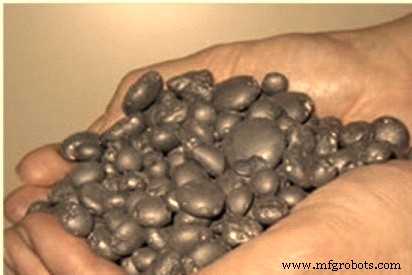
Fig 5 – Iron nuggets
Specific Consumption values for ITmk3 process
The specific consumption of materials and utilities per ton of nuggets for the ITmk3 process are (i) iron ore fines – 1.5 tons, (ii) non coking coal – 0.5 tons, (iii) fuel gas – 1.1 giga calories, (iv) electric power – 200 kWh, (v) water – 2 cum, (vi) compressed air – 85 cum, and (vii) nitrogen – 12 cum.
Environment control
ITmk3 – EAF steel making process route produces lesser pollutants relative to BF – BOF process route. The percent reduction in ITmk3 – EAF process route as compared to BF – BOF process route are (i) carbon mono oxide (CO) – 96 %, (ii) oxides of nitrogen (NOx) – 65 %, (iii) sulphur di-oxide (SO2) – 77.7 %, (iv) volatile organic compounds (VOC) – 86.5 %, (v) carbon di-oxide (CO2) – 41.1 %, and (vi) mercury (Hg) – 58.0 %.
Typical layout of the ITmk3 process
The typical layout giving the land requirement for the ITmk3 process is shown in Fig 6
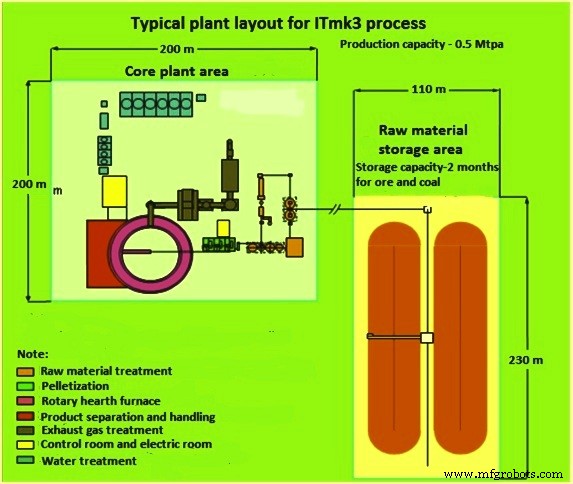
Fig 6 – Typical plant layout for ITmk3 process
Advantages of the ITmk3 Process
ITmk3 process has several advantages over other ironmaking processes. These advantages include (i) the process is simple, (ii) the process allows direct reduction of iron ore fines with non coking coals, (iii) the process is energy efficient since it consumes around 30 % of less energy than the energy consumed during ironmaking by BF, (iv) the process results into lower CO2 emissions, (v) the process is having low capital investment since it eliminates sinter/pellets plant and coke oven battery, (vi) the process uses cheaper raw materials such as iron ore fines and non coking coals, (vii) the process produces high-grade iron nuggets with better meltability than pig iron during the steel making stage, (viii) the process eliminates necessity of handling liquid iron, (ix) the iron nuggets are slag free, free from tramp elements, free from re-oxidation, and does not generate fines and hence easy to transport, (x) operation and adjustment of the process is simple and the process also facilitates the production adjustment by starting and stopping, (xi) the equipment used in the process are simple and with proven reliability.
Manufacturing process
- FINEX Process: Advanced Liquid Iron Production Using Iron Ore Fines & Non-Coking Coal
- HIsmelt: Advanced Direct Smelting for Liquid Iron Production
- Iron Ore Pellets: Production Process & Key Technologies
- Tracing the Evolution of Blast Furnace Iron Production
- Efficient Iron Production with Rotary Hearth Furnace: Direct Reduction Using Non‑Coking Coal
- Romelt Ironmaking Process: Efficient Smelting Reduction for Liquid Iron Production
- Step-by-Step Guide to Producing High-Quality Iron Carbide (Fe3C)
- Matmor Process: Innovative Iron Production Using Lignite Coal
- Comprehensive Overview of Steelmaking Techniques
- Iron Ore Smelting Explained: Process, Principles, and Production