



Optimizing Iron Ore Beneficiation for Efficient Steel Production
Beneficiation of Iron Ores
Iron ore is a mineral which is used after extraction and processing for the production of iron and steel. The main ores of iron usually contain Fe2O3 (70 % iron, hematite) or Fe3O4 (72 % iron. magnetite). Ores are normally associated with unwanted gangue material. Grade of iron ore is usually determined by the total Fe content in the ore. Run of mines ores after dry or wet sizing, if it contains normally greater than 62 % of Fe, are known as ‘natural ore’ or ‘direct shipping ore’ (DSO). These ores can be directly used in the production of iron and steel. All other ores need beneficiation and certain processing before they are used in the production of iron and steel.
Low grade iron ores cannot be used as such for the production of iron and steel and need to be upgraded to reduce its gangue content and increase its Fe content. The process adopted to upgrade the Fe content of iron ore is known as iron ore beneficiation (IOB).
However, Iron ores from different sources have their own peculiar mineralogical characteristics and require the specific beneficiation and metallurgical treatment to get the best product out of it. Also for effective beneficiation treatment, effective crushing, grinding, and screening of the ore is necessary for which suitable crushing, grinding, and screening technologies are to be employed. The choice of the beneficiation treatment depends on the nature of the gangue present and its association with the ore structure. Several methods/techniques such as washing, jigging, magnetic separation, gravity separation, and flotation etc. are used to enhance the Fe content of the Iron ore and to reduce its gangue content. These techniques are used in various combinations for the beneficiation of iron ores. For beneficiation of a particular iron ore the emphasis is usually to develop a cost effective flow sheet incorporating necessary crushing, grinding, screening and beneficiating techniques which are necessary for the upgrading of the iron ore. A typical flow sheet for iron ore beneficiation plant is shown in Fig 1.
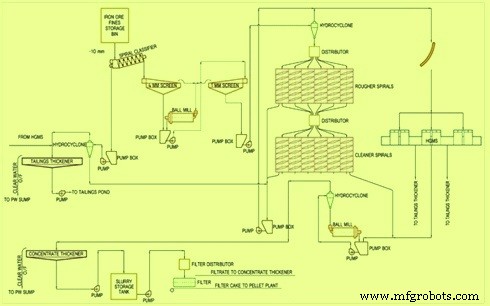
Fig 1 A typical flow sheet of iron ore beneficiation plant
Some of the common methods/techniques applicable for iron ore processing are described below.
Crushing, grinding and screening technique
The purpose of grinding and regrinding is to reduce the ore to a size small enough to liberate and recover the valuable minerals. The crushing, grinding and screening systems of an IOB plant are to be designed taking into account the requirements of the downstream beneficiation processes. The crushing units may include primary, secondary, tertiary and quaternary crushing systems. Jaw, gyratory, cone, and roll crushers are used for ore crushing. Semi autogenous grinding and autogenous grinding circuits are used for grinding the ore. Both rod mills and ball mills are used for this purpose. Capital investment and operation costs of grinding equipment are high. Hence economics play a large part in planning for the degree of crushing and grinding performed to prepare ore for beneficiation. Other factors considered in determining the degree of crushing and grinding includes the value concentration of the ore, its mineralogy, hardness and moisture content. Closed circuit grinding minimizes over grinding of very friable ore normally found in the ore bodies of our region. The more the recirculation load the less is the over grinding of particles.
Washing and wet scrubbing
This process is primitive and widely used in lumpy iron ore processing to dislodge and remove friable and soft lateritic materials, fine materials and limonitic clay particles adhering to the ore. Wet scrubbing is also useful in hard and porous ores, which invariably have cavity/pores filled with clayey material that need substantial removal.
Gravity separation
This technique is used where iron bearing minerals are free from associated gangue materials. The specific gravity of iron bearing minerals is usually higher than the specific gravity of gangue materials. Effectiveness efficiency of the gravity separation depends largely on to proper crushing and sizing of the ore so as to ensure a proper size feed to the gravity separation equipment and also removal of slime from the equipment. A large numbers of equipment/processes functioning on gravity separation principle are available. Some of them are described below.
- Dense media separation – The process is also known as heavy media separation. The process is used for coarse ores (size range 3mm to 50 mm. Ground ferro- silicon of -300 mesh size is used as suspension to create a parting density of 3-3.2 which is sufficient for gangue materials to float and get separated. The suspension material is recovered by using low intensity magnetic separators (LIMS). Feed for the dense media separation must be hard and compact with non porous gangue material.
- Heavy media cyclone – The process is used for iron ore fines with size range of 0.2mm to 6 mm. The cyclone type separator utilizes centrifugal as well as gravitational forces to make separation between ore and gangue material. Ground ferro-silicon of -325 mesh size is used as a media in cyclone.
- Jigging – Jigging is a gravity concentration technique where the iron ore is separated into light density fraction, medium density fraction and heavy density fraction. Size fraction of the iron ore used for jigging is 0.5 mm to 30mm.
- Spirals – Spiral concentrators are flowing film separation devices. General operation is a continuous gravitational laminar flow down on an inclined surface. The mechanism of separation involves primary and secondary flow patterns. The primary flow is essentially the slurry flowing down the spiral trough under the force of gravity. The secondary flow pattern is radial across the trough. Here the upper-most fluid layers comprising higher density particles move away from the centre while the lower-most concentrate layers of higher density particles move towards the centre. Spirals require addition of water at various points down the spiral to assist washing of the iron ore, i.e. transporting away the light gangue from the dense ore. The amount of wash water and its distribution down the spiral trough can be adjusted to meet the operating requirements. Point control minimizes the total water requirements by efficiently directing water into the flowing pulp at the most effective angle. Feed size applicability is in the range of 0.3 mm to 1 mm. Spirals are normally operated at a pulp density of 25 % to 30 % solids.
- Tables – Tables have wide range of application in gravity treatment of iron ores. Tables are normally used in cleaning and scavenging circuits. Feed size applicability is in the range of 0.3 mm to 1 mm. Spirals are normally operated at a pulp density of 25 % to 30 % solids.
- Multi gravity concentrator – They are under development stage and are designed to treat fines and ultrafine particles of iron ore. They are useful in processing of valuables from slimes and tails.
- Cyclones – Cyclones used for concentration of iron ores are of several types. These include hydro-cyclone, stub cyclone and heavy media cyclone. Cyclones are cost effective and simple in their construction. The main parts of a cyclone consist of cyclone diameter, the inlet nozzle at the point of entry into the feed chamber, vortex finder, cylindrical section and cone section. They have proper geometrical relationship between the cyclone diameter, inlet area, vortex finder, apex orifice, and sufficient length providing retention time to properly classify particles. As the feed enters the chamber, a rotation of the slurry inside of the cyclone begins, causing centrifugal forces to accelerate the movement of the particles towards the outer wall. The particles migrate downward in a spiral pattern through the cylindrical section and into the conical section. At this point the smaller mass particles migrate toward the center and spiral upward and out through the vortex finder, discharging through the overflow pipe. This product, which contains the finer particles and the majority of the water, is termed the overflow and should be discharged at or near atmospheric pressure. The higher mass particles remain in a downward spiral path along the walls of the conical section and gradually exit through the apex orifice. This product is termed the underflow and also should be discharged at or near atmospheric pressure.
Magnetic separation
Magnetic separation technologies are used to take the advantage of the difference in the magnetic properties for separating iron ore from the non magnetic associated gangue materials. Magnetic separation can be conducted in either a dry or wet environment, although wet systems are more common.
Magnetic separation operations can also be categorized as either low or high intensity. Low intensity separators use magnetic fields between 1000 to 3000 gauss. Low intensity techniques are normally used on magnetite ore as an inexpensive and effective separation method. High intensity separators employ fields as strong as 20,000 gauss. This method is used to separate weakly magnetic iron ores such as hematite, from nonmagnetic or less magnetic gangue materials. Other factors important in determining which type of magnetic separator system is used include particle size and the solids content of the ore slurry feed.
Typically magnetic separation involves three stages of separation namely (i) cobbling, (ii) cleaning/roughing, and (iii) finishing. Each stage may employ several drums in a series to improve separation efficiency. Each successive stage works on finer particles as a result of the removal of oversized particles in earlier separations. Cobblers work on larger particles and reject substantial percent of feed as tails.
Several types of magnetic separation technologies are used. These are described below.
- Wet and dry, low intensity magnetic separation (LIMS)
- High gradient magnetic separation (HGMS)
- Wet high intensity magnetic separation (WHIMS)
- Roll magnetic separators for processing weak magnetic ores
- Induction roll magnetic separation (IRMS) for concentrating dry ores
Flotation process
Flotation process uses a technique where particles of one mineral or group of minerals are made to adhere preferentially to air bubbles in the presence of a chemical reagent. This is achieved by using chemical reagents that that preferentially react with the desired mineral. Several factors are important to the success of flotation activities. These include uniformity of particle size, use of reagent compatible with the mineral, and water conditions that will not interfere with the attachment of the reagents to the mineral or the air bubble.
Today flotation is primarily used to upgrade concentrates resulting from magnetic separation. Flotation to be used all alone as a beneficiation method is used rarely.
Chemical reagents used are mainly of three main groups namely (i) collectors/amines, (ii) frothers, and (iii) antifoams. Reagents may be added in a number of forms which include solid, immiscible liquid emulsion and solution in water. The concentration of reagents need to be closely controlled during conditioning since adding more reagent than needed retards the reaction and reduce efficiency. Factors which affect conditioning include thorough mixing and dispersal of reagents through the pulp, repeated contact between the reagents and all of the relevant ore particles, and time for the development of contacts with the reagents and the ore particles to produce the desired reactions.
Manufacturing process
- Sintering Iron Ore Fines: Enhancing Blast Furnace Efficiency
- Mining Iron Ore: Process, Types, and Extraction Techniques
- Iron Ore Pellets: Production Process & Key Technologies
- Iron Ore Geology & Exploration: Proven Strategies for Prospecting Success
- Iron Ores Explained: Types, Distribution, and Mining Practices
- Iron Ore Beneficiation: Key Processes and Techniques
- Gravity Separation & Ore Beneficiation: From Ancient Gold Panning to Modern Mining Solutions
- Magnetic Separation & Iron Ore Beneficiation: Advanced Techniques for Efficient Iron Concentration
- Optimizing Low‑Grade Iron Ore: Jigging Techniques for Effective Beneficiation
- Iron Ore Smelting Explained: Process, Principles, and Production