



Blast Furnace Refractory Lining: Protecting Shells for Continuous Operation
Refractory lining of blast furnace
A modern blast furnace (BF) is refractory lined to protect the furnace shell from the high temperatures and abrasive materials inside the furnace. The refractory lining is cooled to further enhance the protection against the dispatch of excess heat that can destroy the refractory lining. BF has a complex refractory system to provide a long, safe life that is necessary for the blast furnace availability and for permitting nearly continuous furnace operation and casting.
Conditions within the blast furnace vary widely by region and the refractories are subjected to a variety of wear mechanisms. Details are given in Tab 1. The application condition of different regions of a blast furnace is not the same due to the very nature of its geometry and also due to the pyrometallurgical process occurring at different stages. There are diverse physical and chemical wear mechanisms in the different regions of the blast furnace and they are complex in nature. For example mechanical wear or abrasion occurs mainly in the upper stack region and is caused by the decent of the charge materials and by the dust laden gases. High thermal loads are a major factor in the lower stack and the belly regions. In the hearth region, horizontal and vertical flow of hot metal combined with thermal stresses often form undesirable elephant foot shaped cavitation. The refractory materials in these regions are to take care of these wear mechanisms to avoid damage due to them. Therefore, the BF stack (upper middle and lower), belly, bosh, raceway and tuyere region, hearth, and taphole all require different quality of refractories depending on the respective application conditions.
| Tab 1 Attack mechanisms in different regions of blast furnace | ||
| Region | Attack mechanism | Resulting damage |
| Upper stack | Abrasion | Abrasive wear |
| Medium temperatures fluctuations | Spalling | |
| Impact | Loss of bricks | |
| Middle stack | Medium to heavy temperatures fluctuations | Spalling |
| Gas erosion | Wear | |
| Oxidation and alkali attack | Deterioration | |
| Lower stack | Heavy temperatures fluctuations | Severe spalling |
| Erosion by gas jets and abrasion | Wear | |
| Oxidation and alkali attack | Deterioration | |
| Thermal fatigue | Shell damage and cracks | |
| Belly | Medium temperatures fluctuations | Spalling |
| Oxidation and alkali attack | Deterioration | |
| Abrasion, gas erosion and high temperature | Wear | |
| Bosh | High temperature | Stress attack |
| Slag and alkali attack | Deterioration and wear | |
| Medium temperatures fluctuations | Spalling | |
| Abrasion | Wear | |
| Raceway and | Very high temperature | Stress cracking and wear |
| Tuyere region | Temperatures fluctuations | Spalling |
| Oxidation (water and oxygen) | Deterioration | |
| Slag attack and erosion | Wear | |
| Damage from scabs | Loss of cooling elements and tuyeres | |
| Hearth | Oxidation (water) | Wear |
| Zinc, slag and alkali attack | Deterioration | |
| High temperature | Stress build up and cracking | |
| Erosion from hot liquids | Break out risk | |
| Iron notch | Heavy temperatures fluctuations | Spalling |
| (tap hole) | Erosion (slag and iron) | Tap hole wear |
| Zinc and alkali attack | Deterioration | |
| Gas attack and oxidation (water) | Wear and deterioration | |
Selection of appropriate refractory combination depending on the wear mechanism is very important. An improper selection of the refractories often leads to a refractory failure which, subsequently, becomes a complex problem to solve. Types of refractory lining required in a blast furnace region wise as well as the trend in the refractory lining pattern is given in the Fig 1.
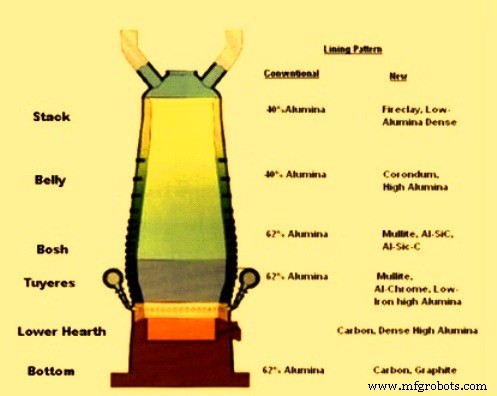
Fig 1 Refractory lining in various region of a blast furnace
Presently the campaign life of a BF is expected to be around 15 years or more. Further there is a trend towards large capacity BFs, which are being subjected to stringent operating conditions. To achieve the goal of long lining life under stringent operating conditions, it is necessary to have a good combination of high grade refractories combined with highly efficient cooling systems and tight control on furnace operation to ensure high productivity without excessive wall working and with minimization of massive ‘slips’ in the BF which can cause excessive premature damage to the refractory linings.
It is known that the bottom and a part of the hearth are corroded mainly by pig iron, slag and alkalis. Refractory bricks in these areas are subjected to high load and temperature. So it requires a refractory lining which should have high strength, lower creep in compression value and higher RUL (refractoriness under load) and PCE (pyrometric cone equivalent) values. Some BFs use low iron, dense 42 % -62 % alumina, mullite refractory bricks, conventional carbon blocks etc. in the bottom and lower hearth while the present trend is to replace it with super micro pore graphite blocks. BF hearth life mainly depends on the following factors.
- Operational factors such as (i) high productivity leading to high heat loads, (ii) high fluid velocity that causing more erosion and (iii) high coal injection means lower permeability. None of these factors are under the control of BF operator and hence, the only solution for this can be a robust refractory lining.
- Refractory lining system design – The entire refractory lining is also subjected to thermal stress which also plays a dominant role especially when the design is inadequate. The refractory lining system or design must (i) optimize thermal resistance, (ii) provide expansion relief, (iii) prevent cracking, and (iv) eliminate built-in barriers.
- Refractory properties – These include (i) High thermal conductivity, (ii) alkali resistance, (iii) low permeability, (iv) low thermal expansion, and (v) low elasticity.
The recent development of micro porous carbon bricks and improvement in the quality of semi graphite and graphite blocks has led to higher infiltration resistance to iron and slags, and thermal conductivity. The problem of brittle layer formation around 800 deg C isotherm by alkali condensation and thermal stresses have been addressed to by using smaller blocks, optimum expansion allowances etc. The carbon refractories are covered by fireclay or mullite bricks to protect it against oxidation. The design of this ‘ceramic cup’ is important, as the isotherms are altered depending on the quality and thickness of the cup material.
The stack bricks are particularly exposed to high abrasion and erosion by charge material from top as well as high velocity fume and dust particles going out due to high blast pressure in a CO (carbon mono oxide) environment. Hence, the application condition demands refractory materials which must have high strength, low permeability, high abrasion resistance and resistance to CO disintegration. Super duty fireclay refractory brick or dense alumina brick having Al2O3 around 39 % – 42 % can impart these characteristics required for stack application.
The tuyere and bosh are attacked by temperature change, abrasion and alkalis; and the belly and lower shaft by thermal shock, abrasion and CO attack etc. In the critical areas of the BF, i.e. tuyere, bosh, belly and lower stack, silicon carbide, SiC-Si3N4 and corundum refractories have replaced carbon and 62 % Al2O3 or mullite bricks. This takes advantage of the high thermal conductivity of SiC in combination with the stave coolers. However due to the problem of water leakage around taphole and tuyere area many blast furnaces are lined with high alumina or alumina-chrome corundum refractories. The present and the trend in the Bf refractories are given in Tab 2.
| Tab 2 Blast furnace refractories | ||
| Area | Present | Trend |
| Stack | 39 % – 42 %% Al2O3 | Super duty fireclay |
| Belly | 39 % – 42 % Al2O3 | Corundum, SiC-Si3N4 |
| Bosh | 62 % Al2O3, Mullite | SiC-Si3N4 |
| Tuyere | 62 % Al2O3, Mullite | SiC self bonded, Alumina-chrome (Corundum) |
| Lower hearth | 42 %-62 % Al2O3, Mullite, Conventional carbon block | Carbon/Graphite block with super micro pores |
| Tap hole | Fireclay tar bonded, High alumina / SiC tar bonded | Fireclay tar bonded, High alumina / SiC tar bonded |
| Main trough | Pitch / water bonded clay / Grog / Tar bonded ramming masses, Castables | Ultra low cement castables (ULCC), SiC / Alumina mixes, Gunning repairing technique |
| Tilting spout | High alumina / SiC ramming masses / Low cement castables | High alumina / SiC / Carbon / ULCC |
Different types of BF refractories
Different types of refractories which are used in blast furnace lining are described below.
- Baked carbon blocks – Micro porous carbon block, semi graphitic carbon block, and micro porous carbon silicon block are made with high temperature electrically calcined anthracite, synthetic graphite and silicon carbide as main raw materials. They possess higher thermal conductivity, lower permeability, good hot metal and alkali resistance. Semi graphitic carbon blocks are used as the lower bottom lining. Micro porous carbon blocks are used as the linings of the upper bottom and lower hearth of blast furnaces with intensified smelting. Micro porous carbon silicon blocks are used in laying the hearth, tap hole and slag hole of the blast furnace.
- Small sized baked carbon bricks – Moulded micro porous carbon bricks and carbon silicon carbide bricks are produced through hot pressed forming, high temperature baking and finished grinding with high temperature electrically calcined anthracite, synthetic graphite and silicon carbide as main raw materials and the oils deriving from coal or phenolic formaldehyde resin as binder as well as ultra micro powder additives. Moulded micro porous carbon silicon carbide bricks can be used for the brickwork of tuyere, slag hole, tap hole, the hearth and the slag forming zones of the blast furnace.
- Ceramic cup brick – These are plastic phase bonded composite corundum brick. The brick is composed of high quality mullite and high purity fused corundum as raw materials with addition of specified binder by shaping at high pressure and sintering at high temperature. With features of high refractoriness under load (RUL), compact structure, low porosity and high resistance to corrosion, the bricks are used for the BF bottom, ceramic cup bottom lining and combined brick of tuyere, tap hole and slag hole of the large blast furnace.
- Corundum brick – The corundum brick is made of brown fused corundum and silicon carbide as starting materials, combined with special additives, through mould press process and sintering before fine machining. The brick is characterized by good alkaline resistance and slag corrosion resistance, which is suitable for lining the bottom, hearth ceramic cup, tuyere, tap hole and slag hole.
- SiC- Si3N4 brick – There are many different types of SiC brick with different bonding systems and varying SiC content. In general, direct bonded SiC have high resistance to alkalis and zinc. Also, they have high thermal conductivity, excellent erosion resistance, very good thermal shock properties, and are resistant to corrosion and CO attack. Generally, nitride bonded SiC are used in applications, such as BF belly.
- Micro porous alumina carbon brick – These bricks are made by adopting special grade bauxite clinker, corundum, graphite and mid alumina as main raw materials, combined with several kinds of super fine powder additives. It features micro pore, good alkali resistance and high thermal conductivity. It is used for lining of bosh, stack and cooling wall of BF.
- 50 % alumina class bricks – Typically refractories in this class are upgraded super duty firebricks. They are generally composed of a mixture of bauxite, flint clay/chamotte and plastic clay. 50 % alumina bricks usually have low porosity, expand upon reheating to 1600 deg C and have good resistance to thermal cycling. A brick in this class containing higher purity materials exhibit good load bearing qualities and have excellent resistance to alkali attack.
- 60 % alumina class bricks – Bricks in this class are composed of a wide variety of materials. The most common and highly regarded mid alumina bricks are composed of minerals from the sillimanite group (usually combined with small amounts of calcined alumina and plastic clays). Other 60 % alumina qualities in this class are composed of a mixture of synthetic chamotte, bauxites, calcined alumina and plastic clays. High levels of mullite formation allow bricks in this class (especially sillimanite containing refractories) to exhibit excellent creep resistance. Sillimanite bricks can be often phosphate/chemically bonded and cured as a means of improving thermal shock resistance.
- 70 % alumina class bricks – This class of bricks is based on primary raw materials bauxite or high alumina chamotte which is added with fireclay. These bricks are fired to around 1400 deg C to prevent excessive expansion during firing (caused by a reaction of siliceous ingredients with bauxite, forming mullite). 70 % alumina bricks exhibit high expansion values in service thus reducing joint sizing.
- 80 % alumina class bricks – These are based on bauxite with additions of calcined alumina and clay materials. They are fired to around 1420 – 1480 deg C to maintain consistent brick sizing. Fired products in this class have about a 20 % porosity, good strength and resistance to thermal cycling. These products are associated with phosphate/chemical bonding (both cured and fired) as a means of imparting greater resistance to abrasion and reducing porosity.
- Fireclay bricks – Fireclay bricks are composed from a blend of usually two or more clays. The use of flint and kaolin clays imparts refractoriness, calcined clays (chamottes) control the drying and firing shrinkages and plastic clays facilitate forming and bonding strength. Fireclay bricks are usually grouped into (i) super duty bricks (PCE > 33) that have a typical alumina content of 40 % to 45 % and have a good refractoriness, resistance to thermal shock and volume stability at higher temperatures, (ii) high duty firebricks (PCE 31 ½ to 33) that are similar to super duty equivalents but are typically manufactured from lower quality flint clays/chamottes and plastic clays (typical Al2O3 40 % to 45%) and are commonly used as a replacement for medium duty firebricks where thermal cycling is a potential problem, (iii) medium duty firebricks (PCE 29 to 31) (typical Al2O3 38 % to 42%) are used in less severe applications and their thermal shock resistance is lower than on super and high duty firebricks, (iv) low-duty firebricks (PCE 15 to 29) (typical Al2O3 35 % to 38%) are used as backing linings and other applications where moderate temperatures are prevalent, and (v) semi silica firebricks that have typical alumina contents of 18 % to 25% with silica values ranging 72 % to 80 % and have excellent load bearing strength and volume stability at relatively higher temperatures.
- Tap hole mass – The main characteristics needed from tap hole mass include good viscosity and good sintering properties combined with corrosion and erosion resistance.
Manufacturing process
- Optimizing Refractory Lining for Maximum Availability in Basic Oxygen Furnaces
- Optimizing Blast Furnace Operations with Nut Coke: Efficiency & Cost Benefits
- Extending Blast Furnace Hearth Life with TiO₂ Coatings: Proven Refractory Protection
- Preventing Irregularities in Blast Furnace Operation: Proven Strategies
- Optimizing Blast Furnace Cooling Systems for Enhanced Efficiency and Longevity
- Refractory Lining Solutions for Continuous Casting Tundishes
- Optimizing Blast Furnace Design for Superior Performance and Longevity
- Comprehensive Capital Repairs for Blast Furnaces: Relining, Shell Repairs & Equipment Overhaul
- Optimizing Blast Furnace Gas Cleaning for Energy Efficiency
- Electric Arc Furnace Refractory Lining: Essential Materials for High‑Temperature Steel Production