



Accurate Aluminum Casting Shrinkage Calculations for Sand Casting Success
Aluminum casting shrinkage is a big concern in the metalworking industry that every foundry has to tightly calculation to minimize casting defects and rejections. This article mainly focuses on analyzing shrinkage in aluminum sand casting that helps manufacturers predict and control shrinkage during the working process.
Sand casting is one of the most economic and popular techniques used to manufacture 1/3 casting parts across the world because of its efficiency and reclaimability.
Considered as a favorite molding treatment, however, the sand casting process exposes many defects which can cause casting rejections if you don’t manage the casting technique well.
One of the chronic issues in sand casting is shrinkage that required to calculate carefully to guarantee casting accuracy and quality.
Today, we discuss aluminum casting shrinkage during the sand casting process that is asked most of the time by readers.
You will find in this article’s content a deep discussion of the aluminum casting shrinkage phenomenon; helpful guidance to calculate aluminum shrinkage and techniques to control the shrinkage in sand casting.
What is aluminum casting shrinkage in sand casting?
Shrinkage is one of the characteristics of metals in the casting process. It is a normal phenomenon that metal shrinks as they solidify.
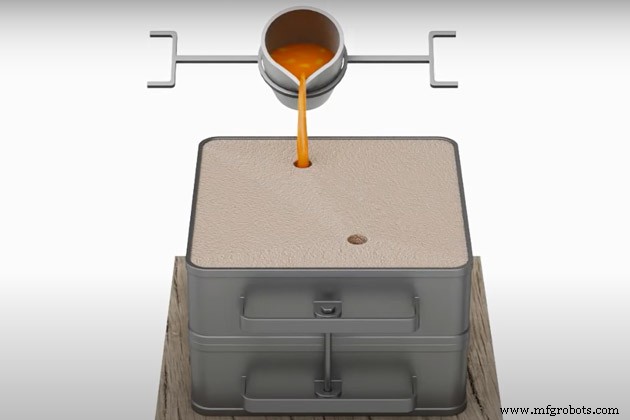
In aluminum sand casting, shrinkage happens when the molten aluminum alloy is poured into the mold cavity and cooled down. Shrinkage leads to internal or external changes of aluminum volume as it transforms from liquid to solid phase. In which, the specific volume of aluminum alloys is decreased when it turns from a liquid state to a solid-state.
What is aluminum alloy casting shrinkage rate?
In casting, the shrinkage is calculated by the shrinkage rate represented by percentage (%).
Different aluminum alloys have different casting shrinkage rates. Even if the same alloy but the casting design is different, the shrinkage rate is also different. Generally, the shrinkage rate of aluminum alloys is ranging from 6 to 8% (specific amount depends on the specific alloy)
What influence of shrinkage on aluminum sand casting parts?
The aluminum casting shrinkage has a decisive influence on the quality of the aluminum casting parts. If the shrinkage allowance of aluminum in sand casting is not managed well, it can cause casting defects including open shrinkage defects (pipe and caved surface) and close shrinkage defects (micro-porosity or macro-porosity) that lower the casting quality.
What are the three steps in which aluminum shrinkage occurs?
As other metal, the aluminum casting shrinkage happens in three stages correspond with three types of shrinkage.
1. The Liquid Shrinkage
In an easy way to understand that liquid shrinkage is the shrinkage of the aluminum alloy liquid during cooling. Here the contraction occurs as the molten aluminum alloy cools but still remaining in the liquid form.
In casting, this stage of shrinkage doesn’t significantly effect on the designing perspective.
2. Solidification Shrinkage
Solidification shrinkage is the shrinkage of the aluminum alloy due to solidification. This phenomenon happens as the aluminum alloy transform from the liquid phase to the solid phase.
The shrinkage that occurs in this stage is because the liquid metal is less dense than the solid one. This shrinkage is the main cause of porosity as well as macrosegregation in aluminum casting parts.
This stage is where alloys shrink largest, hence it requires calculation of carefully supportive tools such as riser, chills to compensate for the alloy shrinkage rate.
You can find our guide on designing risers and chills on the rest of the article.
3. Patternmaker’s shrinkage
Patternmaker’s shrinkage is the continued shrinkage (after the solidification shrinkage stage) that occurred as the aluminum solid casting cools to room temperature.
This phenomenon happens because of the thermal contraction factor due to the temperature dependence of the solid density. This is the reason cause hot and cold cracks in aluminum parts that distort the casting shapes.
This shrinkage stage is also especially significant for design considerations. It requires the casting manufacturer to have to consider reasonable mold design and tool so that the final casting remains the desired dimension and accuracy.
You can find our guide on designing mold and tools on the rest of the article.
Which factors influence shrinkage in aluminum sand cast products?
There are several factors that affect on parameters of aluminum sand casting shrinkage including alloy composition, casting shape, pouring temperature, mold coat, thermal cooling conditions.
Let specify them!
1. Influence of Aluminum Alloy Composition
The composition of aluminum alloys has effects on the freezing range of metal and the shrinkage porosity formation as well.
Specifically, the long freezing aluminum alloys result to reduce the micro-porosity, and in oppositely.
Manufacturing process
- How 3D Printing is Revolutionizing Sand Casting
- Sand Casting Explained: The Fundamentals of Metal Mold Fabrication
- Sand Casting Your Product: Expert Techniques for Precision Metal Parts
- Mastering Aluminum Sand Casting: Techniques for Superior Surface Finish
- Aluminum Casting Methods Explained: Choosing the Right Technique
- 5 Types of Sand Casting Defects & Prevention Strategies
- Expert Guide to Creating Sand Casting Molds for Foundries and DIY Projects
- Mastering Greensand Casting: A Comprehensive Overview
- Aluminum Die Casting Explained: Precision Part Manufacturing
- Molding Sand Explained: Composition, Uses, and Benefits in Sand Casting