



Master Soldering: Types, Techniques, and Step-by-Step Guide
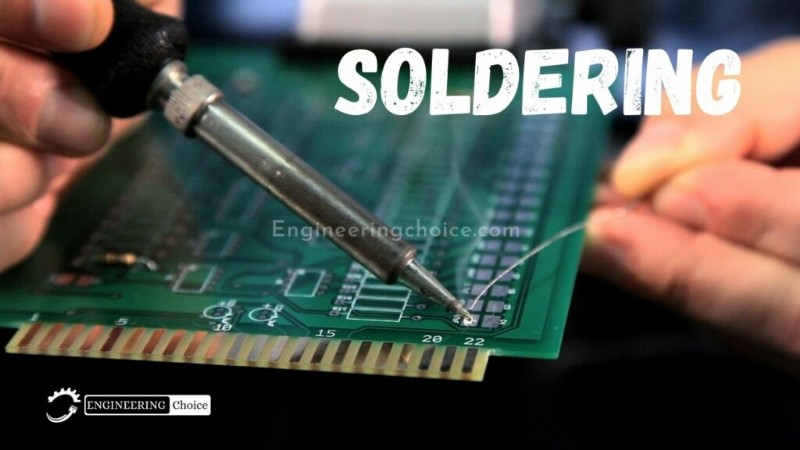
If you were to take apart any electronic device that contains a circuit board, you’ll see the components are attached using soldering techniques. Soldering is the process of joining two or more electronic parts together by melting solder around the connection. Even though soldering can create a permanent connection, it can also be reversed using a de-soldering tool.
Today, we’ll be learning all about soldering. What is it? What are its applications? How does the process go?
What Is Soldering?
Soldering is a joining process that joins different types of metals together by melting solder. Solder is a metal alloy, usually made of tin and lead, that is melted with a hot iron. The iron is heated to temperatures above 600 degrees Fahrenheit, which then cools to create a strong electrical bond.
In contrast to welding, the workpieces are not melted when soldering. Brazing also does not melt the metal of the workpiece, but the filler metal melts at a higher temperature than soldering. Historically almost all solders contained lead, but environmental and health concerns have increasingly dictated the use of lead-free alloys for electronics and plumbing purposes.
What is Solder?
Solder is a fusible metal alloy used to create a permanent bond between metal workpieces. The solder is melted in order to adhere to and connect the pieces after cooling, which requires an alloy suitable for use as the solder has a lower melting point than the pieces being joined.
The solder should also be resistant to oxidative and corrosive effects that would degrade the joint over time. The solder used in making electrical connections also needs to have favorable electrical characteristics.
Soft solder typically has a melting point range of 90 to 450 °C (190 to 840 °F; 360 to 720 K), and is commonly used in electronics, plumbing, and sheet metal work. Alloys that melt between 180 and 190 °C (360 and 370 °F; 450 and 460 K) are the most commonly used. Soldering performed using alloys with a melting point above 450 °C (840 °F; 720 K) is called “hard soldering”, “silver soldering”, or brazing.
In specific proportions, some alloys are eutectic that is, the alloy’s melting point is the lowest possible for a mixture of those components, and coincides with the freezing point. Non-eutectic alloys can have markedly different solidus and liquidus temperatures, as they have distinct liquid and solid transitions.
Non-eutectic mixtures often exist as a paste of solid particles in a melted matrix of the lower-melting phase as they approach high enough temperatures. In electrical work, if the joint is disturbed while in this “pasty” state before it fully solidifies, a poor electrical connection may result; the use of eutectic solder reduces this problem.
The pasty state of a non-eutectic solder can be exploited in plumbing, as it allows molding of the solder during cooling, e.g., for ensuring watertight joint of pipes, resulting in a so-called “wiped joint”.
For electrical and electronics work, solder wire is available in a range of thicknesses for hand-soldering (manual soldering is performed using a soldering iron or soldering gun), and with cores containing flux.
It is also available as a room temperature paste, as a preformed foil shaped to match the workpiece which may be more suited for mechanized mass-production, or in small “tabs” that can be wrapped around the joint and melted with a flame where iron isn’t usable or available, as for instance in-field repairs.
How Does Soldering Work?
Solder is melted using heat from an iron connected to a temperature controller. It is heated to temperatures above its melting point at around 600 degrees Fahrenheit, causing it to melt and then cool, creating the solder joint.
In addition to making strong electrical connections, solder can also be removed with a desoldering tool.
Solder is a metal alloy used to create strong permanent connections; such as copper joints in printed circuit boards and copper tube joints. It can also come in two different types and diameters, lead and lead-free, and can also range from 0.032″ to 0.062″. Inside the solder, the core is the flux, a material used to reinforce and improve its mechanical properties.
What Metals are Used?
Filler metals used in soldering used to be lead-based (lead solder). Due to regulations, lead-containing solders are increasingly being replaced by lead-free solders, which can consist of antimony, bismuth, brass, copper, indium, tin, or silver.
Which Flux Can be Used for Soldering?
Occasionally there will be impurities such as oil, dirt, or oxidation at the point of connection. The flux prevents oxidation and can sometimes dry clean the metal. The flux used is rosin flux which aids in mechanical strength and electrical contact of the electrical connections. Sometimes it is also possible to apply a wetting agent to reduce surface tension.
Different Types of Solder
In short, there are 3 types of solders – lead-free or without lead, lead-based, and flux. Lead-based solders are the most reliable and preferred in critical applications like medical electronics or aerospace.
There are so many different types of solder on the market today that it can be difficult to choose the right one for your project. Luckily, there are really only three main categories of solder that you can use to narrow your search:
- Lead-based solder started the electronics revolution. The most common mixture is a 60/40 (tin/lead) mixture with a melting point around 180-190°C. Colloquially known as soft solder, tin is chosen for its lower melting point, while lead is used to inhibit the growth of tin whiskers. The higher the tin concentration, the better the tensile and shear strengths.
- Lead-free solder began to be developed when the EU began restricting the use of lead in consumer electronics. In the US, manufacturers could get tax benefits for using lead-free solder. Tin whiskers can be mitigated through the use of newer annealing techniques, the incorporation of additives such as nickel, and the use of conformal coatings. Lead-free solders generally have a higher melting point than conventional solders.
- Flux core solder is sold as a “spool of wire” with a reducing agent in the core. The flux is released during soldering and reduces (reverses the oxidation of) metal at the contact point to give you a cleaner electrical connection. It also improves the wetting properties of the solder. In electronics, flux is usually rosin. Acid Cores are for metal repairs and plumbing and should not be used on electronics.
How To Solder
Soldering is the process of joining two or more electronic parts together by melting solder around the connection. Solder is a metal alloy and when it cools it creates a strong electrical bond between the parts. Even though soldering can create a permanent connection, it can also be reversed using a desoldering tool as described below.
To better explain how to solder, we’re going to demonstrate it with a real-world application. In this example, we’re going to solder an LED to a circuit board.
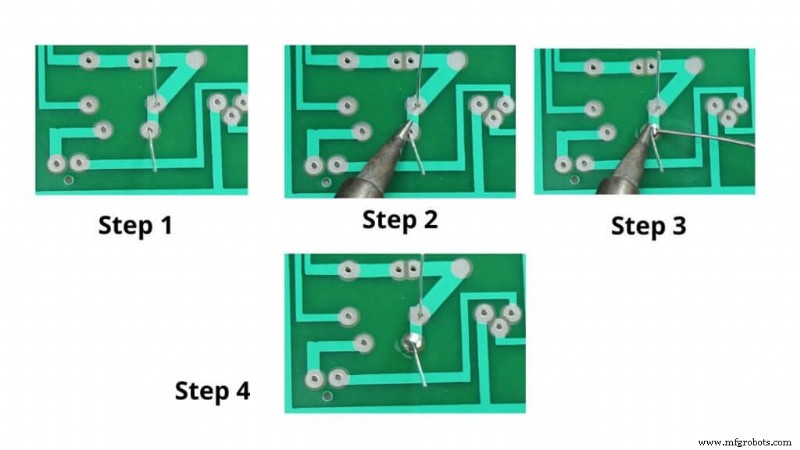
Step 1: Mount The Component: First, insert the cables from the LED into the holes in the circuit board. Flip the board over and bend the cables outward at a 45 ‘angle. This will help the component make a better joint with the copper pad and prevent it from falling out while soldering.
Step 2: Heat The Joint: Turn your soldering iron on and if it has an adjustable heat control, set it to 400’C. At this point, touch the tip of the iron to the copper pad and the resistor lead at the same time. You need to hold the soldering iron in place for 3-4 seconds in order to heat the pad and the lead.
Step 3: Apply Solder To Joint: Keeping the soldering iron on top of the copper pad and lead, touch the connection with your solder. IMPORTANT Do not touch the solder directly with the tip of the iron. You want the joint hot enough to melt the solder when touched. If the joint is too cold, a bad connection is formed.
Step 4: Snip The Leads Remove the soldering iron and let the solder cool naturally. Do not blow on the solder as this can result in a bad joint. After cooling, you can cut the extra wire from the cables.
A proper solder joint is smooth, shiny, and looks like a volcano or cone shape. You want just enough solder to cover the entire joint but not too much so it becomes a ball or spills to a nearby lead or joint.
How To Solder Wires
Now it’s time to show you how to solder wires together. It is recommended that you use helping hands or some other type of clamping device for this process.
First, strip the insulation from the ends of both wires that you are soldering together. When the wire is stranded, twist the strands together with your fingers. Make sure your soldering iron is fully heated and touch the tip to the end of one of the wires. Hold it by the wire for 3-4 seconds.
Holding the iron in place, touch the wire with the solder until it is completely coated. Repeat this process on the other wire. Hold the two tinned wires on top of each other and touch both wires with the soldering iron. This process should melt the solder and coat both wires evenly.
Remove the soldering iron and wait a few seconds for the solder joint to cool and harden. Use heat shrink tubing to cover the connection.
What is Desoldering?
In electronics, desoldering is the removal of solder and components from a circuit board for troubleshooting, repair, replacement, and salvage.
Desoldering is the process of melting the solder and removing the joints made between two materials. In electronics, it refers to the removal of electrical components from PCB for troubleshooting, repairing, replacing, and salvaging. Desoldering is most commonly used for this purpose.
To put it in simple terms, desoldering is the exact opposite of soldering. You undo everything that you did in the soldering process. Like soldering, desoldering is also an intricate process and requires some level of proficiency. You have to follow similar steps and adhere to strict safety measures as in the case of soldering.
Methods of Desoldering
There is more than one method of desoldering. Each one requires different tools and different levels of proficiency in soldering. Below is a comprehensive list of different methods you can use to desolder components.
1. Using a Soldering Iron
Soldering iron is the simplest and easiest method to desolder components. You do not need any other tools apart from the soldering iron and a pair of fliers.
Here is what you have to do,
- Heat the solder using the soldering iron until it starts to melt.
- Nudge the pins using the iron and move the solder away from the joints.
- Pull the components using pliers to remove them from the pinholes.
- While pulling the components, apply pressure at the tips instead of their bodies. Otherwise, the components may get damaged.
If you want to remove solder from holes, stick a safety pin inside the hole. This will suck the solder and help you to remove them easily.
Pros
- You only need a soldering iron to perform desoldering.
- You can reuse the desoldered components.
Cons
- If you use the soldering iron for too long, you may damage the board.
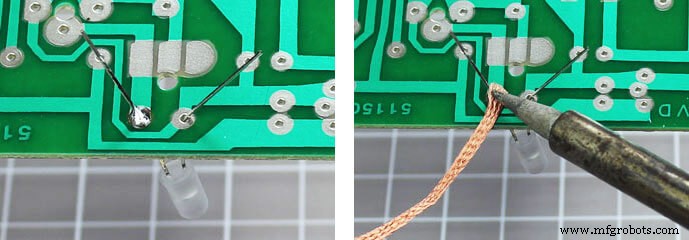
2. Using a Soldering Wick
The soldering wick method is used to remove unwanted solder after the process of soldering. Soldering wick is made by braiding and intertwining copper coils together. Hence, it is also known as a desoldering braid.
Copper wires are used to make the soldering wick because they are good conductors of heat. As solder is attracted to heat, the copper coils suck up the solder from the metal surface.
Some soldering wicks come with flux which makes it easier to remove the solder from the surface. If your solder wick does not have flux, you can dip the end of the wick into some flux to enhance the speed of solder removal.
Here is what you have to do to remove the solder,
- Intertwine a few inches of copper wires and form a braid.
- Apply some flux on the copper braid by dipping the end into flux.
- Place a portion of the solder wick on the joint you want to desolder.
- Keep a hot soldering iron at the tip of the solder wick and the desired pin.
- Wait for a few seconds until the solder melts and the solder wick sucks the melted solder.
- Take the solder wick and remove the portion of the wick that is covered with solder.
- Now, repeat the same process until you remove all the unwanted solder.
While handling the solder wick, ensure that you do not touch it using your hands as it will be very hot. Use a pair of pliers to hold and position it.
Pros
- The method is cheap, simple, and easy to use.
- The method is great for removing solder from flat surfaces.
- You can modify the size of the soldering wick depending on the amount of solder you want to remove.
- You can reuse the desoldered components.
Cons
- You can not reuse the soldering wick. You have to cut the portion covered in solder.
- As the soldering wick gets very hot, it can be difficult to position it against the joint.
- It is difficult to remove solder from pinholes using this method.
3. Using a Desoldering Pump
In this method, you use a desoldering pump to suck the solder. A desoldering pump is basically a small, high-pressure vacuum pump. Before using the pump to suck the solder, you have to heat and melt the solder.
Here are the steps to use the desoldering pump to remove the solder,
- Use a soldering iron to heat the solder until it melts.
- Squeeze the bulb or press down the plunger of the desoldering pump and place it on the molten solder.
- Release the bulb to suck up the solder.
- Some desoldering pumps will have a release button so that you do not have to keep squeezing the bulb.
- Remove the desoldered components.
- Repeat the same steps until you remove the excess solder.
Some desoldering pumps come with a soldering iron so that you do not have to get one separately. You can dispose of the solder in the desoldering pump by repeatedly squeezing and releasing the bulb.
Pros
- Desoldering pumps come in different styles and operating mechanisms for your ease of use.
- The method is great for removing solder from pinholes and desoldering small components.
- You can reuse the desoldered components.
Cons
- Most desoldering pumps are large. So, you will find it difficult to get them into tight spaces.
4. Using a Heat Gun
A heat gun works in the same way as a soldering iron. It heats up the solder so that you can remove the components. You can also use a hot air station instead of a heat gun. It is very effective but at the same, it is also expensive.
Here is how to desolder components using a heat gun,
- Turn on the heat gun.
- Hold the PCB firmly using a stand or pliers.
- Hold the tip of the heat gun against the solder until it melts.
- Remove the components using a pair of pliers.
When using the heat gun, ensure that you do not hold it against the board for too long. Otherwise, you will melt or damage the board.
Pros
- You can desolder and remove the components in a few seconds.
- You can reuse the desoldered components.
Cons
- As it heats the components very quickly, it damages the components in most cases and makes them unusable. In some cases, it also damages the board. If you are not careful, you can injure yourself as well during the process.
FAQs.
What is Soldering?
Soldering is a joining process used to join different types of metals together by melting solder. Solder is a metal alloy usually made of tin and lead which is melted using a hot iron. The iron is heated to temperatures above 600 degrees Fahrenheit which then cools to create a strong electrical bond.
What is Solder?
Solder is a fusible metal alloy used to create a permanent bond between metal workpieces. The solder is melted in order to adhere to and connect the pieces after cooling, which requires an alloy suitable for use as the solder has a lower melting point than the pieces being joined.
The solder should also be resistant to oxidative and corrosive effects that would degrade the joint over time. The solder used in making electrical connections also needs to have favorable electrical characteristics.
What are the types of Solder?
In short, there are 3 types of solders – lead-free or without lead, lead-based, and flux. Lead-based solders are the most reliable and preferred in critical applications like medical electronics or aerospace.
Is soldering welding?
Like many sheets of metal terms, soldering and welding are used interchangeably. However, while these two operations are similar, their process and sub-techniques are different. The main difference between welding and soldering is melting. In soldering, metal fabricators heat the metal to be bonded but never melt them.
What is soldering method?
Soldering is a process used for joining metal parts to form a mechanical or electrical bond. It typically uses a low melting point metal alloy (solder) which is melted and applied to the metal parts to be joined and this bonds to the metal parts and forms a connection when the solder solidifies.
What do I need to solder?
Below is the complete list of accessories that you will need while performing soldering,
- Soldering Preheaters.
- Soldering Helping Hands.
- Soldering Mat.
- Soldering Magnifying Glass.
- Smoke Absorber.
- Solder Tape.
- Tweezers Set.
- Soldering Iron Tip Cleaner (Brass Wool)
What are the two types of soldering?
There are three forms of soldering, each requiring progressively higher temperatures and producing an increasingly stronger joint strength:
- Soft Soldering, Which Originally Used a Tin-Lead Alloy as The Filler Metal.
- Silver Soldering, Which Uses an Alloy Containing Silver.
- Brazing Which Uses a Brass Alloy for The Filler.
Is soldering going to be illegal?
for any person to introduce into commerce any solder or flux that is not lead-free unless the solder or flux bears a prominent label stating that it is illegal to use the solder or flux in the installation or repair of any plumbing providing water for human consumption.
How do you solder step by step?
5 Important Steps of a Wave Soldering Process
- Step 1. Melting the Solder. This is the very first step in the entire wave soldering process.
- Step 2. Cleaning the Components. This is a very crucial step to be carried out.
- Step 3. Placement of the PCB.
- Step 4. Application of Solder.
- Step 5. Cleaning.
What are the three types of soldering?
In summary, there are three main types of solder: lead-based, lead-free, and flux.
What is solder made of?
Generally, solder alloys are based on the metals tin, lead, cadmium, zinc, and indium. They are available in a variety of physical forms to facilitate different means of application. Solder ingots are used to replenish large baths for dip or wave-soldering.
Do you need flux to solder?
Yes, you can solder without flux. While it is helpful in the process of soldering as the flux helps break down the oxides on the metal, it is not needed. Also, most solder nowadays comes with a rosin core which does the job of flux helping break down oxides.
How do you solder safely?
Soldering Safety
- Never touch the element of the soldering iron.
- Hold wires to be heated with tweezers or clamps.
- Keep the cleaning sponge wet during use.
- Always return the soldering iron to its stand when not in use. Never put it down on the workbench.
- Turn unit off and unplug when not in use.
What type of solder is strongest?
A 60-40 solder (60% tin, 40% lead) is the most expensive, but it makes the strongest bond and is easiest to work with because of its low melting point. Less expensive 40-60 solder is more difficult to use. A 50-50 solder is a good compromise between cost and ease of use.
Why is tin used in solder?
The tin/lead mixture allows for solder with a lower melt point than the two metals being bonded. In Welding, the same base metal can be used, for joining the two parts together.
Why flux is used in soldering?
In soldering of metals, flux serves a threefold purpose: it removes any oxidized metal from the surfaces to be soldered, seals out air thus preventing further oxidation, and by facilitating amalgamation improves wetting characteristics of the liquid solder.
Is solder as strong as welding?
The bond is created when the melted soldered material solidifies. Not as strong as welding or brazing. A soldered bond is not as strong as a welded or brazed one because it is not a mechanical connection. If soldering wasn’t done properly, the pieces won’t conduct electricity properly.
Can you solder onto wood?
Many surface finishes are solderable with the right flux. Many of our electronic devices use solder to bond copper, silver, gold, and other metals, but did you know that you can solder wooden surfaces too? Soldering to wood is easy with the correct flux.
What will solder not stick to?
Solder simply will not adhere to dirty or oxidized metal surfaces. Clean any flat surfaces which are to be soldered with steel wool, a file, emery cloth, etc. It’s important to take time to clean the surface thoroughly. Scrape any wire to be soldered with the back of a knife or any flat piece of metal.
Is it OK to solder electrical wires?
According to rule 110.14, it is not against the NEC code to have soldered electrical splices as long as it conforms to their rules. This can vary depending on local jurisdictions, but if it is considered old work, in most cases it would grandfather in unless deemed to be a fire hazard.
Can you solder 230v?
Yes, solder can easily melt under fault conditions. Although solder will become fluid around 180/220c, according to grade, it can become plastic below 120c.
What are the 4 types of solder?
The three main types of solder are lead-free solder, lead-based solder, and flux-core solder. There is another type known as silver alloy solder. These types are made on the composition of alloys. Apart from this, there are other solder types depending on the form, core style, and application.
What heat does solder melt?
Soft solder typically has a melting point range of 90 to 450 °C (190 to 840 °F; 360 to 720 K), and is commonly used in electronics, plumbing, and sheet metal work. Alloys that melt between 180 and 190 °C (360 and 370 °F; 450 and 460 K) are the most commonly used.
What can be soldered?
Metals that can be soldered include gold, silver, copper, brass, and iron. The filler, called solder, melts. When it solidifies, it is bonded to the metal parts and joins them. The bond is not as strong as a brazed joint or welded one.
What are the advantages of soldering?
Advantages of soldering;
- Low power is required;
- Low process temperature;
- No thermal distortions and residual stresses in the joint parts;
- Microstructure is not affected by heat;
- Easily automated process;
- Dissimilar materials may be joined;
- High variety of materials may be joined;
- Thin wall parts may be joined;
What can I use if I don’t have flux?
Petroleum jelly is the best effective alternative to commercial flux. Its waxes and mineral water ingredients make it an antioxidant that why you can easily use it as a soldering flux.
Can I use glue instead of solder?
There is no good substitute for soldering. No glue made will conduct electricity or hold as well as solder.
Manufacturing process
- 3D Printing Explained: Types, Processes, and How It Works
- Understanding Arc Welding: Types, How It Works, and Key Benefits
- Soldering Explained: Types, Techniques, and Step‑by‑Step Guide
- Understanding Gating Systems in Casting: Types, Design, and Best Practices
- Rapid Prototyping Explained: Types, Processes, and Benefits
- Additive Manufacturing Explained: Types, Processes, and Applications
- Arc Welding 101: Types, Techniques, and How It Works
- Brazing Explained: How to Join Metals with Precision and Strength
- Understanding Molding Sand: Types, Properties, and Its Role in Sand Casting
- Master Copper Brazing: A Complete Guide to Joining Tubes & Fittings