



Sine Bar Explained: Principles, Types, and Applications
What is Sine Bar?
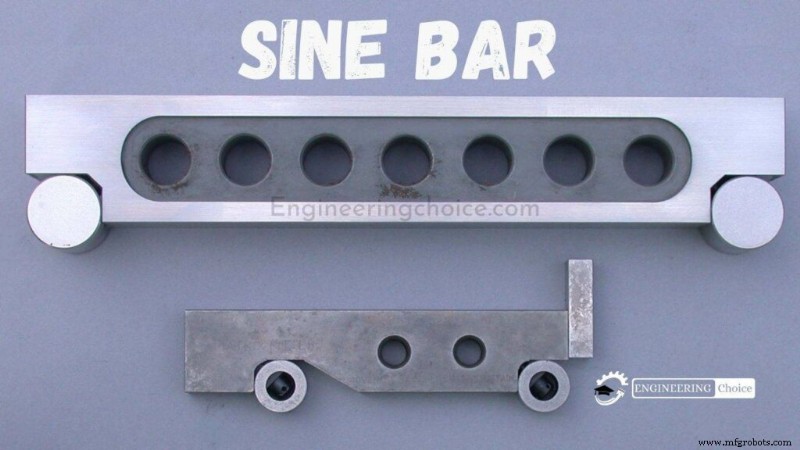
A sine bar consists of a hardened, precision ground body with two precision ground cylinders fixed at the ends. The distance between the centers of the cylinders is precisely controlled, and the top of the bar is parallel to a line through the centers of the two rollers.
The dimension between the two rollers is chosen to be a whole number (for ease of later calculations) and forms the hypotenuse of a triangle when in use.
When a sine bar is placed on a level surface the top edge will be parallel to that surface. If one roller is raised by a known distance, usually using gauge blocks, then the top edge of the bar will be tilted by the same amount forming an angle that may be calculated by the application of the sine rule.
- The hypotenuse is a constant dimension (100 mm or 10 inches in the examples shown).
- The height is obtained from the dimension between the bottom of one roller and the table’s surface.
- The angle is calculated by using the sine rule (a trigonometric function from mathematics). Some engineering and metalworking reference books contain tables showing the dimension required to obtain an angle from 0-90 degrees, incremented by 1-minute intervals.
Sin(angle) = (Perpendicular/Hypotenuse)
Angles may be measured or set with this tool.
Understanding the Sine Bar
A sine bar is used in conjunction with slip gauge blocks for precise angular measurement. A sine bar is used either to measure an angle very accurately or face locate any work to a given angle. Sine bars are made from high chromium corrosion-resistant steel, and are hardened, precision ground, and stabilized.
Two cylinders of equal diameter are placed at the ends of the bar. The axes of these two cylinders are mutually parallel to each other and are also parallel to, and at equal distance from, the upper surface of the sine bar. Accuracy up to 0.01mm/m of the length of the sine bar can be obtained.
A sine bar is generally used with slip gauge blocks. The sine bar forms the hypotenuse of a right triangle, while the slip gauge blocks from the opposite side. The height of the slip gauge block is found by multiplying the sine of the desired angle by the length of the sine bar: H = L * sin(θ).
For example, to find the gauge block height for a 13˚ angle with a 5.000″ sine bar, multiply the sin (13˚) by 5.000″: H = 5.000″ * sin (13˚). Slip gauge blocks stacked to a height of 1.124″ would then be used to elevate the sine bar to the desired angle of 13˚.
Principle
Angles are measured using a sine bar with the help of gauge blocks and a dial gauge or a spirit level. The aim of a measurement is to measure the surface on which the dial gauge or spirit level is placed horizontally.
For example, to measure the angle of a wedge, the wedge is placed on a horizontal table. The sine bar is placed over the inclined surface of the wedge. At this position, the top surface of the sine bar is inclined the same amount as the wedge.
Using gauge blocks, the top surface is made horizontal. The sine of the angle of inclination of the wedge is the ratio of the height of the gauge blocks used and the distance between the centers of the cylinders.
Types of Sine Bar
The simplest type consists of a lapped steel bar, at each end of which is attached an accurate cylinder, the axes of the cylinders being mutually parallel and parallel to the upper surface of the bar. In the advanced type, some holes are drilled in the body of the bar to reduce the weight and facilitate handling.
1. Sine center
A special type of sine bar is sine center which is used for conical objects having male and female parts. It cannot measure an angle of more than 60 degrees.
2. Sine table
A sine table (or sine plate) is a large and wide sine bar, typically equipped with a mechanism for locking it in place after positioning, which is used to hold workpieces during operations.
3. Compound sine table
It is used to measure the compound angles of the large workpieces. In this case, two sine tables are mounted one over the other at right angles. The tables can be twisted to get the required alignment.
Limitations
Following are the limitations of sine bar:
- Any unknown projections present in the component will cause errors in the measured angle to be induced.
- For the construction of slip gauges, there is no scientific approach available and it has to be built on trial-and-error basis and it is a time-consuming process.
- During the measurement of the angle using the sine bar, the sine bar length must be greater than or equal to the length of the component to be inspected.
- If the length of the inspected component is too long, there is no sine bar available that is longer than the component. In these cases, the sine bar will be used together with the height gauge for measurement.
Applications
Following are the applications of sine bar:
- The sine-bar is used to set or determine the workpiece at a given angle.
- For checking the measurement of unknown angles in the workpiece.
- Some specially designed sine bars are used to mount the workpiece to perform conical-shaped machining for the workpiece.
- To check for unknown angles on heavy components.
- For checking the angles of taper key.
- To check the flatness of the surface.
Manufacturing process
- Boring Machine Explained: Types, Uses, and Applications
- Understanding the Sine Bar: Key Principles, Types, and Applications
- Laser Welding Explained: Techniques, Types, and Industrial Applications
- Extrusion Explained: Process, Types, and Practical Applications
- Thermal Spraying Explained: Types, Applications, and Benefits
- Forging Process: Types, Operations, Applications, Benefits & Drawbacks Explained
- Understanding Boring Machines: Types, Uses, and Applications
- Extrusion Explained: Process, Types, and Key Applications
- Laser Welding Explained: Techniques, Types, and Industrial Applications
- Thermal Spraying Explained: Types & Applications Across Industries