



Advanced SMT Manufacturing: Mastering Surface Mount Technology
Have you ever been curious about how washing machine goes into different function mode when you just press some buttons? The secret behind is a PCBA, printed circuit board assembly.
In today’s life electrical machines are not only a cable plus a single-functional appliance, but a ‘helper’ with various capabilities.
The PCBA brings this into reality by gathering different kinds of electronic components together on a very small area of substrate called PCB, providing a circuit that can undertake complex and multi-functional tasks.
Now it’s time for what we’re going to say today, SMT.
What is SMT?
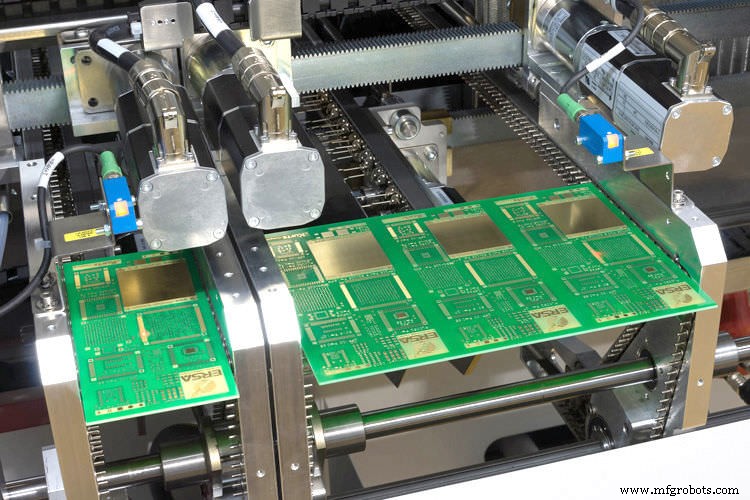
SMT, short for surface mount technology, is a method that attaches electronic components onto the surface of PCB.
Basically it solders SMC (surface mount components) onto the boards through reflow soldering.
Process of SMT manufacturing
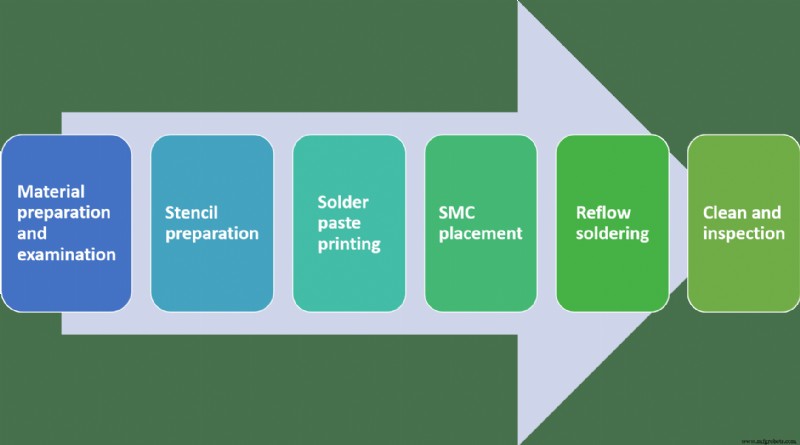
1. Material preparation and examination
Prepare the SMC and PCB and exam if there’s any flaws. The PCB normally has flat, usually tin-lead, silver, or gold plated copper pads without holes, called solder pads.
2. Stencil preparation
Stencil is used to provide fixed position for solder paste printing. It’s produced according to the designed positions of solder pads on PCB.
3. Solder paste printing
Solder paste, usually a mixture of flux and tin, is used to connect the SMC and solder pads on PCB. It’s applied to PCB with the stencil using a squeegee on a angle range from 45°-60°.
4. SMC placement
The printed PCB then proceed to the pick-and-place machines, where they are carried on a conveyor belt and the electronic components are placed on them.
5. Reflow soldering
- Soldering oven: after SMC was placed, the boards are conveyed into the reflow soldering oven.
- Pre-heat zone: the first zone in oven is a pre-heat zone, where the temperature of the board and all the components is raised simultaneously and gradually. Temperature ramp up rate in this section is 1.0℃-2.0℃ per second until it reaches 140℃-160℃.
- Soak zone: the boards will be kept in this zone on temperature from 140℃-160℃ for 60-90 seconds.
- Reflow zone: the boards then enter a zone where the temperature ramp up at 1.0℃-2.0℃ per second to the peak of 210℃-230℃ to melt the tin in the solder paste, bonding the component leads to the pads on the PCB. The surface tension of the molten solder helps keep the components in place.
- Cooling zone: a section to ensure solder freezes at exit of heating zone to avoid joint defect.
If the circuit board is double-sided then this printing, placement, reflow process may be repeated using either solder paste or glue to hold the components in place.
6. Clean and inspection
Clean the boards after soldering, and check if there’s any flaws. Rework or repair the defects and store the products. Common equipment related to SMT include magnifying lens, AOI (Automated Optical Inspection), flying probe tester, X-ray machine, etc.
This is what we have for this post. If you want to know more about SMT, just leave your comment below or contact us. We’re glad to hear from you!
Note: We do not own the images used in this post. Feel free to contact us if they belong to you, and we’ll take them down as quickly as we possibly can.
Manufacturing process
- Comprehensive Guide to Printed Circuit Board Manufacturing Process
- SMT in PCB Manufacturing: Unpacking Surface‑Mounted Technology and Its Impact
- Mastering PCB Assembly: 6 Essential Steps for Consistent Quality
- 8 Key Steps for Precise Rigid‑Flex PCB Production
- Surface Mount Technology Explained: The Future of PCB Integration
- Key PCB Design Factors for Optimal SMT Manufacturing
- Mastering the Soldering Process: A Professional Guide to Precise Metal Joining
- PCB Manufacturing: A Step‑by‑Step Guide to Printed Circuit Board Production
- Top 3 FAQs About Surface Mount Technology Explained
- 5 Key Stages in PCB Manufacturing: From Design to Delivery