



Flexible PCB Reliability Testing: Key Areas to Focus On
To ensure the quality of a certain product, it’s a standard procedure that we carry out reliability test. Then what are the tests for FPC (flexible printed circuit)? We summarize some of the most important tests and the related instruments in this post.
There are mainly 3 parts in FPC reliability examination:
- reliability verification,
- chemistry, hazardous substances analysis and
- failure analysis.
1. Reliability verification
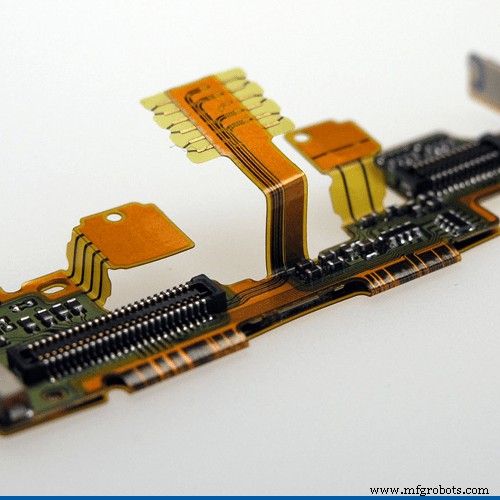
The reliability verification is about verifying the raw materials, processes and products to control the new product development stage and mass production. It involves the majority of tests and instruments, let’s take a look at them one by one.
1.1 Material physical performance test
There’s no doubt that the flexible ability is the key ability of materials for FPC. The enduring snap tester and flexible endurance tester work together to check the bending and flexible ability of the materials.
1.2 Thickness measurement
Thickness is one of the key parameters of FPC product. We use X-ray film thickness tester to check if the thickness of electroplating product matches the standard.
1.3 Electrical performance test
Electrical performance highly influences the performance of FPC. We use a VNA (vector network analyzer) to do the high frequency and high speed circuit loss measurement. And a TDR (time-domain reflectometer) is applied to do the characteristic impedance test.
1.4 Soldering quality test
Soldering is an important control point in the manufacturing process of FPC. Thus, a wetting balance tester is used to check the quality of soldering.
1.5 Wire bonding test
As another crucial control point, wire bonding determines the quality of connection between FPC and other parts of components. The advanced automatic wire bonding instrument can verify the bond pad by imitating the parameters of wire bonding.
Additionally, a tensile testing instrument is applied to test the solder push force or wire bonding tensile ability.
1.6 Environmental test
In order to examine whether the FPC product can withstand different environment, the environmental test is necessary. A thermal shock tester is used to do the temperature cycling and thermal shock test for both products and materials.
Meanwhile, we use a temperature and humidity chamber to do the temperature and humidity cycling as well as the aging test for both products and materials.
2. Chemistry, hazardous substance analysis
Environmental protection is a hot topic nowadays. Thus, we proceed qualitative and quantitative analysis aiming for the chemical solution in the process and hazardous substance in the product to ensure the stability of the process and the conformity of green product regulations.
Here, we use the ICP (Inductively coupled plasma) optical emission spectrometer to quantitatively analyze the heavy metal and hazardous substance.
As for solution, we use an ion chromatography tester to analyze the concentration of anion, a UV (ultraviolet ray) spectrophotometer to analyze the chemical solution during the process and the hexavalent chromium content by the directive of RoHS (Restriction of Hazardous Substances), an atomic absorption spectrometer to analyze the metal concentration in the solution.
3. Failure analysis
Last but not the least, we carry out failure analysis for the abnormality in process or customer’s side by precision instruments to get the root causes of the abnormal to improve the process.
To do a failure analysis, it’s intuitional that we check the circuit first. Therefore here we also use the VNA to examine the where’s the short or broken circuit. Then scanning electron microscope and energy dispersive spectrometer are joining in to analyze the abnormality and the elements of contamination.
In the final step, a Fourier transform infrared spectrum is used to analyze the compounds for identifying the sources of pollution through the establishment of pollution sources database.
If you want to know more about FPC or you have difficulty selecting a FPC supplier, just contact us. We’re hearing.
Note: We do not own the images used in this post. Feel free to contact us if they belong to you, and we’ll take them down as quickly as we possibly can.
Manufacturing process
- Reliability: The Comprehensive Guide to Asset Management
- Building a Reliability Culture: Ownership, Collaboration, and KPI Success
- Aligning Incentives to Build Machine Reliability
- What Makes a Reliability Professional? A Practical Guide to Hiring & Leadership
- Understanding PCB Legends: Purpose, Placement, and Benefits
- How Test Points Enhance PCB Testing and Production Efficiency
- Essential Considerations for HDI PCB Layout: Mastering Key Design Aspects
- Precision Machining Explained: Key Tips & Best Practices for CNC Operations
- Understanding Vacuum Tube Testers: A Comprehensive Guide
- Comprehensive PCB Reliability Test Methods for Ensuring Quality