



Why Accurate Equipment Bill of Materials Is Critical for Reliable Operations
The core mission of any materials‑management team is to deliver the right parts in the right quantities at the right time. That mission relies on a single, often overlooked foundation: the equipment bill of materials (EBOM). Without a complete and accurate EBOM, material‑planning decisions are made in a vacuum, leading to excess inventory, stockouts, expediting fees and costly downtime.
For manufactured items, the bill of materials (BOM) lists every raw material, component and sub‑assembly needed for a single finished unit. An EBOM extends that concept to an entire asset—capturing every assembly, sub‑assembly and component that make up a machine or piece of equipment. A reliable EBOM gives planners the exact parts they need and, in emergencies, empowers technicians to quickly identify and procure the correct replacement parts.
This article presents practical guidelines for ensuring EBOM data is both available and accurate, thereby equipping materials management with a powerful tool for maintaining optimal inventory levels while safeguarding production uptime.
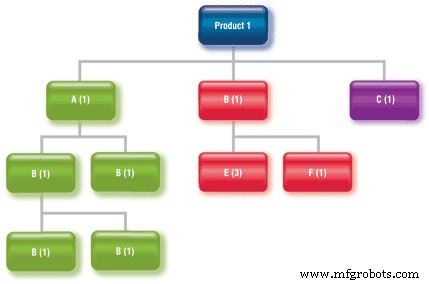
This tree shows a product structure for “Product 1.”
EBOM Structures
Figure 1 illustrates a generic product structure for “Product 1,” comprising assemblies, sub‑assemblies and components in varying quantities. The same structure could represent either a manufactured item or an equipment asset.
The most common EBOM formats are single‑level (a “spare parts list”) and multi‑level (an indented product structure). Examples appear on Page 31.
Single‑Level EBOM
Figure 2 shows a simple single‑level EBOM for Product 1. Each part appears only once, with the total quantity needed for the entire asset. This format is convenient for exploding material requirements in manufacturing contexts, where production needs are derived from a master schedule.
For equipment, however, a single‑level BOM obscures parent‑child relationships among assemblies, sub‑assemblies and components. A maintenance planner might mistakenly assume that all listed items are required for every repair, which is rarely the case when only a specific sub‑assembly fails.
Multi‑Level EBOM
Figure 3 presents a multi‑level BOM that indents components to reveal their hierarchical relationships. Though creating and entering this structure demands more effort, the increased specificity is invaluable when determining the exact parts needed for a particular repair or replacement.
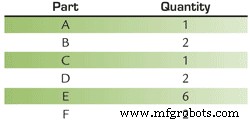
Figure 2: Single‑level BOM for “Product 1.”
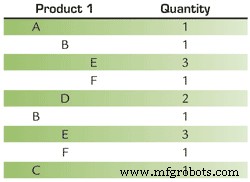
Figure 3: Multi‑level BOM for “Product 1.”
EBOM Creation
Developing an EBOM is a disciplined, step‑by‑step process that should be executed systematically:
Identify Assets Needing an EBOM
All assets ultimately benefit from an EBOM, but priority should be based on criticality. Every critical asset must have an EBOM; other assets should follow as resources allow.
Determine Included Items
Include any spare part or component that may be replaced during preventive (PM) or corrective (CM) maintenance. At minimum, the EBOM must list critical spares. It should also encompass all materials directly used in repairs or those whose usage history is valuable in the CMMS.
Typically, specialty tools, free‑issue small hardware, consumables (rags, towels) and personal protective equipment are excluded.
Specify Required Data Fields
Most CMMS platforms support the following core elements:
- CMMS part number
- Detailed description
- Quantity per asset
- Unit of measurement
- Manufacturer
- Manufacturer’s part number
Additional fields that add value include:
- Preferred supplier
- Supplier part number
- Authorized substitutes
- Revision date or effective dates
- Estimated price
Collect Accurate Data
- Who provides the data? Reliability engineers (REs) usually coordinate this effort. Accuracy is paramount, regardless of the source.
- Where does the data come from? The most reliable source is the original equipment manufacturer (OEM). Request the equipment manual at purchase, assign part numbers, and populate the CMMS before the asset enters service. Alternative sources include supplier documentation, nameplate data, engineering change notices (ECNs), work‑order history and expert knowledge from operators or technicians.
Enter Data into the CMMS
Anyone with sufficient system knowledge and data‑entry skills can populate the EBOM. While materials management often takes the lead, the CMMS may offer automated options to add parts to an EBOM when they are issued on a work order. Such automation can be powerful but must be monitored to preserve data integrity.
EBOM Maintenance
Once created, an EBOM must be updated and reviewed regularly to maintain accuracy:
Decommissioning
Delete the EBOM when an asset is retired. Review each linked item to determine if it can be reused, sold or scrapped.
Design Changes
Reflect any manufacturer‑ or user‑initiated redesigns that alter spare parts or components. After updating, assess existing inventory for reuse or disposal to prevent obsolescence.
Part Substitution and Standardization
When material availability or best practices dictate alternative parts, authorize substitutes and, where possible, standardize similar components across multiple assets or plants. Include effective start and stop dates if supported.
EBOM Review
The planner, as the primary EBOM user, should routinely verify data accuracy. Quick checks during planning are effective, but periodic, board‑led reviews—mirroring inventory cycle counts—provide deeper insight and collective expertise.
EBOM Metrics
Track these two key metrics to gauge EBOM effectiveness:
- EBOM Completion: Aim for 100 % coverage on critical assets and 95 % on others.
- EBOM Accuracy: Measure line‑item or overall accuracy during reviews. Target 100 % for critical assets (no errors) and 98 % for others (no more than one error per 50 items).
EBOM Benefits
Accurate EBOMs deliver tangible benefits, both direct and indirect:
- Fewer incorrect purchases – precise data reduces guesswork and supplier errors.
- Faster planned work – streamlined procurement shortens maintenance windows.
- Quicker unplanned repairs – technicians can locate parts instantly and expedite replacements.
- Efficient inventory disposal – identify non‑moving items no longer needed for active assets.
- Enhanced reliability engineering – standardize or substitute parts across similar equipment.
Extending the BOM
Many CMMS platforms offer a “where used” feature, allowing queries on a part to reveal all EBOMs that reference it. This capability aids in assessing the impact of decommissioning or design changes. Additionally, a critical‑spare flag within the part master helps ensure essential items are always on hand to prevent production loss.
Summary
Ultimately, the RE provides initial EBOM data and engineering changes; the planner ensures ongoing accuracy. Successful EBOM management is a collaborative effort, requiring clear communication and teamwork across reliability, maintenance, and materials functions.
Doug Wallace is a materials‑management expert for Life Cycle Engineering. To learn more, e‑mail dwallace@LCE.com, call 800‑556‑9589 or visit www.LCE.com.
Equipment Maintenance and Repair
- Why Proactive Equipment Maintenance Drives Manufacturing Efficiency & Cost Savings
- Why Oil Analysis Is Crucial for Equipment Reliability
- Mandatory Routine Maintenance: Boosting Equipment Safety and Longevity
- Why a Warranty Matters: Protecting Your Manufacturing Equipment
- Why Regular Maintenance Is Critical for Construction Equipment Reliability
- Why Friction Materials Are Essential for Reliable Safety Systems
- Mastering Bill of Materials Creation in Manufacturing
- Why Regular Equipment Inspections Save Time, Money, and Ensure Safety
- Protect Your Manufacturing Plant: Key Winterization Practices
- Why Maintenance Management Matters: Key Benefits and Essential Practices