



20 Proven Benefits of a CMMS: Boost Efficiency, Cut Costs, and Enhance Safety
Adopting a Computer‑Based Maintenance Management System (CMMS) can seem daunting—researching vendors, justifying ROI, and training staff. Yet the tangible returns—time savings, cost reductions, improved safety, and data‑driven insights—often outweigh the initial effort.
Table of contents
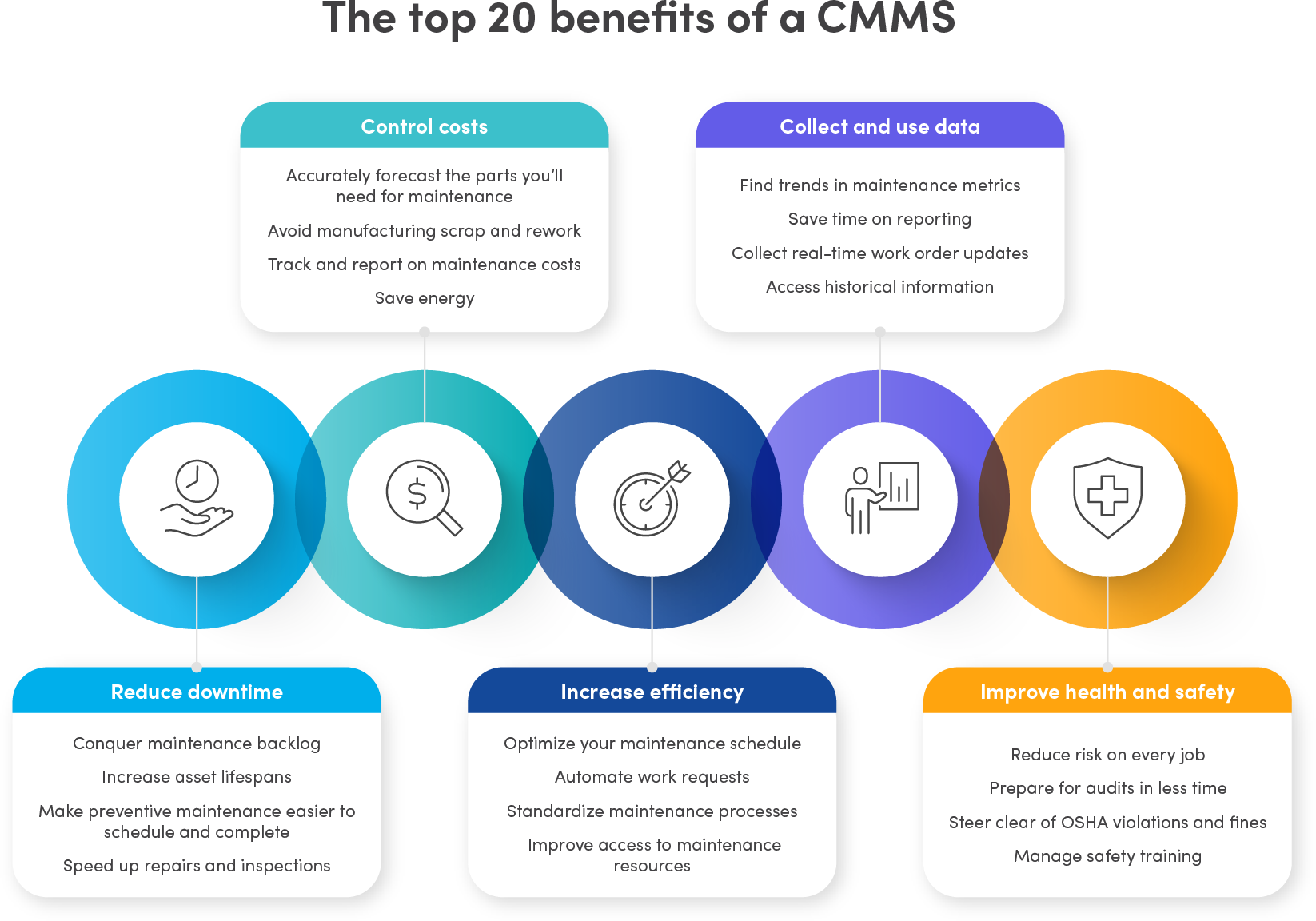
- Reduce downtime
- Control costs
- Increase efficiency
- Collect and use data
- Improve health and safety
- Beyond the basics: CMMS as a strategic asset
20 CMMS Benefits
Reduce Downtime
1. Tackle the maintenance backlog
While a small backlog is inevitable, excessive work waiting to be done can cripple operations. For example, backlogged maintenance at U.S. national parks was estimated at $12 billion, illustrating the need for rigorous scheduling. A CMMS levels resource allocation, tracks every repair, and ensures no job slips through the cracks.
2. Extend asset lifespans
Industrial equipment in the U.S. averages 35 years—its longest lifespan since the 1940s. Aging machinery often fails not because of design flaws but due to neglected upkeep. By integrating a CMMS with sensors, PLCs, SCADA, and MES, operators receive real‑time health data, predict failures, and schedule preventive work before breakdowns occur.
3. Streamline preventive maintenance (PM)
Preventive maintenance reduces unexpected failures, but scheduling PM remains a challenge. CMMS automates work orders via triggers based on usage, time, or condition, so maintenance teams can focus on execution rather than logistics.
4. Accelerate repairs and inspections
Downtime spikes when repairs take too long. A mobile CMMS app gives technicians instant access to equipment history, diagrams, spare‑part locations, and more, cutting repair time to a minimum. The system also flags prolonged tasks, enabling continuous improvement.
Case study: Reducing downtime by 54% with a CMMS
Perth County Ingredients’ maintenance manager, Tom Dufton, battled frequent machine failures. After implementing a CMMS, reactive maintenance dropped 54 % and after‑hours call‑ins fell 42 %. Read Tom’s full story here.
Control Costs
5. Forecast parts demand accurately
Uncontrolled inventory inflates costs by 12–20 %. A CMMS automates purchasing, tracks stock, and uses AI‑driven forecasting to eliminate over‑ and under‑stocking, reducing waste and avoiding rush orders.
6. Eliminate scrap and rework
Scrap and rework consume energy, generate waste, and erode productivity. A robust PM program—enabled by a CMMS—prevents unplanned failures and the associated rework, keeping production on schedule.
7. Track maintenance expenditures
Every work order includes parts, labor, and other costs. CMMS reporting reveals spending patterns, allowing managers to compare reactive versus planned maintenance costs and justify capital investments.
8. Cut energy consumption
American manufacturers spend $230 billion annually on energy. Well‑maintained equipment is more efficient; reactive maintenance wastes energy. A CMMS optimizes PM schedules and eliminates inefficiencies, driving measurable energy savings.
Case study: Cutting inventory costs by millions with a CMMS
Liberty Oilfield Services suffered from phantom inventory losses that crippled quarterly budgets. After adopting a CMMS, inventory gaps disappeared, and CFOs reported negligible inventory costs. Read Liberty’s full story here.
Increase Efficiency
9. Optimize maintenance scheduling
Planning is only as good as the data fed into it. By integrating CMMS with real‑time monitoring tools, managers fine‑tune PM frequencies and allocate staff where they’re needed most.
10. Automate work requests
Legacy request methods—phone, sticky notes, whiteboards—are error‑prone. CMMS eliminates manual entry, allowing staff to log requests, trigger PMs, or connect sensors that automatically generate work orders.
11. Standardize processes
Consistency reduces downtime and costs. A CMMS lets teams create checklists, workflows, and reporting templates, ensuring everyone follows best practices.
12. Centralize maintenance resources
With a single digital hub, technicians can access manuals, videos, and inventory data instantly—cutting knowledge‑gap delays and audit risks.
Case study: Saving hundreds of labor hours with a CMMS
Ryan Robinson’s tree‑grower facility once relied on paper binders. Digital work‑order histories and real‑time asset data cut manual scheduling and redundant repairs, saving hundreds of labor hours annually. Read Ryan’s full story here.
Collect and Use Data
13. Identify maintenance trends
CMMS captures actionable metrics—mean time between failures, cost per repair, and more—enabling data‑driven decision making.
14. Reduce reporting effort
Automated KPI dashboards replace tedious Excel spreadsheets, delivering real‑time insights and reducing human error.
15. Track real‑time work‑order status
Live updates on priority, assignee, and duration let managers reallocate resources promptly, preventing bottlenecks.
16. Preserve historical data
Each asset’s log of repairs, inspections, and labor hours remains intact, protecting critical knowledge from turnover.
Case study: Increasing wrench time by 540 hours a year with a CMMS
Rambler Metals & Mining transformed fragmented notes into structured data, boosting productivity by 15 % and adding 540 hours of wrench time annually. Read Rambler’s full story here.
Improve Health and Safety
17. Minimize on‑the‑job risks
Work orders can embed checklists, safety data sheets, and PPE requirements, ensuring technicians execute tasks safely.
18. Simplify audit preparation
CMMS makes compliance evidence searchable, enabling swift audit reports and reducing the risk of costly fines.
19. Avoid OSHA violations
Visible safety procedures on the CMMS platform prevent oversight and keep teams compliant.
20. Manage safety training
By tracking certifications and generating safety reports, CMMS ensures staff receive timely, relevant training—reducing injuries by up to 24 %.
Case study: Achieving perfect audits for six years with a CMMS
Scottish Sea Farms now enjoys flawless audit results across six facilities, thanks to a CMMS that streamlines compliance and training. Read Scottish Sea Farm’s full story here.
Bonus Benefit: Connect with Maintenance Experts
Maintenance teams thrive on community. A forward‑thinking CMMS vendor offers access to events, forums, and training—turning software into a gateway for knowledge exchange.
CMMS: More Than a Tool, a Strategic Asset
Every facility stakeholder—from line technicians to CFOs—seeks efficiency, cost control, or data insight. A CMMS equips all with the information and automation necessary to eliminate waste, uncover opportunities, and harness workforce talent.
Equipment Maintenance and Repair
- 7 Key Advantages of Computerized Maintenance Management Systems (CMMS)
- How Mobile Plant Maintenance Drives Efficiency, Productivity, and Profitability
- How Predictive Maintenance Drives Efficiency and Cuts Downtime
- Cloud Maintenance: Unlocking Efficiency, Reliability, and Cost Savings
- Maintenance Software vs Spreadsheets: Why CMMS Outperforms Manual Tracking
- Transforming Life‑Science Operations: Trends, Regulations, and the Strategic Edge of CMMS
- How a CMMS Transforms Facility Management: Key Benefits Explained
- Unlocking Efficiency: The Proven Advantages of Preventive Maintenance Software
- 5 Key Benefits of Preventative Maintenance for Industrial Equipment
- Unlocking Efficiency: The Benefits of Mobile CMMS Software