



Understanding Slitting Saws: Design, Function, and Applications
When a machinist needs to cut material significantly deeper than wide, a Slitting Saw is an ideal choice to get the job done. These are unique due to their composition and rigidity, which allows it to hold up in a variety of both straightforward and tricky to machine materials.
What is a Slitting Saw?
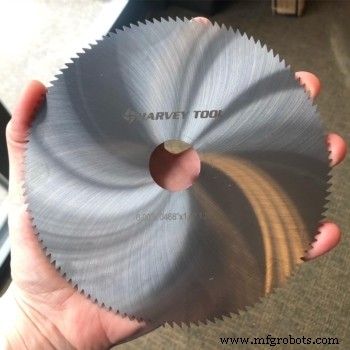
A Slitting Saw is a flat (with or without a dish), circular-shaped tool that has a hole in the middle and teeth on the outer diameter. Used in conjunction with an arbor, this tool is intended for machining purposes that require a large amount of material to be removed within a small diameter, such as slotting or cutoff applications.
Other names include (but are not limited to) Slitting Cutters, Slotting Cutters, Jewelers Saws, and Slitting Knives. Both Jewelers Saws and Slitting Knives are particular types of saws. Jewelers Saws have a high tooth count enabling them to cut tiny, precise features, and Slitting Knives have no teeth at all. On Jewelers Saws, the tooth counts are generally much higher than other types of saws in order to make the cuts as accurate as possible.
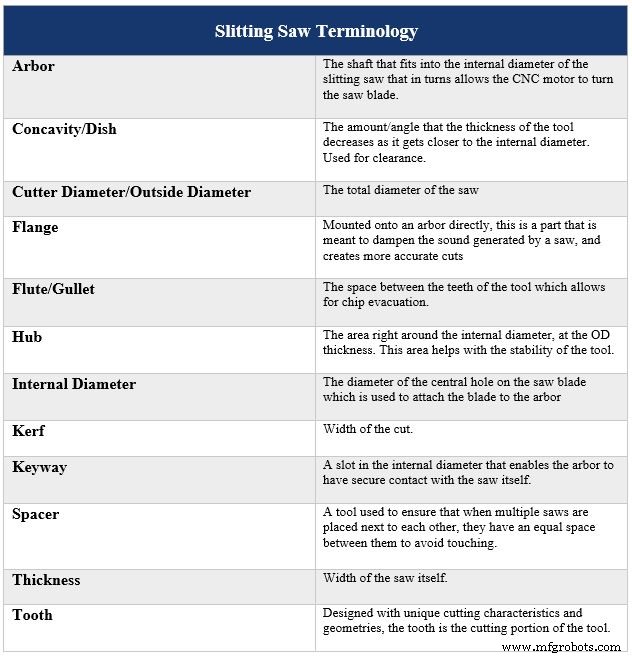
Key Terminology
Why Use a Slitting Saw?
These saws are designed for cutting into both ferrous and non-ferrous materials, and by utilizing their unique shape and geometries, they can cut thin slot type features on parts more efficiently than any other machining tool. Non-Ferrous slitting saws have fewer teeth, allowing for aggressively deep depths of cut.
Common Applications:
- Separating Two Pieces of Material
- If an application calls for cutting a piece of material, such as a rod, in half, then a slitting saw will work well to cut the pieces apart while increasing efficiency.
- Undercutting Applications
- Saws can perform undercutting applications if mounted correctly, which can eliminate the need to remount the workpiece completely.
- Slotting into Material
- Capable of creating thin slots with a significant depth of cut, Slitting Saws can be just the right tool for the job!
When Not to Use a Slitting Saw
While it may look similar to a stainless steel circular saw blade from a hardware store, this tool should never be used with construction tools such as a table or circular saw. Brittle saw blades will shatter when used on manual machines, and can cause injury when not used on the proper set up.
In Conclusion
Slitting Saws can be beneficial to a wide variety of machining processes, and it is vital to understand their geometries and purpose before attempting to utilize them in the shop. They are a great tool to have in the shop and can assist with getting jobs done as quickly and efficiently as possible.
CNC Machine
- Doosan Group & Puma Turning Center: A Legacy of Innovation
- Aluminum Extrusion: From Historical Roots to Future Innovations
- Technology in Manufacturing: Benefits, Challenges, and Future Outlook
- Understanding G‑Code vs M‑Code: Key Differences for CNC Operators
- Cold Saws: Precision Cutting Machines for Modern Fabrication
- Bandsaw Types Explained: Selecting the Perfect Saw for Every Cutting Task
- Band Saws vs. Circular Saws: Which Cutting Tool Delivers the Best Performance?
- The Evolution of Sawing: From Brass Reinforcements to Steel Innovations
- Tracing the Evolution of Band Sawing: Key Innovations and Industry Impact
- Precision Laser Engraving for Aerospace: Ensuring Safety & Quality