



CNC Prototyping: Elevating Precision, Reliability, and Production Speed in Aviation
Posted on Oct 9th, 2020 | By WayKen Rapid Manufacturing
Development of the aviation industry of a country truly reflects the quality of craftsmanship and the level of technical knowledge it possesses. Requirements of structural rigidity, precision, accuracy, quality and reliability are really critical for this industry. The concept of improvement in aircraft design and inducing pace in the production lineups has always remained a challenge.
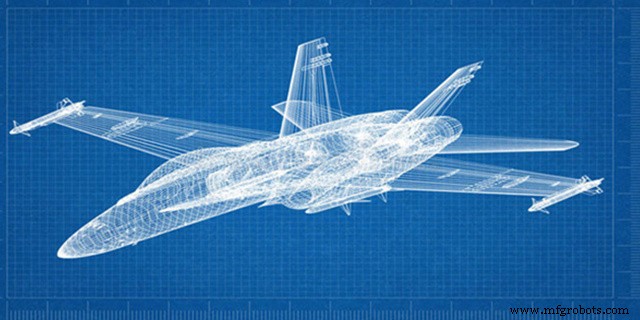
Therefore, CNC machining and prototyping made their way into this industry. CNC machines, that are able to meet tight tolerance requirements, provide a great solution to meet a diverse set of requirements while keeping up with the pace of production,too. As the article progresses, we will discuss in detail the various parameters that come into play in the aviation industry and how CNC technology revolutionizes it.
Why is CNC Technology Suitable for the Aviation Industry?
In an article by Lufthansa, it was claimed that it took Boeing 6 million parts to build the 747-800 commercial liner. There are several advantages that CNC technology brings forth to the aviation industry. Let us discuss some of these:
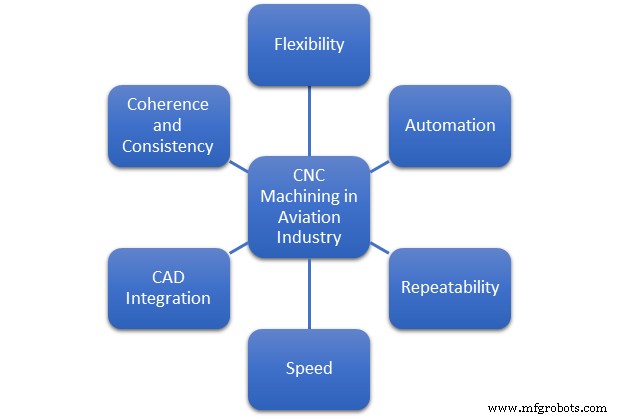
- Automation and flexibility are two key required parameters in the aviation industry. Production lineups are not redundant. CNC technology provides the ability for production lineups to quickly adapt for various parts. Therefore, a diverse set of machining processes can be accomplished. Multiple CNC processes can be completed on the same machine under a single clamping. This helps reduce the processing and production time by a great margin thus increasing profit margins and efficiency.
- There are numerous pros for producing parts utilizing this method which include precision, repeatability, speed and CAD Integration.
- Unlike manual milling that is solely human-controlled, variations between copies are huge whereas duplicates being made through CNC Mills ensure a perfect copy of the object every time. The integration of Computer-Aided Design (CAD) into the CNC Mills allows for better performance and perfect copies to be produced each time. One can design, modify or recast any part as needed prior to being produced. The design carved on CAD can easily be adjusted allowing different programs to be created whereby then feeding the design in the CNC machine allows the mill to produce a physical copy of the part. This can rapidly lead to fast and easy prototyping.
- The advancement of technology not only in the commercial sector but also within a country’s armed forces has escalated the demand for aircraft that are consistent in quality with minimum flaws. To produce perfect copies of parts with accuracy and to keep up with the demand of companies like Boeing, Lockheed-Martin, Vickers, and others, CNC machines are the best substitute. CNC machines ensure both consistency and coherence of the parts that are produced allowing for better quality products to be manufactured and used in the aviation industry. Many of the aerospace parts today are required to be produced out of one solid piece of aluminum billet or forgings or other materials like stainless steel and other high-stress alloys so that they can lift heavy weights and provide structural strength to the aircraft. Copies of parts like these can be easily manufactured in CNC machines with little to no difference at all.
- The increased demand of aircraft manufacturers who are looking for aviation parts has paved the way for numerous businesses to invest millions of dollars in companies providing CNC machining services both in the commercial sector as well as the military. Large companies have gone as far as to manufacture enormous parts with dimensions amounting to diameters of 50”, length of 60”, the width of 40”, and height of 32”. The weight of CNC machined parts can exceed 100lbs in total. These CNC machining service providers can afford and host such large numerically computer integrated controlled mill machines and also provide manufacturers with parts following tough criteria of tolerances. The places where tolerance is measured include the flatness, roundness, and cylindricity; flatness as low as ±0.000002 in., diameter roundness ±0.00005 in., and cylindricity ±0.001in. These close tolerances play a major role in parts like the landing gear regarding which Raymer quotes: “Of the many internal components that must be defined in an aircraft layout, the landing gear will usually cause the most trouble.”
- Tolerances have a major role in parts where there is little room for errors in size. There are CNC machining providing companies that specialize in the creation of such parts. The manufacturing of aviation parts has forced companies to invest in equipment that would allow them to complete the manufacturing in a single clamping.
Applications of CNC Machining in the Aviation Industry
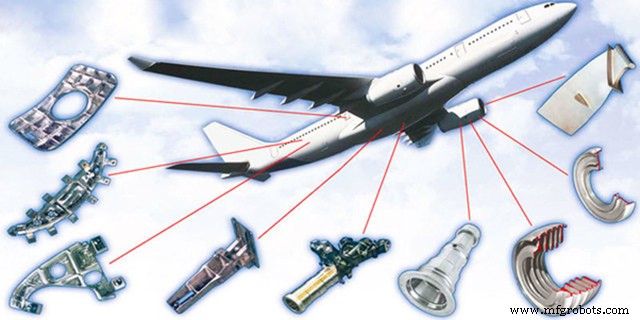
The evolving complexity of parts in modern aircraft requires immense precision. What started from wood, wire and other basic materials in 1903 has quickly evolved to the use of modern composites and metals in this industry. Today’s modern aircraft involves the use of a complex system of avionics, state of the art hydraulic systems, aerodynamically streamlined control surfaces, trim systems and servo tabs and revolutionary engine systems.
As these systems evolve rapidly, there is always a need for custom parts to improve existing airframes. It is not always viable to design entirely new aircraft from scratch for some improvements. To increase cost viability, a list of upgrades and part replacements is drafted for several aircraft lineups. The orders for similar custom parts are then amalgamated which provides both compatibility and cost savings. For instance, an old lineup of Boeing 747’s requiring an upgrade to the latest Fly-by-wire control system does not require manufacturing the entire aircraft from scratch. Instead, machining is carried out of the components of the specific system.
Similarly, critical evolutions in the aviation industry require intensive testing. CNC prototyping helps a great deal in this regard. It is used to manufacture parts of structural components, avionics, propulsion systems and aerodynamic parts.
Having discussed the need for custom parts and prototypes, let us discuss some key parts that are produced using CNC machining:
| Part | Material | Manufacturing Process |
| Aileron housing | 15-5PH Stainless Steel Cond H1025 | 5-axis CNC milling |
| Reflectors for wing lights | 6061-T6 Aluminum | 5-axis CNC milling |
| Housing for control valve of the braking system | 2024-T351 Aluminum | 4-axis CNC milling |
| The seat of an airflow regulator valve | 347 Stainless Steel | 5-axis CNC machining |
| Check valve of the braking system | 18-8 Stainless Steel Cond B | Precision Turning |
| Hinge of Flaps | Inconel 718 | 3-axis CNC milling |
| Piston of Engine | 7075-T651 Aluminum | Conventional CNC turning |
| Swivel bracket | 2024-T351 Aluminum | 4-axis CNC milling |
And this list does not end here!
The materials incorporated in manufacturing include Aluminum, Titanium, Stainless Steel, Inconel, Kovar and Copper. The types of machining generally used in manufacturing aircraft parts include 3-axis, 4-axis and 5-axis CNC Milling, Turning, Wire Electrical Discharge Machining (EDM), Deburring, Micromachining and Sinker Electrical Discharge Machining (EDM).
A notable example in this regard is about Thompson Aero Seating which is an aviation seating solutions provider in Northern Ireland. The company used a CNC machining service provider to manufacture aluminum support rails for its business seating frames with the goal to accomplish shorter cycle times. Due to incorporation of CNC milling, cycle times were reduced by a whopping 100% from 61 minutes to merely 32 minutes! Moreover, superior surface finishing from CNC milling allowed the elimination of deburring and polishing operations.
Conclusion
Given the facts in this article, the pivotal role of CNC prototyping and machining is quite evident. From achieving precise tolerances to the reduction of cycle times, CNC machining provides a comprehensive solution. Moreover, given the current amount of innovation being induced in the aviation industry, CNC prototyping provides all the necessary machining steps to comprehensively analyze performance, aesthetics, and manufacturability.
CNC Machine
- Bridging 3D Printing and CNC for Rapid Prototyping
- CNC Machining: Precision Solutions for the Automotive Industry
- CNC Machining: Key to Robotics Manufacturing Success
- Discover 6 Key Advantages of CNC‑Turned Parts for Precision Manufacturing
- Aluminum CNC Machining: Precision Solutions Driving Electronics Innovation
- How CNC Machining Enhances Mining Equipment Performance
- Precision CNC Milling: Crafting High-Quality Automotive Components
- Why Choosing the Right CNC Prototyping Company Matters for Your Production Success
- Top 5 CNC Machining Applications Revolutionizing the Defense Industry
- 3 Critical CNC Machining Insights Driving Automotive Innovation