



Understanding the Five Axes in CNC Machining: Why Each Axis Matters
What Are the Axes in 5‑Axis Machining? Why Would You Need Each of Them?
4 min read
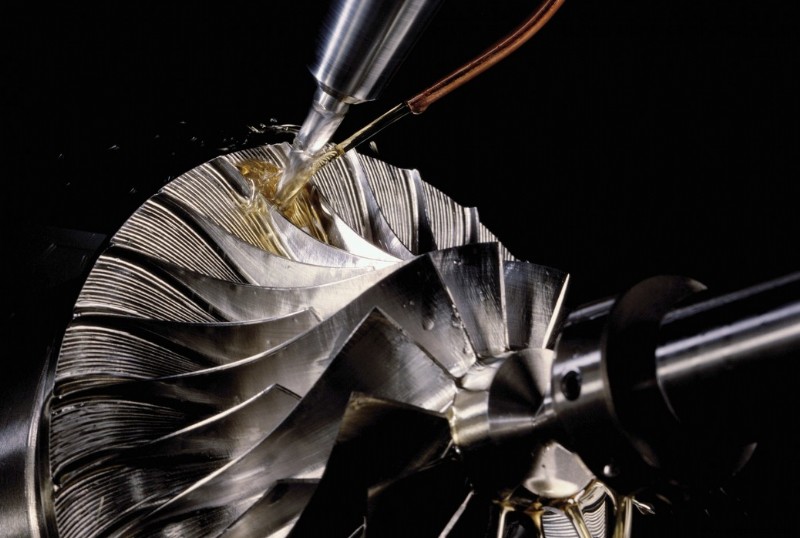
CNC machining is a precise subtractive process that removes material from a solid block to produce high‑accuracy parts. Traditional 3‑axis machines move along X, Y, and Z, but 5‑axis CNC adds two rotational axes—A and B—allowing simultaneous movement in five directions. This capability unlocks design flexibility and production efficiency that three‑axis machines simply cannot match.
The History of 5‑Axis Machining
While 3‑axis machining dominated manufacturing for decades, the concept of five axes first appeared in a 1995 article by Golden E. Herrin, who traced its roots back to 1958 numerical control experiments. The pioneering machine—a Cincinnati Milacron electric‑traced vertical mill—was built for the U.S. Air Force and laid the groundwork for modern multi‑axis technology.
Initially deemed impossible, the vision of 5‑axis machining became reality thanks to advances in computer hardware and design software. Today, CAM tools such as Autodesk Fusion simplify code generation, enabling designers to craft toolpaths that move smoothly along all five axes. The result is faster setup, reduced manual edits, and greater consistency.
All About the Axes
The five axes in CNC machining are the paths that a tool or workpiece can follow simultaneously:
- X, Y, Z: The classic Cartesian coordinates introduced by René Descartes. These axes define the primary linear motion in three‑dimensional space.
- A: Rotates around the X‑axis, changing the tool’s orientation relative to the workpiece’s X‑direction.
- B: Rotates around the Y‑axis, altering orientation along the Y‑direction.
Although a C axis—rotation around the Z‑axis—exists in theory, it is rarely used in standard CNC machining. Machines are configured in different styles depending on which rotational axes are employed. For example, trunnion‑style machines use A and C, while swivel‑rotate machines use B and C, each offering unique advantages for specific part geometries.
Benefits of 5‑Axis Systems
Adding the A and B axes expands manufacturing possibilities dramatically:
- Unrestricted tool approach: Cutting tools can reach complex geometries from any angle, enabling true undercutting without repositioning the workpiece.
- Reduced handling: Fewer material moves cut cycle time, lower labor costs, and diminish human error.
- Improved surface finish: Closer tool alignment reduces vibration, producing smoother surfaces that often require less post‑processing.
- Higher productivity: Even simple 3‑axis jobs run faster on a 5‑axis machine because the tool remains tangent to the cutting surface throughout each pass.
Software like Autodesk Fusion amplifies these benefits by offering extensive toolpath libraries, real‑time optimization, and minimal manual polishing, ensuring that every part is manufactured to the highest standards.
CNC Machine
- Virtual CNC Systems: The Ultimate Guide to Training & Simulation
- How to Draft Accurate CNC Drawings: Essential Tips
- Haas is Hot: New Europe Flyer Unveiled
- Satisfaction Guaranteed: A U.S. Customer Raves About the ELE1325-R CNC Router
- Precision CNC Machining for Aerospace: Unmatched Quality & Reliability
- How to Choose the Ideal Harvey Tool Miniature Drill for Your Project
- Cyprus Client Raves About Blue Elephant 5×10 ATC CNC Router
- Annealing Explained: Enhancing Metal Strength, Durability, and Workability
- Nine Essential CNC Cutting Tools for Precision Fabrication
- Ultimate Guide to CNC Machining Materials: Metals & Plastics