



Early Adopter Reviews: Electric Construction Equipment Insights
As more and more companies consider electric construction equipment to supplement their existing fleet, several contractors have expressed hesitancy — and for good reason. For one thing, emobility is new to the construction industry. Also, while electric makes sense for many now, there are a lot of considerations to think about first before making an investment. Things like an adequate charging infrastructure and how and where electric machines will be used are important to figure out upfront.
That said, some contractors out there have been eager to jump on the electromobility train, working hard to secure machines to try them out and better understand exactly how electric construction equipment will play a role in their evolving businesses.
These three early adopters have found success running electric construction equipment — specifically, the Volvo ECR25 Electric excavator and L25 Electric wheel loader.
Early Adoption Reviews of Electric Construction Equipment
BALTIC SANDS INC. – UNITED STATES
Jacques Marais is the director at Baltic Sands, Inc. out of Yucca Valley, California. His company specializes in environmentally sensitive, luxury off-grid property development and real estate. He’s been working with machines all his life — and electric has always been on his mind.
“I’ve always been curious and quite anxious to see where this is going and how we can apply electromobility to our business,” he says. “I can’t emphasize enough how excited we are to be in this position right now. I just have a sincere belief that this is the future.”
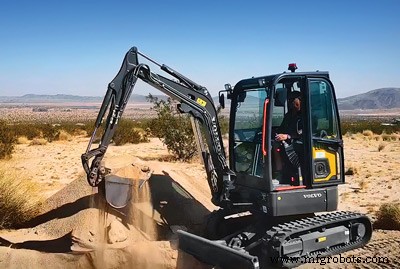 Jacques and his crew have piloted the two Volvo electric machines in Southern California and it’s his hope that this is just the beginning.
“For Baltic Sands, this is where ideology meets reality,” he says. “Right now, we’re seriously pursuing the idea of how we integrate these units into a business that delivers the type of work that we do and has traditionally depended on diesel-powered equipment. Our ambition is to be one of the first to try it out.”
So what advice does Jacques have for contractors out there who may be a little skeptical of electric construction equipment?
“Investigate what your operation is — really scrutinize what your existing units are doing on an average type of job,” he says. “It’s important to examine how many hours ‘x’ unit is being used to know the amount of time it’s under full utility during an eight-hour work cycle. That will determine whether or not electric machines can be well integrated into your fleet, without having a negative effect on your total productivity or total timeframe for your budgets.”
Read more about how Baltic Sands Inc. is using Volvo compact electric equipment for site development in Southern California.
CITY OF ZURICH: EBERHARD AND B. MEIER AG – SWITZERLAND
Emission-free and silent, Volvo electric machines are ideal for cities such as Zurich, where low emissions and low noise levels are becoming a prerequisite for jobsites.
As an example, the Volvo L25 electric compact wheel loader is demonstrating its value at Eberhard, a company that offers civil engineering, deconstruction, recycling and the remediation of contaminated sites. From recycling concrete rubble in the 1980s to building the first soil washing plant for contaminated soil in the 1990s, protecting the environment has always been important to Eberhard.
Today, the company is building a plant for processing mixed demolition material and has developed zirkulit®, the most environmentally friendly concrete in the world.
“We’re investing a lot to make our construction sites as environmentally friendly as possible,” says Silvan Eberhard, head of logistics. “We’re supporters of the circular economy, and sustainability is part of our culture.”
 The L25 electric wheel loader is being used at a landfill site, as well as for road clearing, small-scale material handling and as a forklift. It’s biggest advantage is that it’s low emission, silent and has minimal vibration. In the future, Eberhard plans to use the L25 on construction sites in downtown Zurich, and in other cities where requests for low emissions and silence is high.
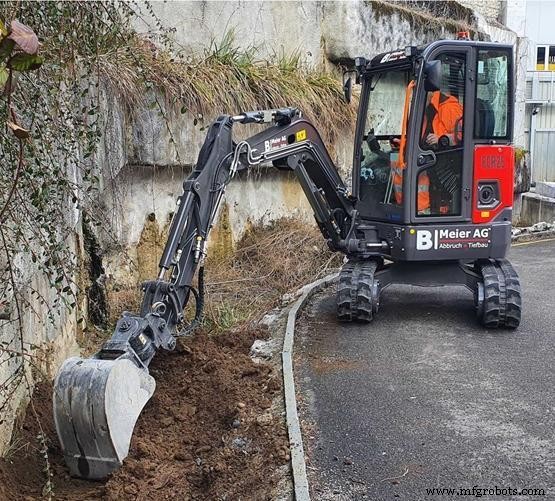
The ECR25 electric excavator is also in action at B. MEIER ABBRUCH + TIEFBAU AG, a demolition and civil engineering firm. The compact excavator is being used to prepare sites for construction.
“The responsibility for looking after our environment falls on everyone,” says Bruno Meier, CEO and owner. “As our organization has grown, we wanted to look at alternative machines that don’t rely on diesel. The ECR25 is our first foray into the world of electric machines.”
The compact electric excavator is being used in built-up areas and complex spaces, such as near hospitals and schools, where its emission-free and silent operation is appreciated.
AWB ABFALLWIRTSCHAFTSBETRIEBE COLOGNE GMBH (AWB) – GERMANY
The responsibility for keeping Cologne, Germany’s fourth-largest city, looking its best falls to AWB Abfallwirtschaftsbetriebe Cologne GmbH. Its vital work in street cleaning and waste disposal ensures that not only is this cathedral city kept clean and safe, but that the surrounding Rhine area and its network of highways are kept open and safe for travelers all over the region.
Around 700 employees are on hand to keep some 1,200 miles of main road, 370 miles of access road and over 300 miles of residential streets free from snow and ice.
For such a substantial task during the most challenging months of the year, AWB needed a partner that could play a vital role in its operations — one that could not only work with power and performance no matter the conditions, but also one that would limit its environmental impact with zero emissions.
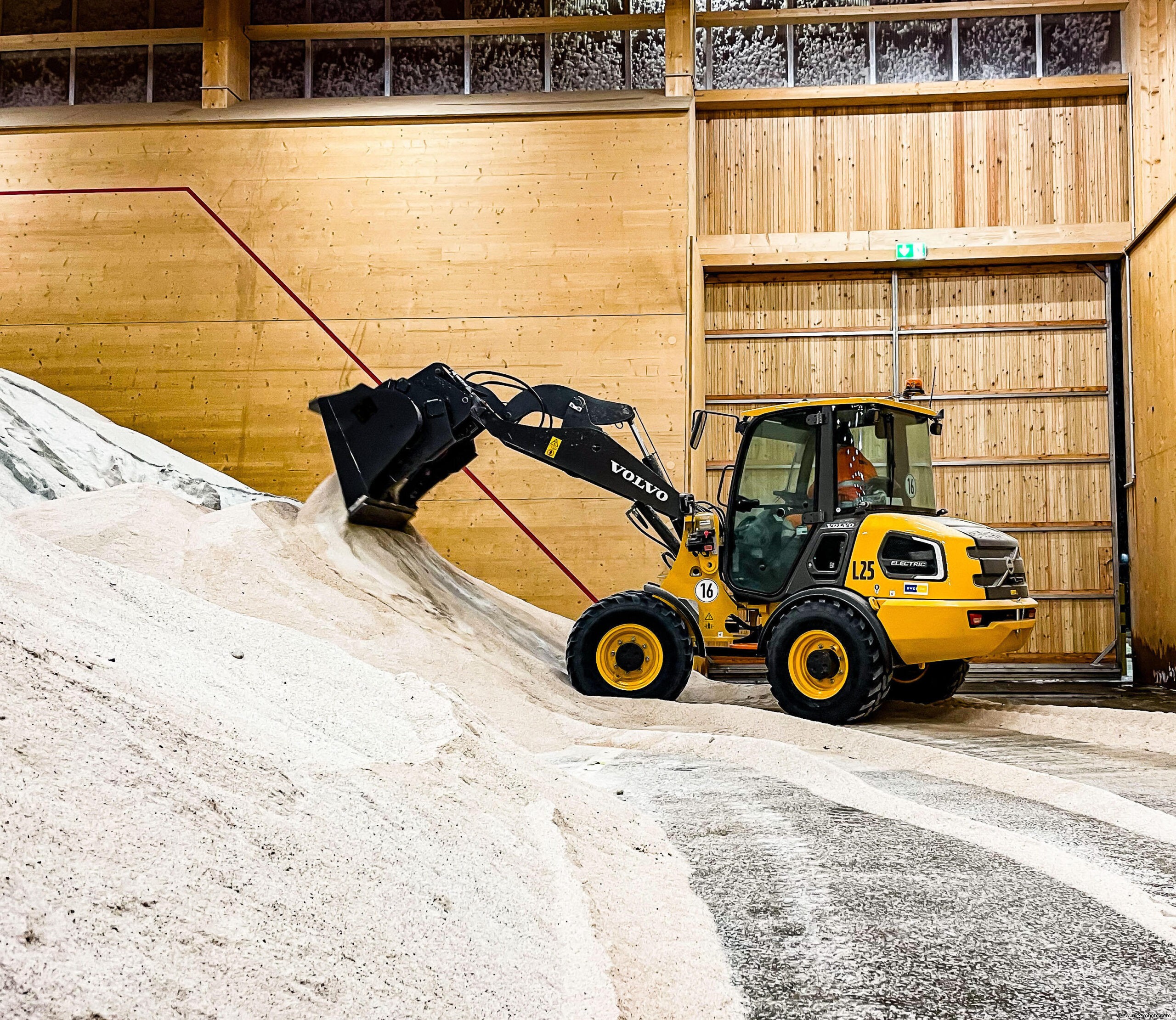 That’s why AWB chose the Volvo L25 electric wheel loader to help keep its winter service provision moving from its new depot in the heart of the city. The electric wheel loader was picked for the task because it produces zero exhaust fumes, low noise and low vibrations, making it an ideal solution for work inside a depot, without the need for a ventilation system.
Sustainability has been a core objective at AWB for some time and the company is recognized as a pioneer of environmentally responsible initiatives within its industry. In addition, the company regards itself as a partner to the city of Cologne and is committed to continuously improving the quality of life for its citizens. As such, care is always taken to only employ vehicles and machines that are low emissions.
“The wheel loader is an important milestone in our journey to introduce more electric mobility at AWB Cologne and is certainly fulfilling our expectations,” says Dr. Bert Schröer, head of mobility and sustainability. “We’re managing well with the electric power, even in the cold. Capacity, handling and shovel size — everything fits. So far, there have been no aspects that would make us question our decision. It was definitely the right choice.”

Volvo Electric Equipment: New Opportunities for Heavy Equipment Jobs
One of the things I find myself saying quite often about our new Volvo electric excavator and wheel loader and ...Read More

Electric Construction Equipment vs. Diesel Performance Comparisons
As the product manager for electromobility here in North America, I’ve spent a lot of time helping with the design ...Read More
Industrial equipment
- Rent vs. Buy Construction Equipment: A Practical Decision Guide
- Electric Construction Equipment Glossary: Essential Terms & Definitions
- Volvo ECR25 Electric Excavator & L25 Loader Tested by Industry Experts at Utility Expo 2021
- Electric vs. Diesel Construction Equipment: Power & Performance Showdown
- Revolutionizing Construction & Mining: Electric & Autonomous Heavy Equipment
- The Future of Construction: Embracing Electric & Hybrid Equipment
- 3 Proven Tips for Securing Quality Construction Equipment at Auction
- Why Regular Maintenance Is Critical for Construction Equipment Reliability
- 5 Clear Indicators Your Construction Equipment Requires Immediate Repair
- Expert Construction Equipment Maintenance: Prevent Costs & Boost Longevity